Get Full Government Meeting Transcripts, Videos, & Alerts Forever!
Get email alerts on the Hiv Sti topic
No spam. Unsubscribe anytime.
Annual HIV/STI report: testing fell during COVID; syphilis among women and congenital cases prompt concern
Summary
DPH epidemiologists reported large declines in HIV and STI testing in 2020 tied to the pandemic, a 22% drop in HIV diagnoses, and a troubling rise in female syphilis and five congenital syphilis cases in 2020; the department outlined outreach, home testing and harm‑reduction measures to address disparities.
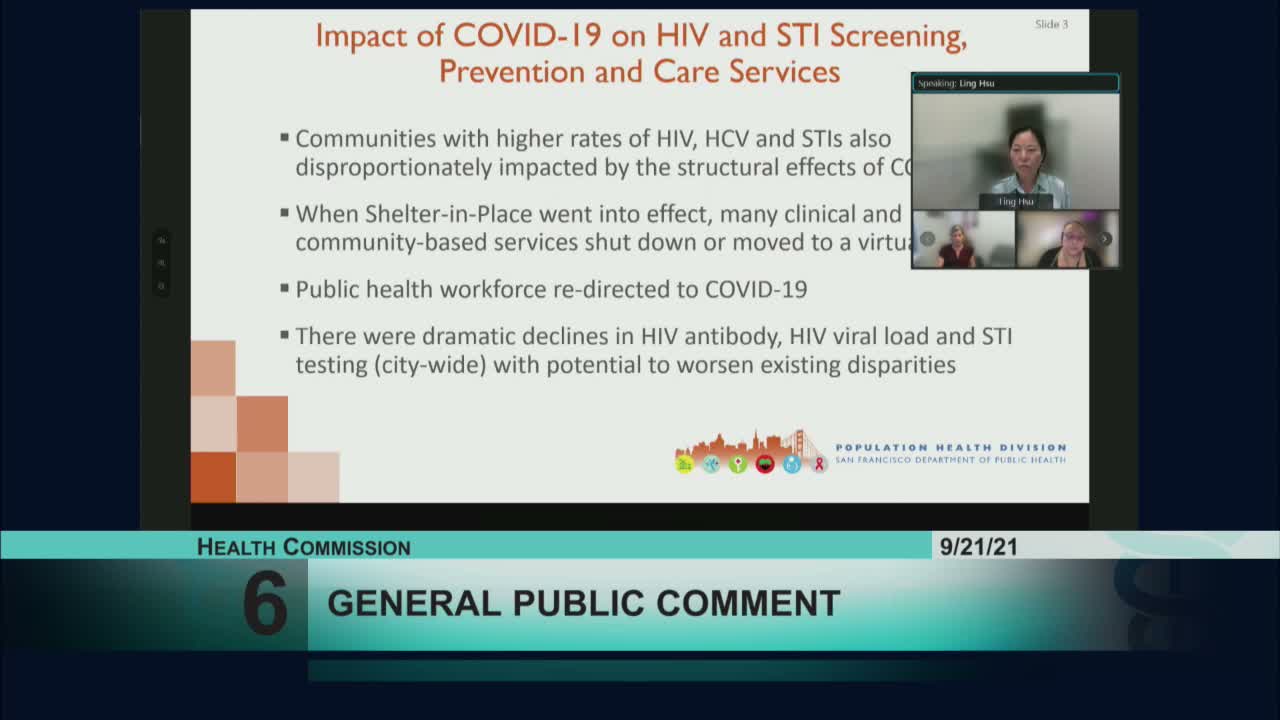
San Francisco Department of Public Health epidemiologists told the Health Commission that COVID-19 disrupted testing, care and surveillance for HIV and sexually transmitted infections, producing a complex set of trends and persistent disparities.
Ling Hsu, Director of HIV Surveillance and Epidemiology, said medical HIV testing fell by about 18% in 2020 compared with 2019 and community testing fell by about 44% in 2020 before rebounding toward 2019 levels by mid‑2021. Hsu said new HIV diagnoses declined 22% (from 168 in 2019 to 131 in 2020) but cautioned some infections were likely missed because of reduced testing.
Dr. Stefan Cohen summarized STI trends: between 2016 and 2019 gonorrhea, chlamydia and early syphilis rose, but all three declined sharply from 2019 to 2020 — a pattern the presenters attributed largely to fewer tests. Despite the overall drop, Cohen highlighted a persistent and concerning increase in syphilis among cisgender women and said San Francisco recorded five congenital syphilis cases in 2020 — the highest total in 26 years, including one infant death.
Presenters underscored disproportionate impacts: Latinx residents had the highest number of new HIV diagnoses in 2020; people experiencing homelessness accounted for about 18% of new HIV diagnoses and showed larger declines in care engagement and viral suppression. Hsu reported that viral suppression among people living with HIV fell from 75% in 2019 to 70% in 2020, with people experiencing homelessness particularly affected (viral suppression among that subgroup dropped to about 20% in 2020).
The commission heard program responses: the Getting to 0 consortium described a multi‑pillar approach (reach, rapid response, render services) with pop‑up clinics and street outreach; Eileen Loughran outlined Ending the Epidemics (ETE) investments to expand status‑neutral services, hire navigators, extend street medicine and fund community engagement; and Nicole Treanor presented 'Take Me Home' home‑testing (launched Feb. 2021) offering lab‑based panels and reporting initial uptake (approximately 144 kits ordered with six STI positives and zero new HIV diagnoses as of August 2021).
Speakers urged continued focus on congenital syphilis prevention through expanded screening (including in ER and jail settings), point‑of‑care options and cross‑system referrals, and described pilot programs to build capacity for testing, harm reduction and outreach to youth and people experiencing homelessness.