Get Full Government Meeting Transcripts, Videos, & Alerts Forever!
Get email alerts on the Public Safety Health topic
No spam. Unsubscribe anytime.
DPH outlines security staffing changes and BERT expansion after declines in law-enforcement force incidents
Summary
DPH reported changes to hospital security staffing: expansion of the Behavioral Emergency Response Team (BERT), substitution of private security/community-based health workers for some deputy roles, training standards, and early indicators of decreased law-enforcement use of force.
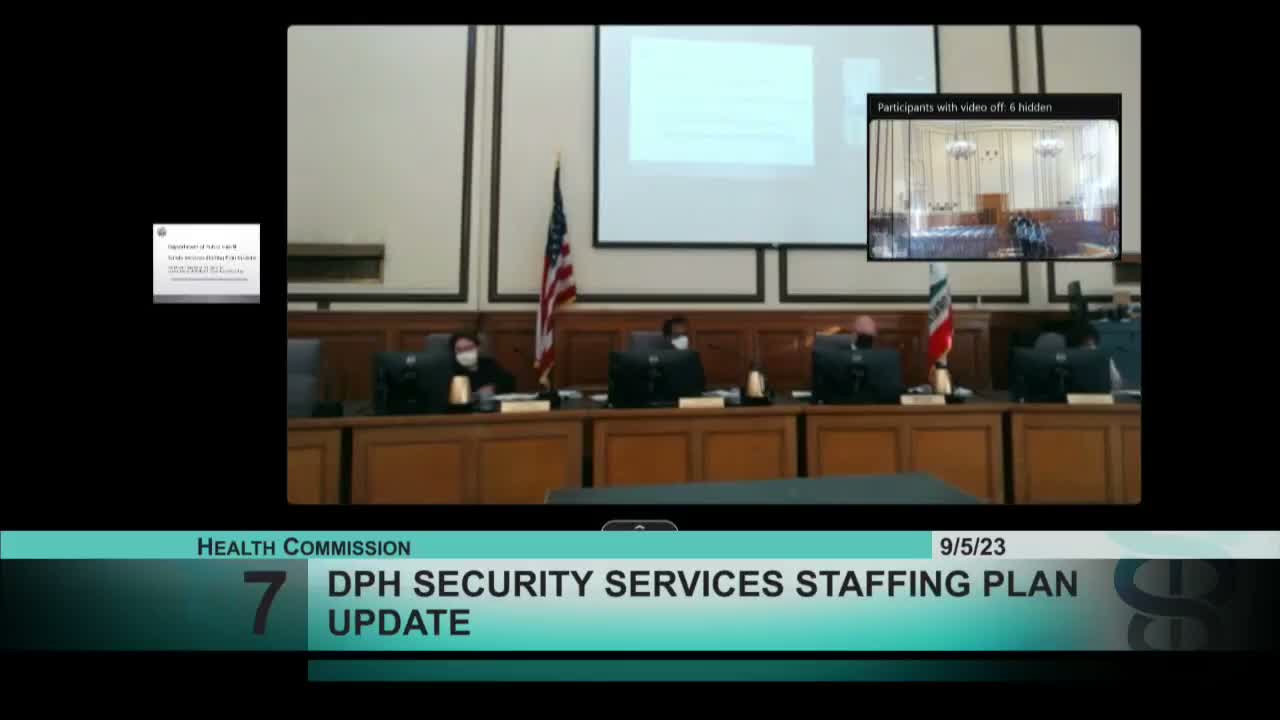
Basil Price, DPH director of security, presented the department’s security staffing plan Sept. 5, outlining a multi-year shift toward health-led responses to behavioral emergencies.
Price said the plan initially proposed reducing sheriff’s deputies and adding psychiatric nurses and technicians to form a 24/7 Behavioral Emergency Response Team (BERT) focused on de-escalation and clinical care. Staffing shortages at the Sheriff’s Office, psych-tech training gaps in the Bay Area and onboarding delays led DPH to revise the implementation approach: the department contracted with private security through the Office of Contract Administration (OCA), added health workers to greeter and client-safety roles, and intends to recruit licensed vocational nurses to augment BERT coverage.
Price said the BERT model has produced measurable shifts in practice: a four-year trend shows a 10% decrease in law-enforcement use of force and a 25% decrease from the prior year; since BERT staffing began in February 2023, the team logged thousands of proactive activations—most without law enforcement involvement. Price also noted racial disparities in use-of-force incidents and described training efforts (implicit-bias training, crisis intervention, conflict management) to address equity.
Commissioners asked how and when ratios of deputies to BERT staff might shift and whether funding allocations could follow once data supports the model. Price said deputies will remain for incidents that escalate to crimes in progress, but the department aims to reduce law enforcement involvement where a clinical response suffices and will continue recruitment and training efforts.
Public commenters questioned contracting costs and the number of proposed FTEs for behavioral emergency coverage; Price acknowledged cost concerns and said the department is refining job classifications and contract scopes.