Get Full Government Meeting Transcripts, Videos, & Alerts Forever!
Get email alerts on the Covid Policy topic
No spam. Unsubscribe anytime.
San Francisco health officials stop short of reinstating mask mandate as cases rise; public urges transit and school mandates
Summary
The Health Commission heard a detailed COVID update on July 19 and faced sustained public pressure to reinstate indoor mask mandates—especially on public transit and in schools—while health officials emphasized distribution of high‑quality masks and targeted guidance rather than issuing a citywide health‑officer mandate.
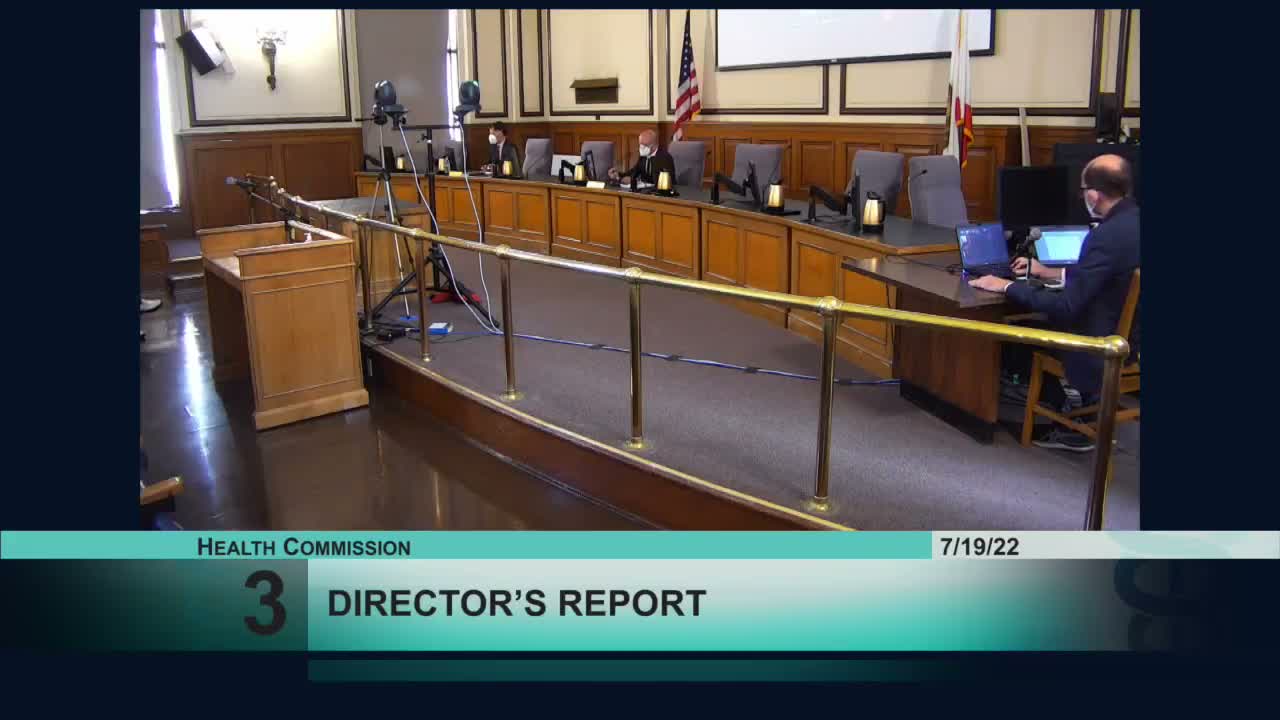
Health officials told the San Francisco Health Commission on July 19 that COVID case rates and hospitalizations are rising locally and across the country, but stopped short of recommending a new citywide mask mandate.
Director of Health Grant Colfax briefed commissioners on case metrics, hospital capacity and vaccination coverage, saying San Francisco’s case rate was running around 50.4 per 100,000 residents and noting that reported case counts are an undercount because of home testing. The department reported ICU capacity at roughly 36 percent and medical‑surgical bed occupancy around 17.7 percent.
Dr. Susan Philip, director of population health and San Francisco’s health officer for the presentation, said the department is prioritizing outreach and widening access to high‑quality respirator masks rather than issuing a health‑officer mandate immediately. “We have really continued to focus on making sure people understand the information about the current subvariants, the importance of high quality masks rather than moving to a health officer mandate,” she said.
Commissioners pressed for firmer action. Commissioner Dorado and Vice President Green asked whether the city should align its policy with neighboring jurisdictions reintroducing mandates and whether transit agencies can be required or assisted to distribute masks. Dr. Philip responded that agencies such as BART and Muni can set requirements for their own passengers and staff; the department is coordinating with community partners to increase mask access and encouraging providers to give masks to high‑risk patients.
Public commenters – many representing Senior and Disability Action and other advocacy groups – urged an immediate indoor mask requirement, especially on public transit and in schools, arguing that high community transmission and risks from reinfection require stronger measures. “Please reinstate an indoor mask mandate,” said Alice, who identified herself as an active member of Senior Disability Options. Callers also pressed for clearer “on‑ramps” and “off‑ramps” (metrics) that would trigger reinstatement.
Health officials emphasized harm‑reduction steps: encouraging N95/KN95/KF94 use when available, suggesting double‑masking as an alternative where respirators are inaccessible, and distributing masks through community partners and providers. No change to the city’s formal mask policy was adopted during the meeting.
The commission did not vote on any mask order; it moved on to other agenda items after public comment and discussion. The department said it will continue to monitor hospital capacity and case trends and to coordinate with transit and community partners on mask distribution and communication.