Get Full Government Meeting Transcripts, Videos, & Alerts Forever!
Get email alerts on the Charity Care topic
No spam. Unsubscribe anytime.
Charity care report: San Francisco charity-care patients decline but traditional charity care remains essential
Summary
DPH presented the FY2016 Charity Care Report showing citywide unduplicated charity-care patients fell from about 60,671 in FY2015 to 51,569 in FY2016 (15% decline); expenditures stabilized around $85 million while uncompensated care including medical shortfall totaled roughly $661 million.
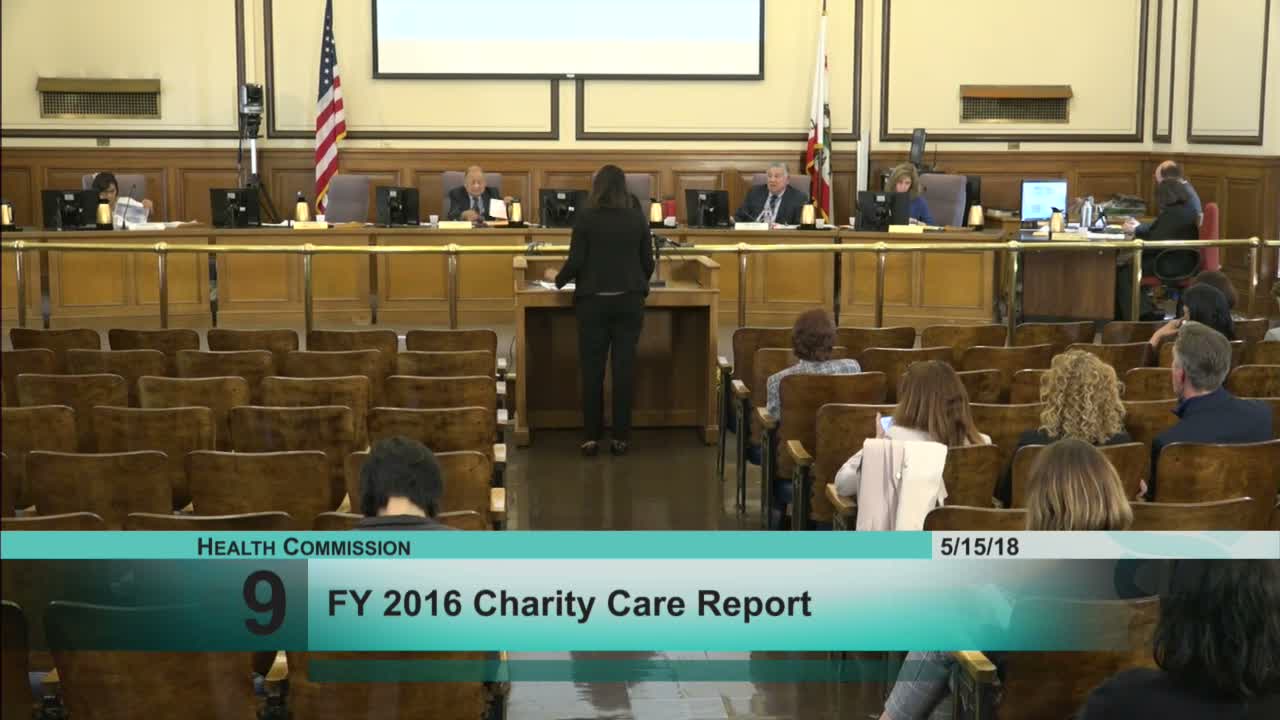
The Department of Public Health presented the FY2016 Charity Care Report to the Health Commission, summarizing citywide trends across eight reporting hospitals.
Krishna Patel (Office of Policy and Planning) said unduplicated charity-care patients declined from about 60,671 in fiscal year 2015 to 51,569 in fiscal year 2016, a roughly 15 percent reduction. She described charity-care expenditures as stabilized near $85 million for FY2016, and said that when combined with Medi-Cal shortfall the total uncompensated care in the city was about $661 million.
Patel said declines were concentrated among participants in Healthy San Francisco — the city’s locally created health-access program — and that traditional charity-care populations remained steady and more likely to rely on emergency services. “In fiscal year 2016, one in three services provided to traditional charity-care patients was emergency care,” she said, noting outreach and access barriers for homeless and hard-to-reach populations.
David Serrano Sewell, regional vice president for the Hospital Council, praised the report’s refinement and the hospitals’ efforts to provide the data. Commissioners asked about policy implications, data on affiliated outpatient units, and whether the ordinance’s reporting could be expanded; staff said the charity care ordinance requires hospital reporting and that changes to reporting would require formal adjustment.
Patel noted zip-code and supervisorial-district breakdowns in the appendix and said staff would continue tracking trends, including the potential impacts of federal changes to the ACA.