Get Full Government Meeting Transcripts, Videos, & Alerts Forever!
Get email alerts on the Soma Rise Contract topic
No spam. Unsubscribe anytime.
Health Commission approves 18-month contract to pilot SoMa RISE sobering center; lease still requires Board sign-off
Summary
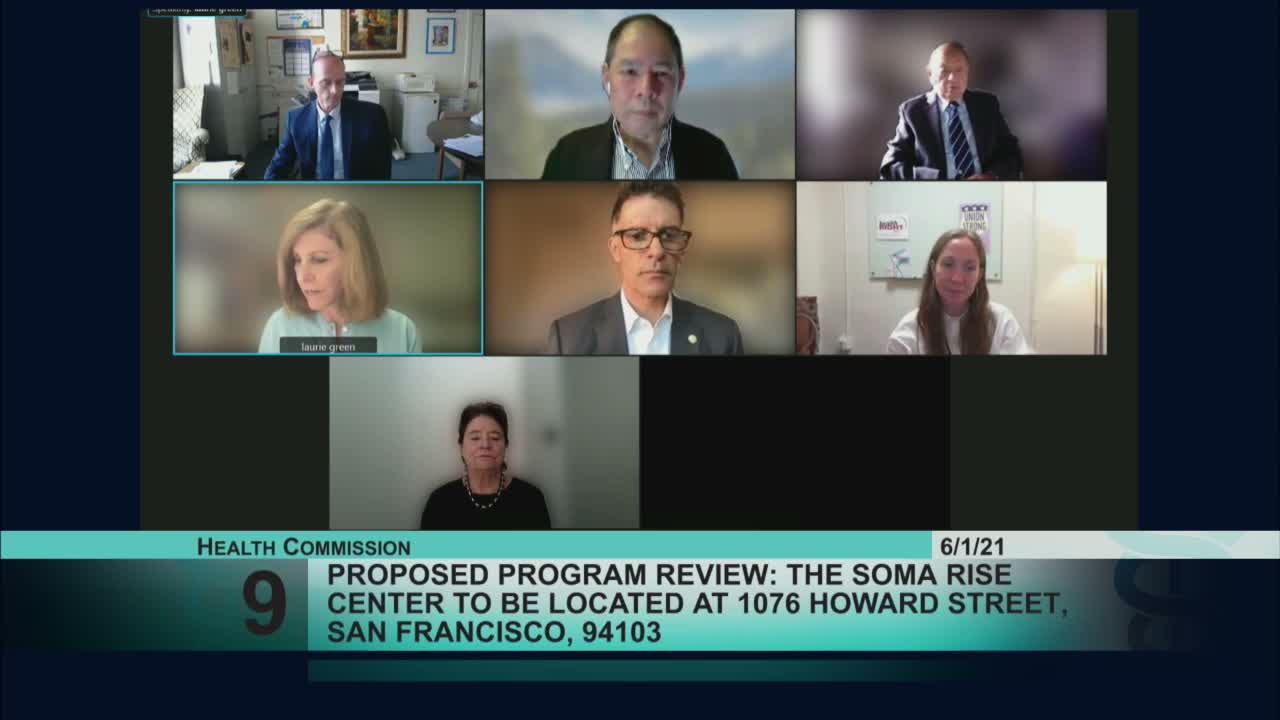
The San Francisco Health Commission voted June 1 to approve an 18-month, not-to-exceed $5,925,437 sole-source contract with HealthRight 360 to operate the SoMa RISE drug sobering pilot at 1076 Howard Street; final certification hinges on a Board of Supervisors lease vote scheduled June 8.
The San Francisco Health Commission on June 1 approved a sole-source contract with HealthRight 360 to run a pilot drug sobering center in South of Market, voting to authorize up to $5,925,437 for an 18-month term beginning July 1, 2021 and ending Dec. 31, 2022. The contract is intended to fund a low-barrier, 24/7 “sobering” program aimed at people experiencing intoxication and homelessness.
The pilot, called the SoMa RISE Center, is proposed to operate at 1076 Howard Street. Dr. David Pating, the DPH addiction psychiatrist who is project lead, said the program is a neighborhood-focused walk-in and referral model designed to bring people indoors for care, immediate supports and safe monitoring. "One of my mottos for this program is there can be no deaths," he said, describing safety and monitoring as top priorities.
HealthRight 360 will staff the site with EMTs, health workers and safety monitors, provide showers, a sleeping area and on-site medical triage, and coordinate transportation and referrals to shelters, clinics and treatment programs. Kathleen Silk, managing director of behavioral health services for HealthRight 360, said the agency will hire a mix of experienced staff and people with lived experience and provide extensive onboarding and training.
The contract approval followed a multi-hour public hearing in which dozens of callers offered two-minute statements. Proponents, including community clinics, harm-reduction providers and advocacy groups, urged the commission to move quickly to address rising overdose deaths and racial disparities in overdose mortality. Opponents—business owners and neighborhood residents—strongly objected to the Howard Street location, repeatedly noting that the site sits within blocks of several child-serving facilities and youth programs and urging the city to place services closer to Tenderloin hotspots.
DPH and HealthRight 360 offered multiple mitigation commitments: a local outreach ambassador program to discourage loitering, on-site janitorial services and supervised designated smoking areas, a transportation plan with a list of 20'30 destinations for people leaving the site, partnership with needle and medical-waste pickup services, and near-real-time tracking of 311 and 911 calls in adjacent census tracts to identify and respond to neighborhood impacts.
Commissioners asked for and were given commitments to post-opening community engagement: DPH agreed to convene an initial community forum in the first quarter after opening and quarterly check-ins during the pilot, and to return to the commission with evaluation metrics and early findings. DPH staff also told commissioners that the contract and its certification are contingent on the Board of Supervisors approving the lease for 1076 Howard Street at an oversight committee hearing scheduled for June 8.
The motion to approve the contract was moved and seconded on the record and carried on a roll-call vote with all present commissioners recorded in favor. The commission noted that final contract certification will not occur unless the Board of Supervisors approves the lease for the site.
Next steps: the Board of Supervisors will consider the lease and, if approved, DPH and HealthRight 360 will proceed to operationalize staffing, transportation and neighborhood-monitoring plans and begin the 18-month pilot.