Get Full Government Meeting Transcripts, Videos, & Alerts Forever!
Get email alerts on the Prop Q Clinic Transfer topic
No spam. Unsubscribe anytime.
Sutter to transfer Mission Bernal clinics to Mission Neighborhood Health Center; commission to vote in two weeks
Summary
At a Prop Q hearing Sutter Bay Hospitals announced it will close Mission Bernal adult and pediatric clinics April 1 and transfer assets plus a five‑year operating grant to Mission Neighborhood Health Center, which plans to reopen services April 5; commissioners requested more detail on payer mix and post‑five‑year sustainability.
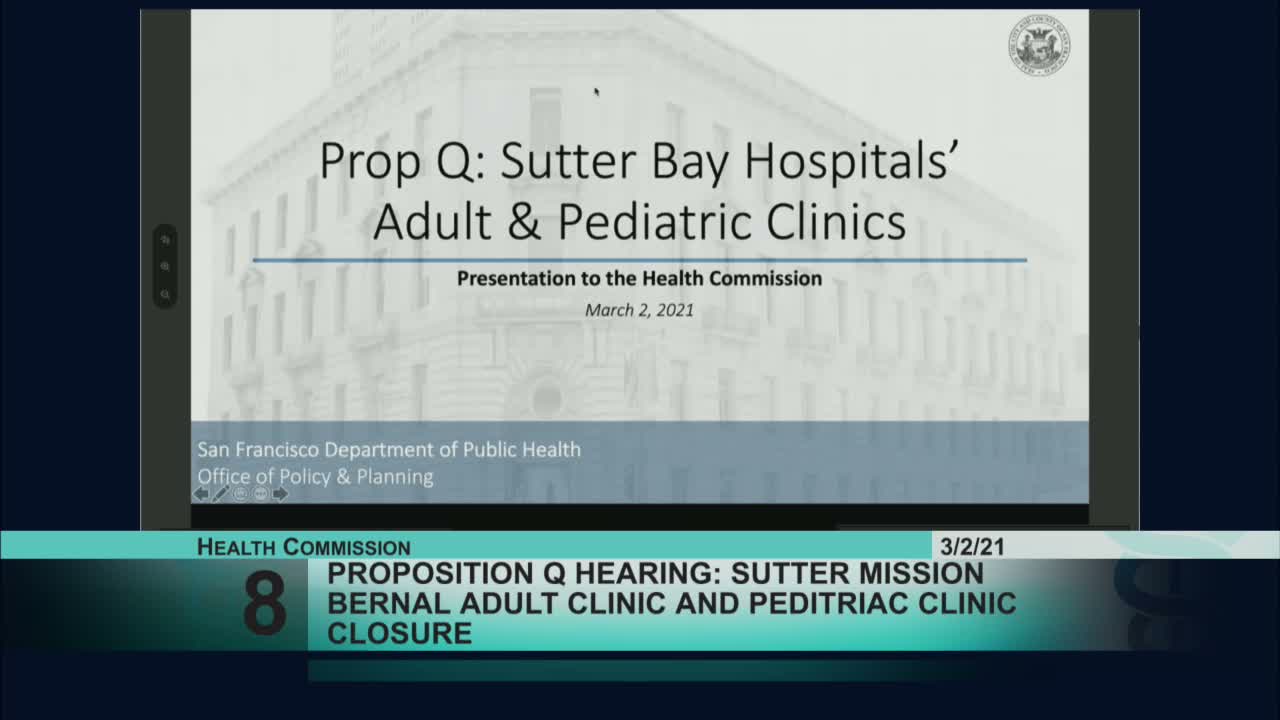
Sutter Bay Hospitals notified the Health Commission of plans to transfer both the adult and pediatric Mission Bernal clinics to Mission Neighborhood Health Center under Proposition Q notice procedures. DPH staff said the transfer is scheduled for April 1 with Mission Neighborhood reopening the clinics on April 5; Sutter will continue after‑hours pediatric coverage during the five‑day transition.
Claire Lindsey (DPH Office of Policy and Planning) summarized the Prop Q notice: Sutter intends to donate clinic assets and provide an operating grant of support for five years to Mission Neighborhood Health Center to cover potential ramp‑up losses. The adult primary‑care clinic (formerly St. Luke’s Health Center adult clinic) and the pediatric clinic (including appointment‑only after‑hours pediatric care) are located on the CPMC Mission Bernal campus. Sutter’s presenter said many of the clinics’ providers have agreed to join Mission Neighborhood and that Mission Neighborhood expects to add some 2,600 Medi‑Cal managed‑care patients to its panel.
Tammy Chin (CPMC site administrator) described the change as a transition rather than a closure: she said the clinics will remain in the same physical location, current clinic supervisors will transfer, and the parties are coordinating electronic health record data conversions and payer contracting. Brenda Story, CEO of Mission Neighborhood Health Center, said the community health center planned to maintain services and to integrate the clinics into its medical‑home model.
Public commenters and several commissioners raised questions about the five‑year operating grant: whether Mission Neighborhood will be sustainable after five years, how private insurance contracts will be handled, and the high share of patients shown as "private" in the payer mix. Emily Webb, Sutter’s vice president for external affairs, said Sutter and Mission Neighborhood modeled the subsidy and intended the five‑year period to be sufficient for Mission Neighborhood to reach sustainability as an FQHC (federally qualified health center).
DPH added that around 40% of patients’ race/ethnicity data pulled from state systems were missing; commissioners requested more complete demographic data, contract negotiations status with commercial payers, and comparative models for successful transitions. The hearing was informational; the commission will hold a second Prop Q hearing and a vote at the March 16 meeting.