Get Full Government Meeting Transcripts, Videos, & Alerts Forever!
Get email alerts on the Food Security topic
No spam. Unsubscribe anytime.
Health Commission hears expansion of 'food as medicine' programs as pandemic deepens food insecurity
Summary
San Francisco Department of Public Health briefed the Health Commission on a network of emergency and clinic-based food programs that have supplied thousands of households during COVID‑19 and advanced the 'Food as Medicine' model for medically supported food services now eligible for Medi‑Cal funding.
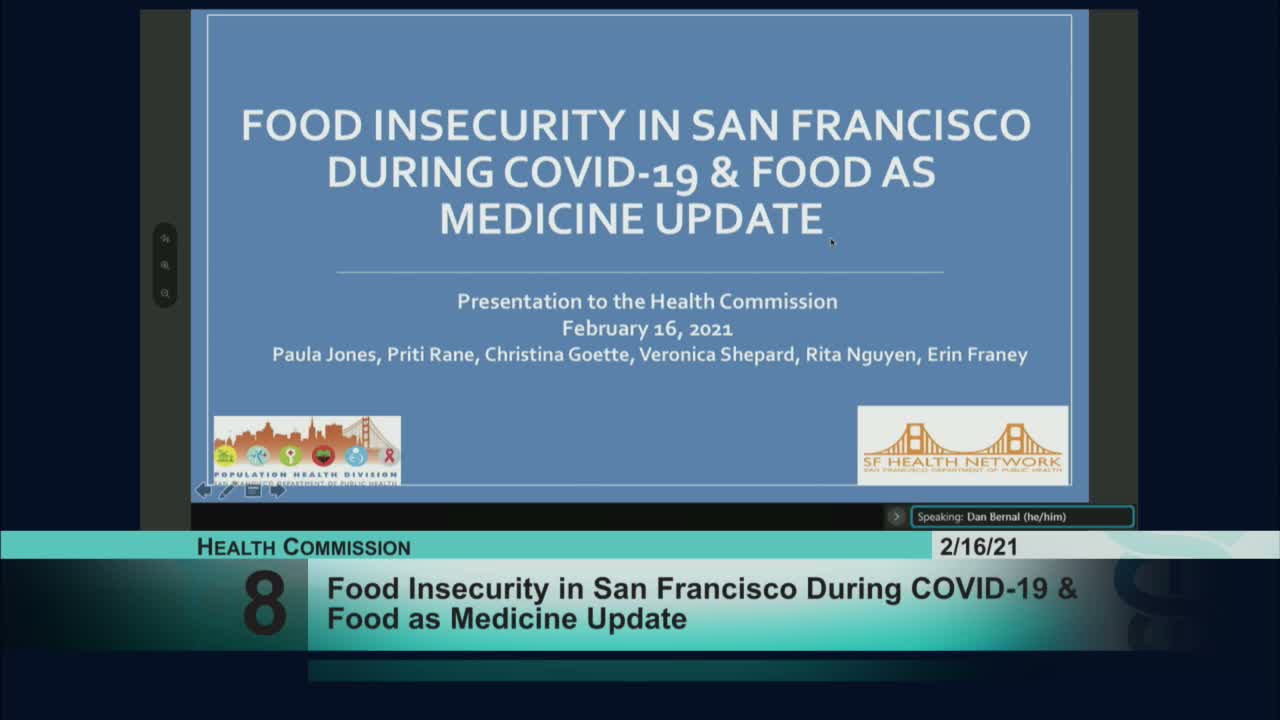
The San Francisco Department of Public Health on Feb. 16 told the Health Commission that pandemic-driven job loss and program closures have sharply increased food insecurity and that DPH and community partners scaled household delivery, vouchers and clinic-based food pharmacies to reach residents.
DPH Director of Food Security Paula Jones told commissioners that local need spiked during the pandemic and that coordinated city efforts have delivered immediate help: a quarantine/isolation meal program referred by medical providers and contact tracers has served more than 4,700 households (about 16,500 people) to date, and a voucher program distributed roughly 100,000 grocery and produce vouchers to about 3,400 families targeted to high-need communities. "Food insecurity means that you do not have adequate food because of lack of money and other resources," Jones said, framing food access as a health issue.
Nut graf: Presenters argued that food programs must be integrated with clinical care to improve chronic‑disease outcomes and address health inequities. Rita Nguyen, assistant health officer and co‑lead of the Food as Medicine Collaborative, described clinic-based "food pharmacies"—sites where clinicians can link patients to on-site food, nutrition education and community resources—and said the county has scaled the model across health systems and clinics.
DPH reported that the Food as Medicine network now operates in 16 clinics across five systems and serves about 700 patients per week. Nguyen and program staff cited measurable clinical effects in pilot sites, including improved dietary behaviors and a small but statistically significant decline in systolic blood pressure among participating patients. The presenters also said policy progress had followed program work: medically tailored meals and other nutrition services were added to a Medi‑Cal waiver as of Jan. 8, which could allow health plans to reimburse food-based interventions if federal approval holds.
Community partners and program managers described rapid scaling during the emergency and urged sustained funding. Veronica Shepherd, director of the Office of Anti‑racism and Equity, emphasized household-level responses and culturally appropriate food: partnerships with faith‑based groups and the SF Produce Market delivered millions of pounds of produce and thousands of culturally tailored grocery boxes, often targeted to the Tenderloin, Bayview and Mission neighborhoods.
Commissioners and community callers pressed DPH on sustainability and reach: speakers urged continuing coordination among clinics, community hubs and city benefits to close remaining gaps for children, seniors and linguistically diverse residents. Presenters said many federal nutrition flexibilities and local innovations increased access (for example, remote WIC enrollment and pandemic EBT for schoolchildren) but that private and philanthropic funds had been critical to rapid responses and will not replace ongoing public investment.
Ending: DPH asked the commission for continued support to sustain coordination and to secure funding as the emergency's long-term effects on food security continue. Commissioners said they would support efforts to anchor successful pilots in predictable city and Medi‑Cal funding streams.