Get Full Government Meeting Transcripts, Videos, & Alerts Forever!
Get email alerts on the Covid Transition topic
No spam. Unsubscribe anytime.
San Francisco health officials report steady COVID-19 metrics and lay out phased plan to transition pandemic response back into city departments
Summary
DPH told the Health Commission that cases have plateaued, vaccination coverage is rising but supply is constrained, and staff outlined a phased, milestone-driven plan to move COVID response functions from an incident-command structure back into departmental operations.
Director Brent Colfax and DPH transition staff briefed the San Francisco Health Commission on April 20, saying the city—s COVID-19 case curve has stabilized and that the department is preparing a phased transition of pandemic response work back to regular city departments.
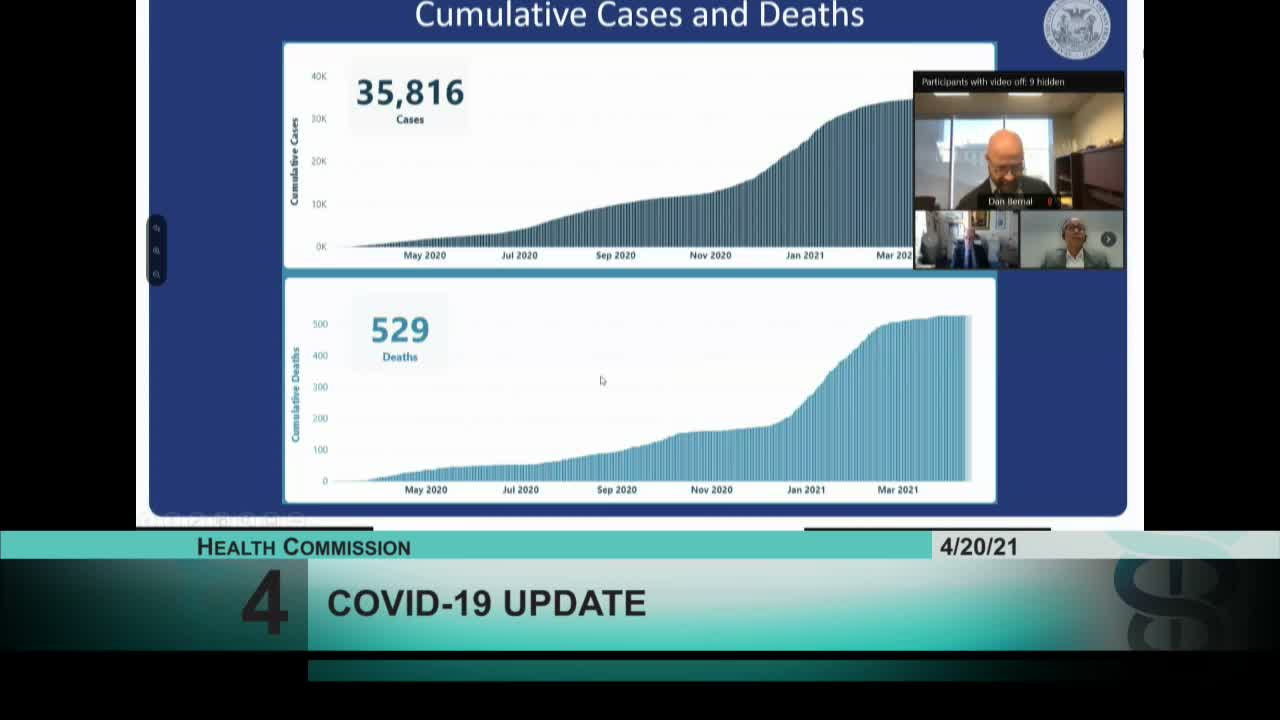
Colfax said San Francisco has recorded 35,816 diagnosed COVID-19 cases to date and described a long, steady decline in hospitalizations; he said that, as of the briefing, there were three COVID-positive inpatients at Zuckerberg San Francisco General Hospital. He reported that 64% of eligible residents had received at least one vaccine dose and that 42% were fully vaccinated, while local daily administration averaged about 10,400 doses. "We now have the capacity to do over 20,000 vaccines a day in our city," Colfax said, while noting state supply reductions had lowered local allocations.
The director also addressed the Johnson & Johnson pause announced April 13, saying DPH followed FDA and CDC guidance to temporarily halt J&J distribution. Colfax said San Francisco had administered roughly 33,000 J&J doses locally and had not identified any related adverse events; he called the reported clotting cases an "extremely rare event." He added that DPH issued provider alerts and placed local J&J doses on hold, and that the pause produced minimal disruption because of continuing Moderna and Pfizer supply.
DPH transition manager Dr. Yoo presented a multi-month, milestone-driven plan to shift the unified incident-command structure back to department-led operations. Yoo described four resourcing options being modeled for fiscal planning: continued partial activation of deployed staff, use of contractors, hiring temporary exempt positions, and creating budgeted positions in fiscal year 2022. The plan is phased rather than a single cutover date and links transition triggers to hiring, funding, and service-level assumptions. Yoo said the planning assumes no major surge, no immediate booster campaign and at least 80% adult vaccine saturation but includes contingency planning if those assumptions change.
Commissioners pressed staff for follow-up reporting: DPH said it will continue regular COVID updates and can provide deeper transition briefings on request, including more detail on testing, contact tracing and how specific functions (for example, housing and reopening) will transfer to other departments such as HSA, HSH and DEM. Yoo emphasized that reimbursement priorities (FEMA) and staffing availability are key constraints on the timeline.
The commission heard that some operational pieces—vaccine operations, data and virus tracking, housing and joint information functions—will be sequenced back into DPH or other city departments as milestones are met. Colfax closed by urging commissioners and staff to reach out to colleagues and community members who may be affected by the stress of the moment.
The commission did not take a formal vote on the transition plan; staff committed to ongoing reporting as the planning work continues.