Get Full Government Meeting Transcripts, Videos, & Alerts Forever!
Get email alerts on the Covid Vaccination topic
No spam. Unsubscribe anytime.
DPH update: San Francisco moves into red tier, cases fall and vaccinations accelerate amid supply limits
Summary
At the March 2 health commission meeting DPH said San Francisco is moving into the state's red tier, case rates and hospitalizations have dropped from winter peaks, and roughly 166,000 residents have received at least one vaccine dose. Officials emphasized supply constraints and targeted outreach to high‑burden neighborhoods.
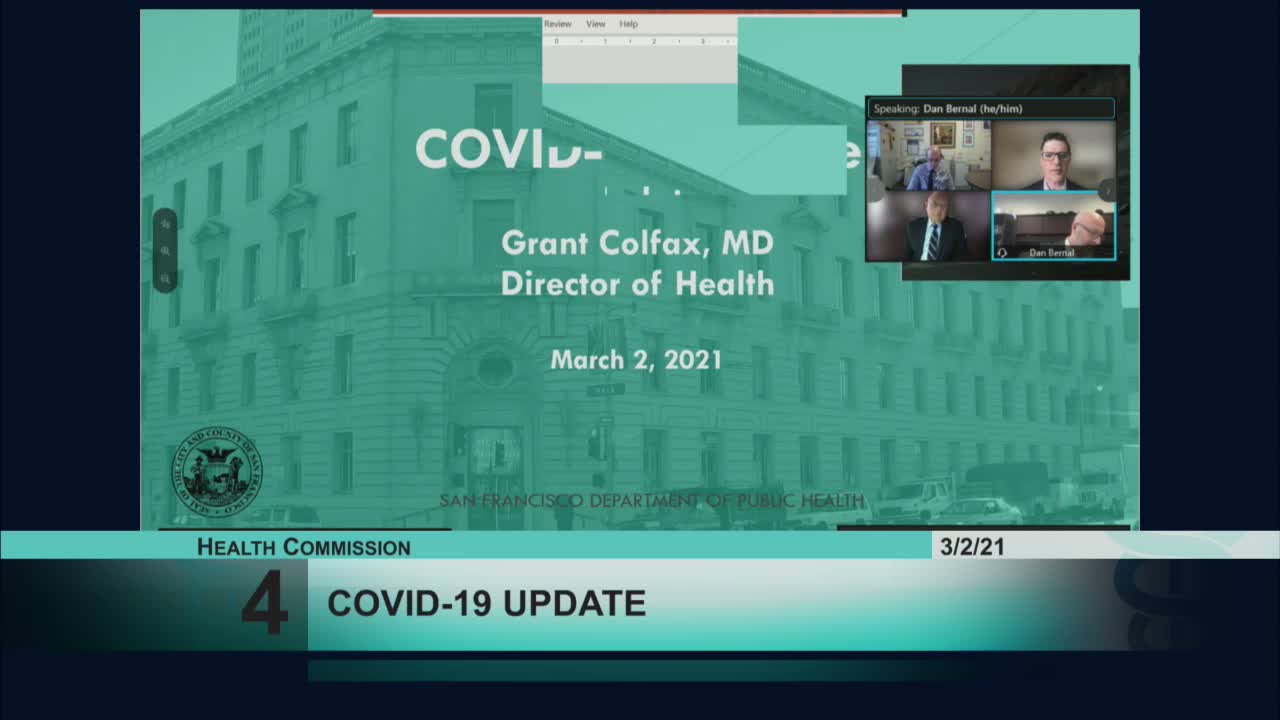
Director Colfax provided the commission with the city’s latest COVID‑19 figures and vaccine rollout status, saying San Francisco will enter the state’s red tier as of the next day and that the move will allow limited indoor dining and other cautiously expanded activity.
“Starting tomorrow, we will be in the red tier,” Director Colfax said, summarizing the mayor’s announcement and state guidance on indoor dining, gyms and museums. The presentation showed the city’s case rate down to about 7–8 per 100,000 and a reproduction number under 1 at roughly 0.75.
Colfax told commissioners that San Francisco has recorded more than 34,000 confirmed COVID‑19 cases and 422 deaths, and that hospitalizations had declined sharply from a winter peak of 256 patients to about 74 currently. “So positive news there,” the director said, while urging continued masking and distancing.
On vaccines, Colfax said the city has administered more than a quarter‑million doses and that roughly 166,000 San Franciscans — about 22% of the city’s population — had received at least one dose. DPH is administering about 4,300 doses a day overall and roughly 1,700 second doses; the department noted a prior daily peak above 7,000 but stressed that supply — not capacity — remains the limiting factor.
Colfax also described vaccine distribution and equity work: DPH directly administers about a quarter of doses arriving in the city and is prioritizing neighborhoods and populations with high disease burden, including seniors and people with comorbidities. The presentation included charts on racial and neighborhood breakdowns of doses administered by DPH and emphasized ongoing efforts to direct mobile vaccination teams to hard‑to‑reach populations.
Commissioners asked whether Johnson & Johnson vaccine shipments would be used to expand mobile teams and how DPH will coordinate with the state’s third‑party administrator. Colfax said DPH has mobile teams ready to vaccinate as many as 1,000 people a day and is in early conversations with state partners about distribution of new vaccine shipments.
The commission did not take action on the report; the director said staff will return with updates and that the city’s data tracker and DPH website remain the primary public resources for scheduling and eligibility information.