Get Full Government Meeting Transcripts, Videos, & Alerts Forever!
Get email alerts on the Public Health Covid Response topic
No spam. Unsubscribe anytime.
SFDPH outlines surge response, CCC structure and Mental Health SF rollout; commission approves minutes and consent calendar
Summary
San Francisco Department of Public Health leaders updated the Health Commission on the COVID Command Center’s structure, surge data, testing and vaccine planning, staffing and budget implications and the early launch of a street crisis response team under Mental Health SF. Commissioners pressed on staffing, billing and equity.
San Francisco Department of Public Health Director Colfax told the Health Commission that the city is in a third COVID-19 surge and the department is preparing for increased hospital demand while weighing additional limits on indoor activities and a travel quarantine advisory similar to Santa Clara County’s. Colfax said the city currently has 87 San Franciscans hospitalized with COVID-19 and its reproduction rate is about 1.4, a level that could increase hospital census beyond earlier peaks.
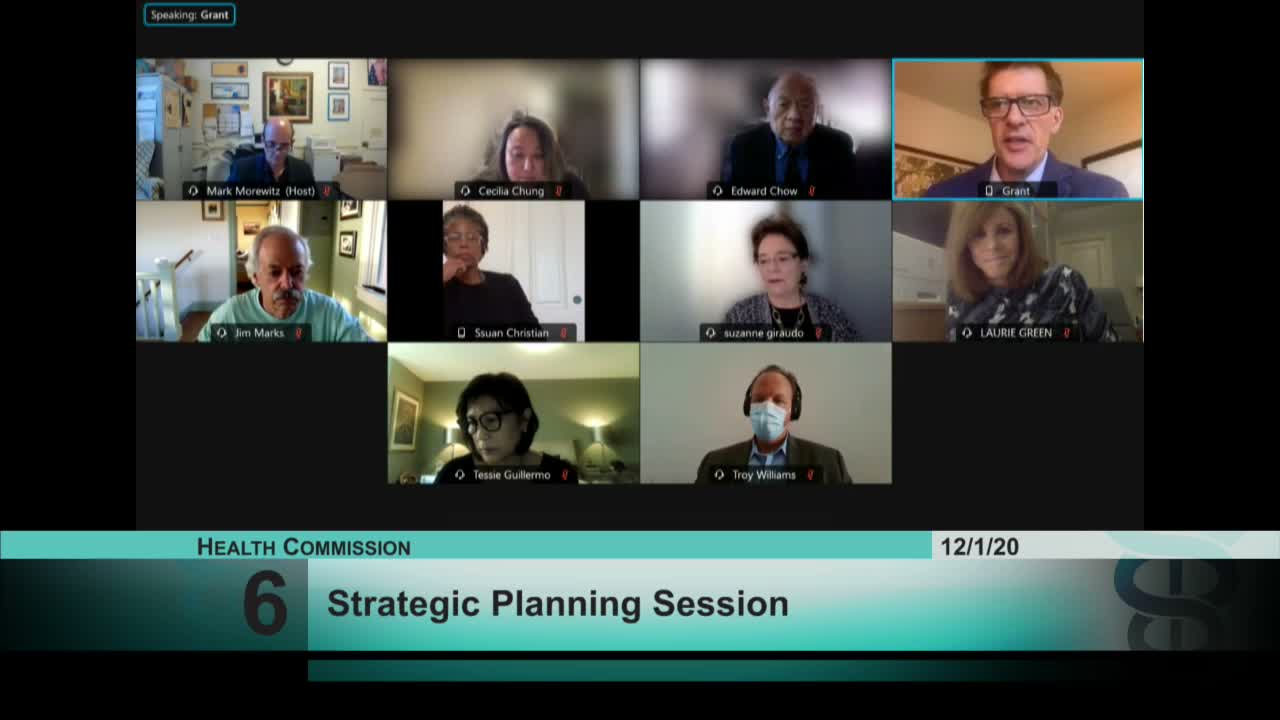
The report to commissioners came during a strategic planning session that summarized the COVID Command Center’s unified‑command structure, data and surge planning, and staffing and budget impacts. Troy Williams, the CCC unified commander, described the command structure and said the CCC’s FY21 operating plan includes a grand total of about $204,800,000 for CCC operations, funded by FEMA, CARES Act and general‑fund support. Williams said DPH, HSA and DEM hold most CCC appropriations authority and that the controller’s office will review FY22 funding beginning in January.
Colfax and CCC leaders emphasized three operational priorities: a data‑driven test‑trace‑isolate strategy targeted to high‑positivity neighborhoods; surge planning to preserve emergency and ICU capacity (including activation of alternate care sites and a 93‑bed field hospital); and equitable vaccine distribution planning once supply becomes available. Andy Tanner (operations) and other speakers described the CCC’s health services, human services and community branches that supply testing, isolation/quarantine hotels, outreach hubs for nine priority neighborhoods and congregate‑living outbreak response teams.
Commissioners pressed presenters on workforce sustainability, contracting and billing. Greg Wagner, chief operating officer, said the department created expedited and batch hiring processes that have produced hundreds of hires (including a reported increase in RNs and porters) and that the city added roughly 109 budgeted COVID positions to address sustained CCC needs. Wagner and other staff said roughly 516 DPH staff were officially deployed to the CCC at a recent count, with many more assisting indirectly.
On revenue, the commission heard that federal coverage is expected to pay for vaccine product in the early rollout, but the city expects to incur administering and logistics costs that will need local funding or billing. Wagner said the testing‑vendor RFP has been awarded and the department expects a contract in place in January with operational ramp‑up through spring; billing and reimbursement workflows for testing are being developed now.
Rita Nguyen, director of the Information & Guidance branch, described ING’s role in translating public‑health policy into guidance and public messaging. She said ING has produced roughly 300 guidance products and worked with the Joint Information Center and community partners to develop campaigns (including a regional Latinx campaign) and messages on ventilation, playground reopening and PPE guidance for shelter staff.
The Office of Health Equity reported continued work despite staff deployments: the office said it would provide the department’s racial equity action plan (required by the city’s racial equity ordinance) in roughly one week to 10 days and noted $36 million in reallocated community funds that will be distributed with a community prioritization process.
Population Health and SF Health Network leaders described operational tradeoffs: hundreds of staff from clinical services and the network have been redeployed to CCC work, causing paused or reduced prevention programs, fewer clinic visits (some clinics at roughly half their typical volume), and delayed accreditation, research and chronic‑disease work. Network clinical leaders said more than 800 SFHN staff were cumulatively deployed to CCC functions during the pandemic and that an LAC (low‑acuity care site) with 93 beds is ready to activate if hospital capacity is overwhelmed.
Mental Health SF work moved forward even amid the pandemic. Hallie Hammer said a street crisis response team piloted yesterday; the team will operate initially eight hours a day, five days a week while planners evaluate expansion to multiple teams and 24/7 coverage. Other Mental Health SF domain groups (care coordination, service centers, new beds and overdose prevention) are in design and hiring phases.
At the start of the meeting the commission handled routine business: a motion to approve the November minutes was made and passed by roll call, and the two‑item consent calendar was approved. The meeting closed with a roll‑call vote to adjourn. The commission heard no public commenters during the period allotted for public comment.
The commission requested follow‑up information on: (1) how new and budgeted FTEs will be deployed to relieve ongoing CCC deployments and timelines for rebalancing staff back to regular duties; (2) progress on the testing vendor contract and expected revenue/billing timelines; (3) periodic reports on the street crisis response pilot and Mental Health SF domain milestones; and (4) updates on reporting metrics and how CCC objectives map to the department’s True North measures.
Sources: presentations and exchanges delivered to the Health Commission during the strategic planning session, including statements by Director Colfax, CCC unified commander Troy Williams, operations chief Dr. Andy Tanner, COO Greg Wagner, Info & Guidance director Rita Nguyen, Office of Health Equity director Robert Bennett, Population Health Division and SF Health Network leaders.