Get Full Government Meeting Transcripts, Videos, & Alerts Forever!
Get email alerts on the Covid Metrics And Policy topic
No spam. Unsubscribe anytime.
San Francisco health leaders report rising hospitalizations, outline how health orders and reopening decisions are made
Summary
Department of Public Health leaders told the Health Commission that San Francisco has passed 10,000 COVID-19 cases and is seeing rising hospitalizations; officials described targeted testing in hard-hit neighborhoods, the city’s approach to reopening under the state’s blueprint and how health officer orders and directives are developed.
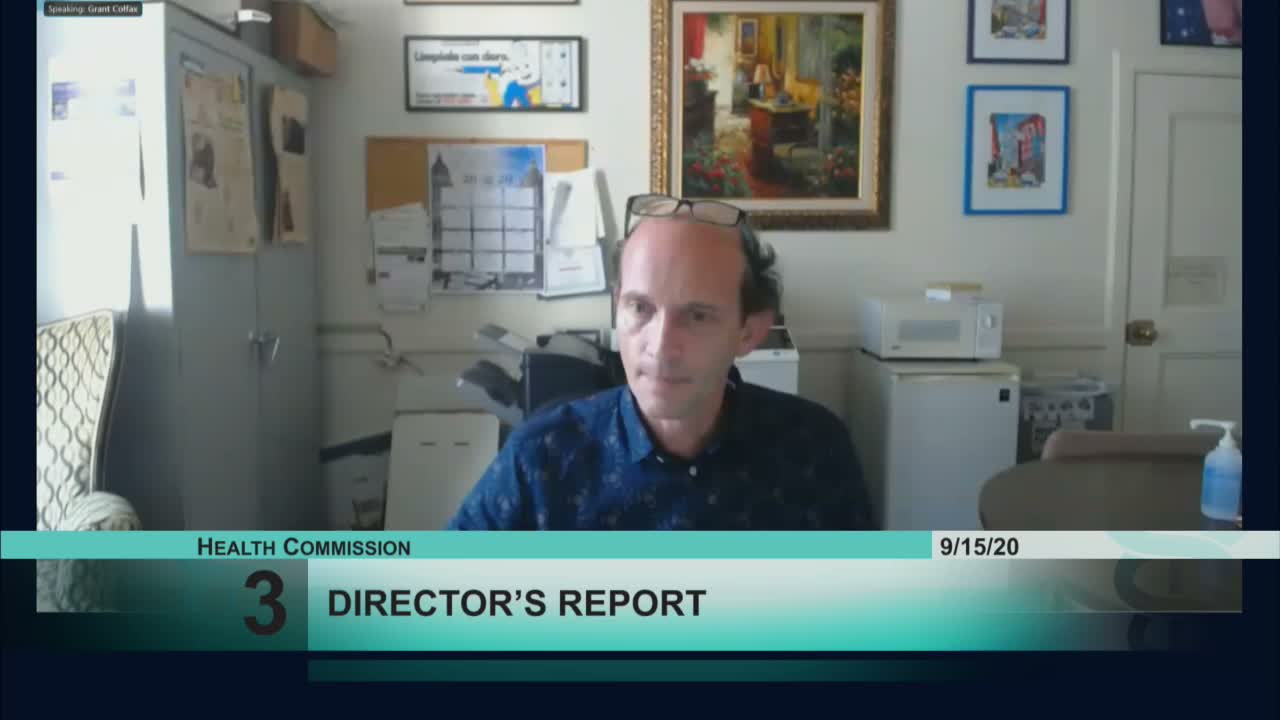
Grant Colfax, San Francisco's director of health, told the Health Commission on Sept. 15 that the city has exceeded 10,000 confirmed COVID-19 cases and was monitoring a concerning uptick in hospitalizations.
"Since 2 weeks ago, our last meeting, we have exceeded our number of 10000 cases in San Francisco. We're currently at, 10430," Colfax said, adding the city had recorded 91 deaths. He reported a 7-day average of about 3,401 tests collected and a 7-day average percent positive of 2.36 percent, and warned that hospitalizations had prompted a "high alert red" designation.
Colfax emphasized inequities in the local outbreak and said the department is targeting testing and prevention resources to neighborhoods with high positivity: "We are focusing on working with community leaders to strengthen our prevention and care response, including through increased access to testing" in the Mission, OMI, Visitation Valley and Bayview Hunters Point.
Commissioners pressed for practical guidance on smoke exposure during wildfire events. Commissioner Christian asked for recommendations residents can use when medical-grade respirators must be reserved for health care; Colfax said the department already has guidance and will provide a link during the meeting and share it with the commission before adjournment.
Health officer Thomas Aragon provided an extended briefing on the legal and operational framework for health orders. He explained that California delegates public health police powers to counties and described the city's two-step approach: an order that establishes legal authority and directives (operational guidance that carry the force of law).
"The order usually stays constant, mostly constant, and then we adapt the directives because things are changing all the time," Aragon told commissioners. He said San Francisco views itself epidemiologically in the state's highest tier based on local data but that the state's case-rate adjustment for high-testing counties has placed San Francisco in a lower tier. "So, epidemiologically, we're purple," Aragon said, describing a risk-based approach to opening lower-risk activities first.
Aragon summarized the department's prioritization checklist for orders and reopening decisions: health impact, health equity, ethics, efficiency, legal exposure, logistics and building public trust. He described engagement with subject-matter experts, Office of Economic and Workforce Development, the Mayor's Office and community organizations when drafting directives and noted the department conducts site visits for elementary schools seeking waivers to reopen.
Public commenters representing neighborhood merchants and small fitness studios urged clearer and earlier distribution of guidelines. Small-business owners said many learned of new reopenings from media rather than from the department and asked to be included earlier in consultation and provided with simpler, actionable checklists for compliance.
The Health Commission approved procedural minutes at the start of the meeting and adjourned after routine business. Commissioners did not take additional formal policy votes in the session's presentations on COVID metrics and orders.
What's next: DPH said it would provide the requested smoke-protection guidance before the meeting ended, will continue to expand pop-up testing in high-positivity neighborhoods, and Aragon said Bay Area health officers are beginning regional discussions about vaccine distribution logistics.