Get Full Government Meeting Transcripts, Videos, & Alerts Forever!
Get email alerts on the Behavioral Health topic
No spam. Unsubscribe anytime.
BHS proposes targeted 117-bed expansion and housing linkages to reduce boarding
Summary
The Department of Public Health's Behavioral Health Services presented a bed-optimization simulation that found bottlenecks across acute psychiatric, skilled-nursing, residential and 12-month treatment beds and recommended an initial 117-bed expansion paired with housing investments and annual re-running of the model to improve flow for people experiencing homelessness and reduce inappropriate inpatient boarding.
Marlo Simmons, acting director for Behavioral Health Services, and Dr. Anton Neguse Bland, director for mental health reform, updated the Health Commission on July 7 on system performance, COVID-19 impacts and a bed-optimization study meant to right-size acute behavioral-health capacity.
Simmons provided system context: BHS reaches about 25,000 people in treatment and roughly 40,000 across prevention programs annually; the BHS budget is approximately $450 million and roughly two-thirds of services are delivered via contracts with about 80 community-based organizations. She described equity initiatives, language-access improvements, expansion of the mobile response team for youth, telehealth pivots and deployment of behavioral-health staff in shelter-hotels and other COVID-response activities.
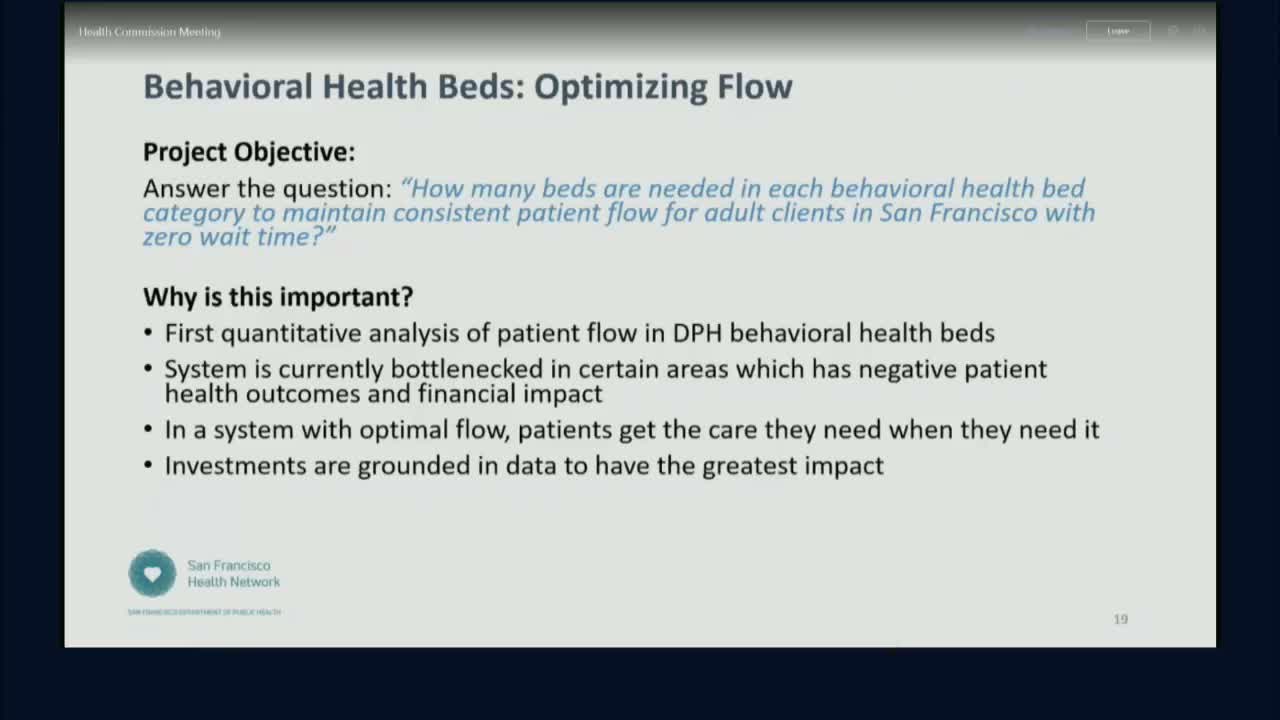
Dr. Bland presented a simulation model calibrated to FY18-19 utilization data (more than 25,000 admissions) developed with philanthropic support and an external vendor. The model identified high-occupancy bottlenecks in four categories: acute psychiatric treatment beds, psychiatric skilled-nursing facilities, residential care/board-and-care settings (including RCFE) and 12-month mental-health residential treatment programs. The analysis found that many acute inpatient beds were occupied by people who could be served in lower-intensity community settings if those placements were available and that people experiencing homelessness comprise a large share of this population (the report noted ~68% of analyzed patients were experiencing homelessness).
To reduce boarding delays and improve patient flow, the team recommended a targeted initial expansion of 117 beds across the levels of care most constrained in the model and pairing each treatment expansion with housing capacity so that treatment gains are not lost after discharge. Bland also recommended investing in fixed-bed facilities dedicated to DPH patients (rather than relying only on market-contracted shared beds), improving wait-time and placement-tracking data systems, and repeating the simulation annually to guide future investments.
Commissioners sought additional detail: what the timeline and procurement path would look like if funding were available; how much of the recommended expansion would require new facilities versus buying capacity from existing operators; and how workforce and language-capability constraints would affect implementation. Simmons said the department would return with a projected work plan and timeline in the coming months that ties the recommendations to budget realities, licensing and procurement steps.
Public commenters urged immediate housing action and protections for board-and-care homes, linking the bed and treatment recommendations to the city's ongoing responsibilities to house unhoused residents during the pandemic.
Bland emphasized that the recommended expansion addresses current system demand and smoothing of flow rather than an estimate of unmet community-wide need; the modeling should be repeated regularly to reflect changes in demand and to inform further investments.