Get Full Government Meeting Transcripts, Videos, & Alerts Forever!
Get email alerts on the Jail Health topic
No spam. Unsubscribe anytime.
Jail health chief reviews decarceration, intake testing and safety steps as population shifts
Summary
Jail Health Services reported testing and cohorting protocols, a sharp COVID-era decline in the jail census, and ongoing operational planning to keep incarcerated people and staff safe while County Jail 4 is scheduled for closure.
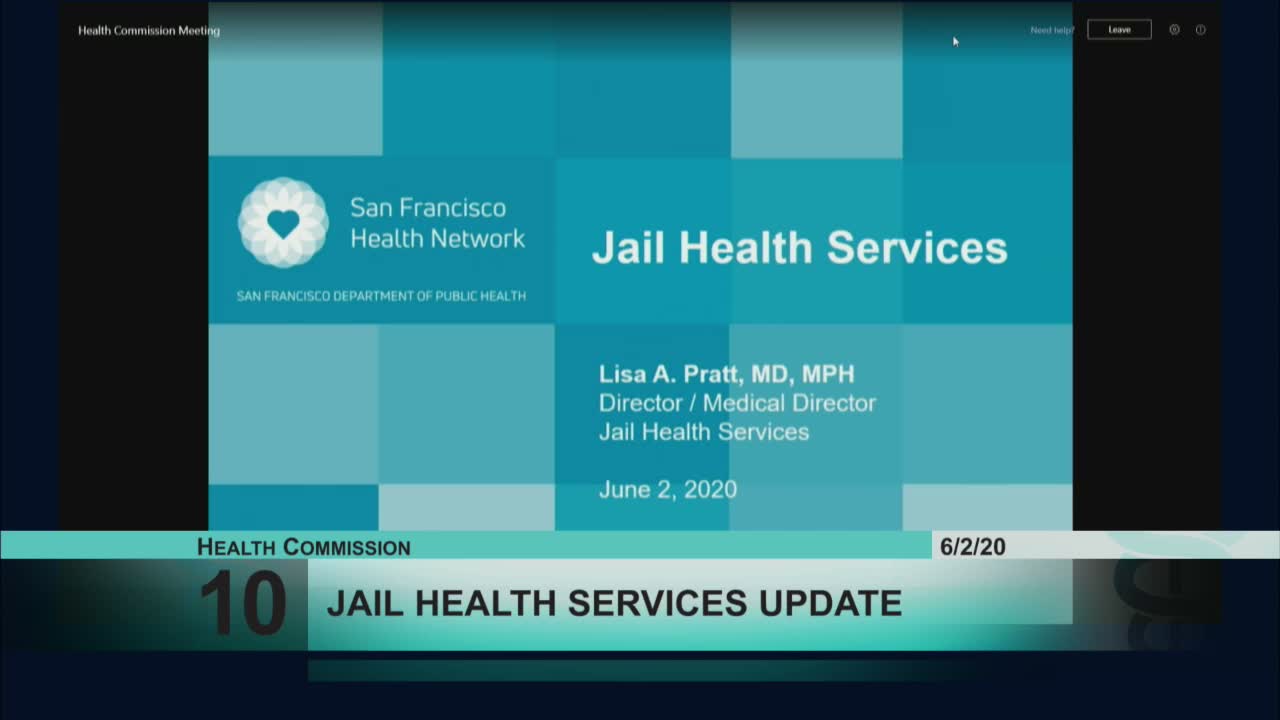
Dr. Lisa Pratt, director of Jail Health Services, briefed the Health Commission on June 9 about how the department is managing COVID-19 risks in San Francisco’s jails and how the pandemic accelerated decarceration trends.
Pratt said the jail population fell sharply since February for a mix of policy and pandemic reasons — including litigation and local changes to pretrial practices — and that COVID-19 pushed the count lower still. "Our nadir was about 690," she said, while noting the population had started to climb again as arrests resumed. She described the department’s intake testing, cohorting and isolation procedures and said that rapid testing prioritized for the jail has been a "game changer." The department began offering intake testing universally on April 13 and reported about a 69 percent acceptance rate for testing among people booked.
On clinical operations, Pratt said medically vulnerable individuals are being cohorted and that the sheriff’s department and DPH have limited nonessential access to the jails, conducted symptom screening and provided masks and sanitizer to staff and incarcerated people. The department reported 10 positive jail cases identified at intake (all asymptomatic at detection) and described a quarantine protocol that includes a 14‑day monitoring period and, in some pathways, up to 21 days before movement into long‑stay housing.
Pratt also reviewed the operational implications of the County Jail 4 closure scheduled to begin July 11: the sheriff plans to consolidate populations and convert some dorms into single or double cells, which will reduce aggregate capacity and require adjustments to staffing, reentry planning and behavioral‑health programming.
Public comment during the item highlighted the need to maintain staffing for jail health and to coordinate reentry services, particularly placements for people who are conserved or have psychiatric needs.
Next steps: DPH will continue to monitor jail testing supplies and advocate for prioritized rapid testing capacity, provide updates on population trends, and coordinate with criminal‑justice partners to preserve medical and behavioral health services as housing and operations are reconfigured.