Get Full Government Meeting Transcripts, Videos, & Alerts Forever!
Get email alerts on the Public Health Covid topic
No spam. Unsubscribe anytime.
San Francisco Health Commission hears surge plans, warns testing and supplies remain constrained
Summary
San Francisco's health leaders told the Health Commission on March 17 that the city had 43 confirmed COVID-19 cases and is implementing regional shelter-in-place suppression measures; hospitals are coordinating a joint surge plan but testing, PPE and staffing shortages limit immediate scale-up.
San Francisco's public-health leaders told the Health Commission on March 17 that the city was facing community spread of COVID-19, had 43 diagnosed cases and had moved to regional suppression measures including a joint shelter-in-place order.
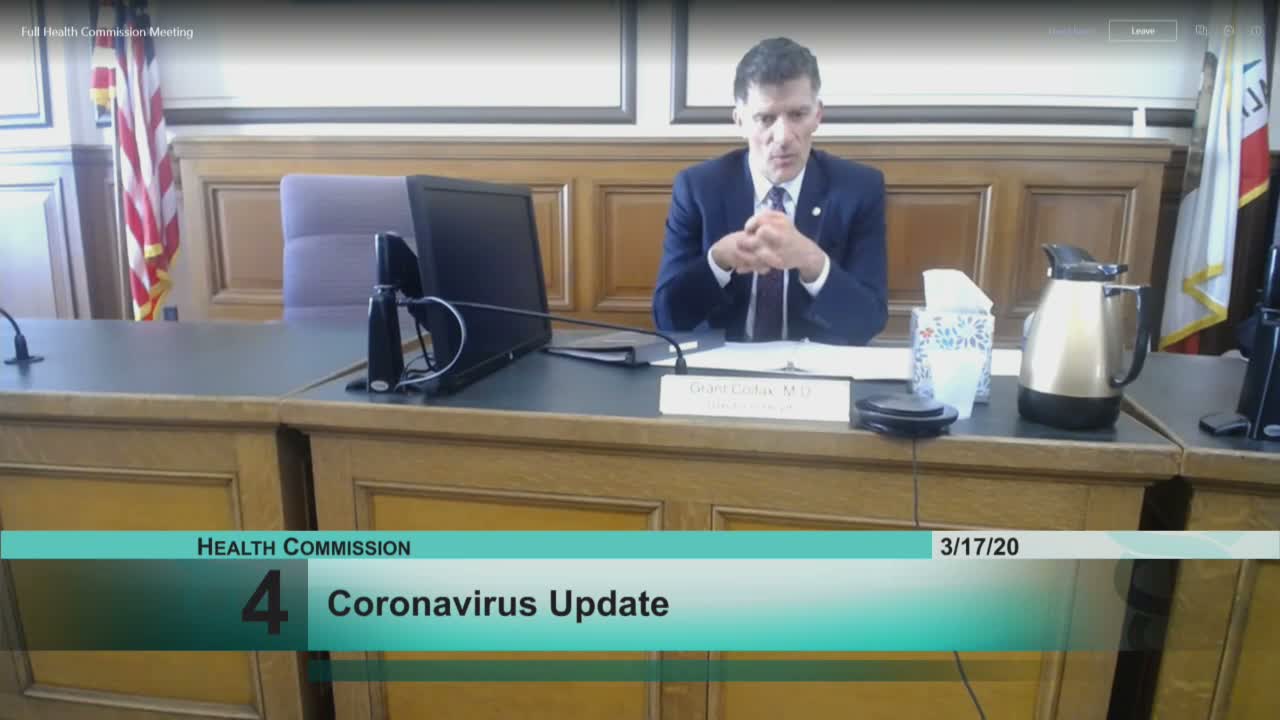
"We are at 43 diagnosed cases of COVID-19 in San Francisco," Director of Health Grant Colfax said, adding that the department was seeing evidence of community spread and was focusing on three priorities: social distancing, protecting vulnerable people and protecting health-care workers.
Health Officer Thomas Aragon told commissioners that "hours matter," describing a progression of public-health strategies and saying the city had begun implementing suppression measures intended to drive the reproductive number below 1. "The shelter-in-place order really provided the best intervention from public health that we are aware of at this time to decrease the spread of the virus," he said.
Hospital officials described steps taken to create bed and staffing capacity. "We're setting up a tracking system among all the hospitals, and a joint surge plan that will help us identify on a daily basis where all the hospitals are with respect to capacity utilization," said Dr. Susan Ehrlich, CEO of Zuckerberg San Francisco General Hospital. Ehrlich said ZSFG had moved from a green to yellow surge designation and reported 15 COVID-positive patients or persons under investigation at ZSFG that day; she said other hospitals were between green and yellow.
Commissioners pressed hospital leaders on the mechanics of opening centralized surge resources and who would "pull the trigger" to occupy repurposed units. Ehrlich described a three-pronged model: basic support services provided by the hosting hospital, registry staffing for nursing positions, and a shared-provider model among systems, and said the trigger rules were still being worked out.
Testing capacity emerged as a key constraint. Colfax and Aragon said the city's public-health lab had limited supplies and that, at times, the department had only days to a week of tests available. Private labs such as Quest have longer turnaround times, and UCSF virologists who had developed tests could not scale up immediately because of reagent shortages. "We're often projecting capacity of only having a few days worth of tests or at best a week left of tests," Colfax said.
Officials outlined steps to expand and coordinate testing: a citywide testing plan being developed with UCSF to track tests delivered and run, a rapid assessment of private and public capacity, and prioritization of tests for hospitalized patients, health-care workers and high-risk contacts. Colfax said the department was also working with the mayor's office and other city departments to identify resources and logistical support.
Vulnerable populations were another focus: Colfax said the department was coordinating with the Human Services Agency and the Department of Homelessness and Supportive Housing to establish social-distancing protocols in shelters and to identify hotel rooms and other isolation options for people experiencing homelessness. "We are working on establishing social distancing protocols within the navigation centers and shelters," he said.
Colfax and Ehrlich cautioned that staffing and personal protective equipment (PPE) are national challenges and that additional state or federal resources likely will be needed if demand grows substantially. The mayor had issued orders to streamline hiring and waive civil-service provisions to accelerate staffing, Colfax said.
The commission asked for daily counts of COVID-positive patients and ICU occupancy across hospitals; Ehrlich said the joint surge plan will provide daily capacity tracking and the indication of when centralized surge resources should be activated. The shelter-in-place order covered six counties plus Berkeley and was set initially through April 7, with decisions about extension to be made closer to that date.
Next steps: the department will continue to refine the citywide testing plan, coordinate hospital surge trigger criteria with partners, and expand isolation options for vulnerable populations. Commissioners were briefed and reserved detailed questions for follow-up as the hospital and public-health systems operationalize the surge plan.
The Health Commission moved on to other agenda items after the briefing; later in the meeting commissioners held officer elections and voted to go into a closed session.