Get Full Government Meeting Transcripts, Videos, & Alerts Forever!
Get email alerts on the Budget topic
No spam. Unsubscribe anytime.
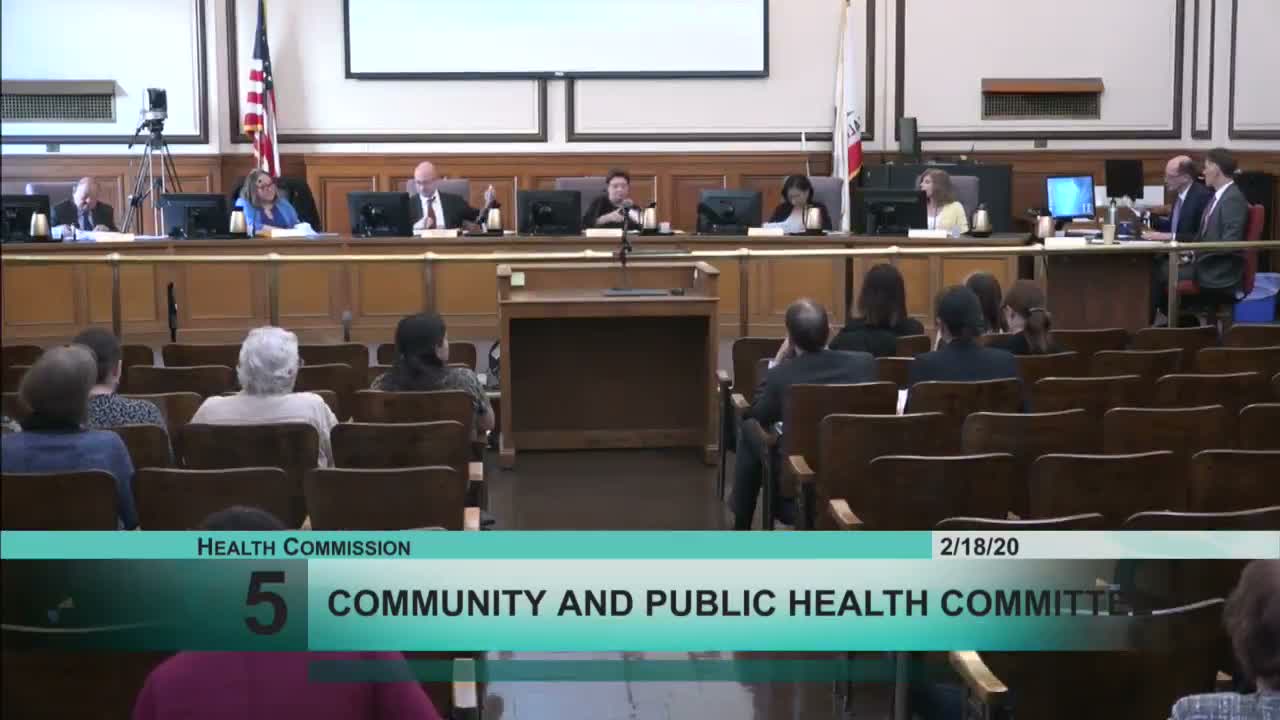
Health Commission approves DPH budget package while commissioners press for more detail on Mental Health SF
Summary
The Health Commission approved the Department of Public Health—s FY2020–22 budget submission, including proposed revenue adjustments, workforce additions and a $7 million first-year surplus earmarked as a down payment for Mental Health SF; commissioners pressed for clearer assumptions on waivers, FTEs and long‑term funding.
DPH Chief Financial Officer Greg Wagner and Budget Director Jenny Louie presented the department—s budget submission and ten initiatives the commission was asked to forward to the controller and mayor—s offices. Louie highlighted projected baseline revenues for Zuckerberg San Francisco General, Laguna Honda rate increases, an unusual one‑time settlement recognition of about $65.9 million tied to closing prior Medicaid waiver cost reports, and a proposal to stand up a specialty pharmacy within the San Francisco Health Network.
Louie described emerging needs and programmatic proposals: centralized quality management in response to deficiencies at Laguna Honda, three maternal‑child health equity initiatives (a $400,000 state‑funded Perinatal Equity Initiative plus a general‑fund coordinator; a doula program; and an "abundant birth" income supplement), and operational staffing to support a persistently high census at ZSFG. The package also included proposals to add HR positions and permanent staffing for surge med‑surg capacity and psychiatric technicians in the ED.
Commissioners questioned several assumptions: the size and sustainability of revenue increases (CFO noted revenue conservatism due to waiver uncertainty), the rationale for added FTEs in quality management after consolidation, and whether wage‑equity and cost‑of‑doing‑business (MCO/CODB) amounts were included in the initiatives or managed separately. Wagner said some MCO/CODB funding ($1.2M ongoing and another ~$6.6M anticipated) is handled centrally and not double‑counted in the initiatives.
Public commenters from Homeless Emergency Service Providers Association (HESPA) and partner organizations urged the commission to fund overdose prevention sites (~$2M), substance‑use services for transition‑age youth (~$2.5M), and ongoing residential treatment (~$1.4M) to align DPH priorities with Mental Health SF.
After deliberation the commission moved and voted to approve DPH—s FY2020–21 and FY2021–22 budget submission for transmittal to the Controller and Mayor (motion moved and seconded; vote recorded as 'Aye'). DPH said the projected two‑year surplus of about $7 million would be treated as a down payment toward implementation of Mental Health SF while acknowledging full implementation could cost roughly $100 million or more and will require additional revenue sources such as a ballot measure or state/federal funds.