Get Full Government Meeting Transcripts, Videos, & Alerts Forever!
Get email alerts on the Public Health Covid Response topic
No spam. Unsubscribe anytime.
Health Commission hears DPH COVID-19 update; callers press for more nursing-home testing
Summary
San Francisco Department of Public Health Director Grant Colfax briefed the Health Commission on COVID-19 data, surge capacity, testing limits and a rapid expansion of contact tracing. Multiple callers and commissioners urged faster testing and transparency for nursing homes and other congregate settings.
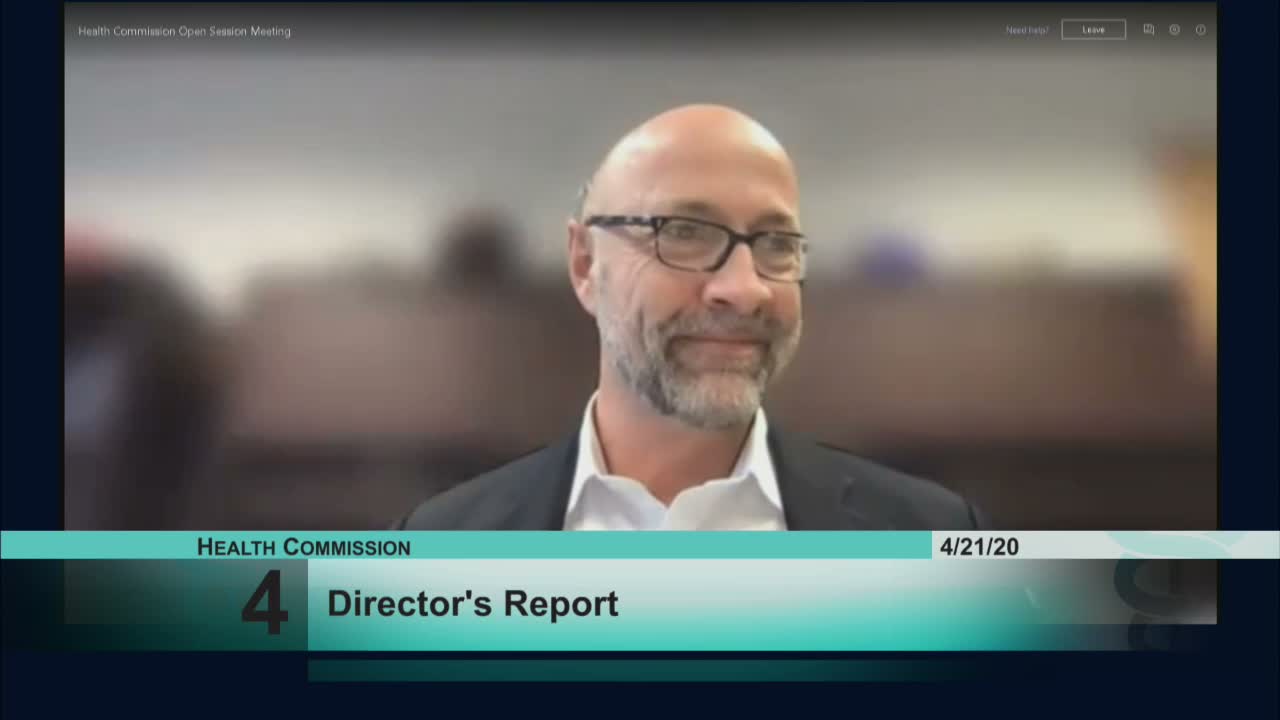
San Francisco Department of Public Health Director Grant Colfax on April 21 told the Health Commission that the city had recorded 1,231 confirmed COVID-19 cases and 20 deaths among people who had tested positive, and that the department had performed nearly 12,000 tests with a positivity rate that has ranged about 11 to 15 percent. Colfax said the city has expanded medical-surge capacity, reporting about 1,262 acute care beds and 436 ICU beds available across the city to meet a moderate surge.
Colfax described the department's priorities as flattening the curve, protecting the most vulnerable, safeguarding health-care workers, and building medical surge capacity. He said the public-health laboratory and UCSF had boosted testing throughput but that the limiting factor has been supplies such as swabs and culture media. "We have 1231 total cases," Colfax said, adding that available supply chains have recently improved and the department plans an evidence-based expansion of testing eligibility consistent with state guidance.
On testing and contact tracing, Colfax said San Francisco is increasing staff and systems. He described a partnership with UCSF and a firm called Dimagi to build a contact-tracing data system and said the city expects to train a team of more than 150 contact investigators in the coming weeks to support case investigations and follow-up. "We are building our contact tracing capacity," he said, while cautioning that continued supply issues and the need for evidence-based prioritization limit immediate expansion to on-demand testing for everyone.
Public callers repeatedly urged expanded testing in long-term care and congregate facilities. Teresa Palmer, M.D., a geriatrician, said: "The lack of testing of asymptomatic contact and asymptomatic staff at the nursing home is a form of rationing. It's a statement that nursing home patients' lives are not worthwhile." Senior and Disability Action member Jessica Layman asked that the city test all staff and residents at any facility with a suspected or confirmed case and regularly post counts of cases and deaths at congregate facilities.
Colfax and commissioners discussed jurisdictional limits: Colfax said private nursing homes are under state jurisdiction while his department retains responsibility for case investigation and contact tracing and can make testing recommendations in the course of specific outbreak investigations. He described targeted responses to outbreaks—such as at Laguna Honda and MSC South shelter—where the department deployed testing, isolation and hotel placements for residents and staff.
Commissioners asked about protecting immigrant communities and privacy in contact tracing; Colfax said information collected is confidential and the contact-tracing outreach will be multilingual and include community partners to address trust concerns. On the question of staffing and timing, Colfax said he expected to meet the initial staffing target for contact tracing "in the next couple of weeks" and to scale further as needed.
The update concluded with commissioners pressing for continued clarity on testing priorities, expansion timelines, and outplacement options for patients leaving hospitals. Colfax said DPH would continue to prioritize vulnerable populations and health-care workers as testing expands and to coordinate with state and regional partners if additional resources are needed.
What happens next: Commissioners asked DPH to come back with more details on testing capacity, hotspot testing plans, and behavioral-health supports for people housed in hotels or shelters.