Get Full Government Meeting Transcripts, Videos, & Alerts Forever!
Get email alerts on the Health Care Master Plan topic
No spam. Unsubscribe anytime.
DPH and Planning release 2019 Health Care Services Master Plan draft, propose planning-code changes to improve access
Summary
The 2019 Health Care Services Master Plan draft would prioritize services for vulnerable populations, revise consistency-determination procedures to focus on large institutional footprints, and propose planning-code changes to reduce barriers for priority health services.
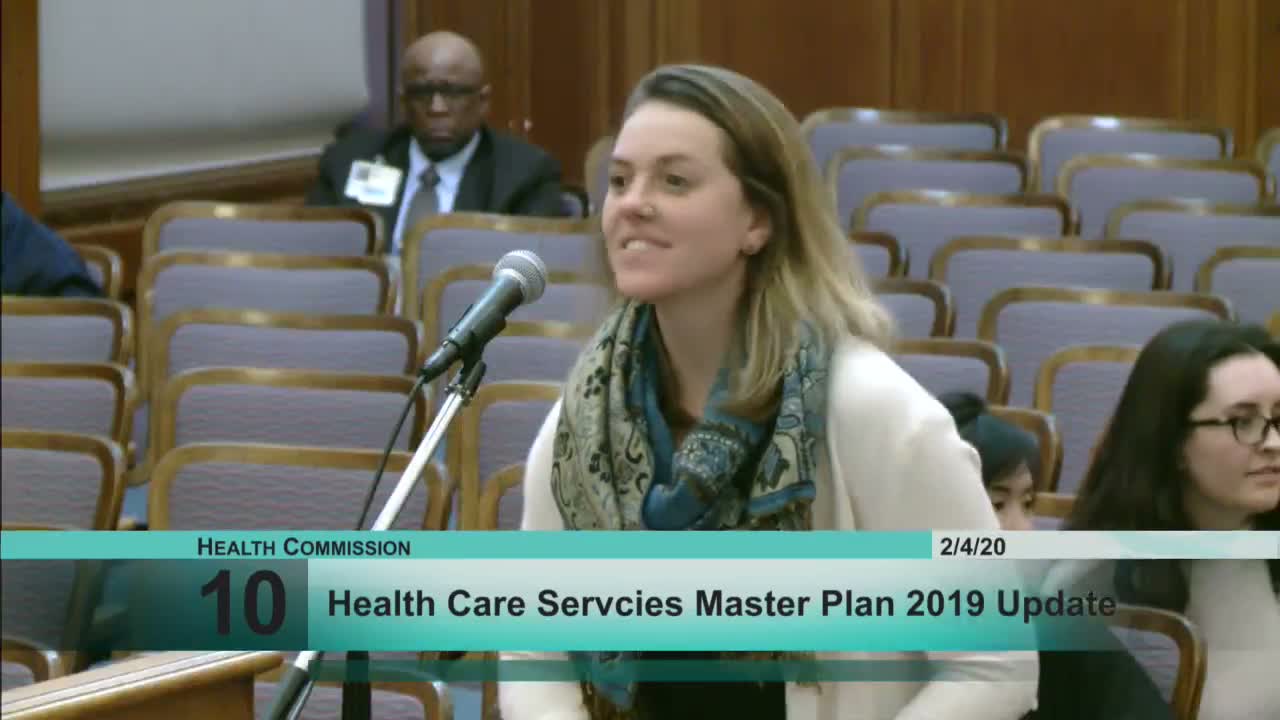
Claire Lindsey of DPH and Sheila Nicholas of the Planning Department presented an informational hearing on the 2019 Health Care Services Master Plan draft, which updates assessments of community health needs, land use, capacity and system trends and proposes changes to consistency-determination guidelines and the planning code.
Key points: The draft advances six broad recommendations: expand access to appropriate care for vulnerable populations; increase behavioral-health services and access; increase long-term care capacity; harness health information technology for care coordination; improve transportation access to care; and ensure health facilities contribute positively to neighborhoods. Staff recommended updating the master-plan cycle to a 10-year full update with a five-year monitoring report and retooling the consistency-determination process to apply mainly to large institutional master plans (IMPs) to reduce unnecessary delays for smaller, needed facilities.
Why it matters: The plan is a citywide land-use and service-planning document that aims to steer where health facilities locate and how they contribute to equitable access. Lindsey emphasized that the master plan is not only a DPH product but a citywide plan that draws on community health needs assessments and other studies. Proposed planning-code adjustments include expanding where residential-care facilities can locate, defining "priority health services" tied to state license types, and removing certain neighborhood-notification requirements for designated priority providers to speed placement in underserved areas.
Commissioner concerns and next steps: Commissioners praised the data but pressed staff on implementation: how the plan will translate into funded services, how to ensure providers accept Medi-Cal, and how to address workforce and transportation barriers. Staff said outreach for the 2019 update included interviews, workshops and meetings and invited further discussion at the joint Planning Commission/Health Commission adoption hearing scheduled for March 12 at City Hall.
What happens next: The draft is out for public comment; a joint adoption hearing with the Planning Commission is scheduled for March 12, and staff will report back on public input and implementation implications.