Get Full Government Meeting Transcripts, Videos, & Alerts Forever!
Get email alerts on the Budget topic
No spam. Unsubscribe anytime.
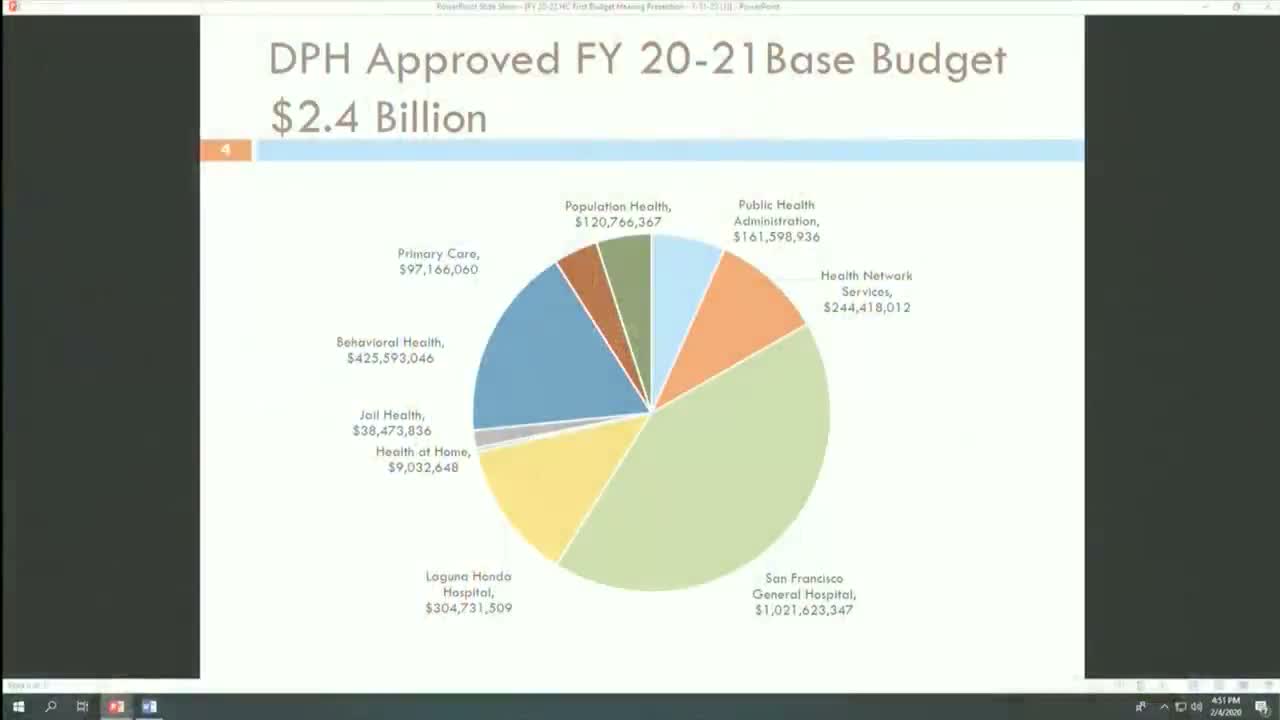
DPH outlines $2.4 billion operating budget, Mental Health SF priorities and revenue plan to close projected shortfall
Summary
DPH presented a $2.4 billion operating budget and previewed Mental Health SF—s five pillars, described revenue strategies (fee-for-service, supplemental Medi-Cal payments, EPIC capture, reserves), and noted mayoral reduction targets of 3% then 7% to address an estimated $420 million two-year shortfall.
CFO Greg Wagner and budget director Jenny Louie presented the Department of Public Health—s high-level budget framework for fiscal years 2020–21 through 2021–22 and previewed key initiatives, including the Mental Health SF framework and Medi-Cal waiver monitoring.
Louie said DPH's budget is "currently projected to be $2,400,000,000" across operations, capital and grants, with personnel costs as the largest expenditure and San Francisco General the department's biggest division. She said departmental revenues offset roughly 65 percent of costs and that a roughly 35 percent general-fund subsidy (about $861 million) remains necessary.
Why it matters: Louie and Wagner told commissioners the city faces a two-year projected gap the department will help address as part of the mayor—s instructions to seek efficiency reductions (about 3 percent in year one, rising toward 7 percent in year two) while minimizing service impacts. Mental Health SF is a priority that will require targeted funding and an implementation plan to the Board of Supervisors within a year.
Key elements: The Mental Health SF framework includes a 24/7 mental health services center (triage, urgent care, pharmacy hours, transportation and a sobering center), an Office of Coordinated Care to expand case management and create an inventory of city-funded mental health programs, a street-based crisis response team, service expansions (residential treatment, secure inpatient and transitional beds), and a proposed Office of Private Insurance Accountability to help privately insured residents access mental-health benefits. Louie said the department is still working with the mayor—s office to determine which agency will administer that office.
Revenue strategy and uncertainties: CFO Wagner and Louie said revenue growth will be central to meeting reduction targets. Tools include fee-for-service growth at hospitals and clinics, supplemental federal Medi-Cal payment programs that can be drawn down when quality metrics are met, closing out old state waiver reserves, and better charge capture through the EPIC electronic health record implementation. Louie said the state—s CalAIM ("Healthier Medi-Cal for All") process may reconfigure how some supplemental payments are delivered and that DPH expects to track negotiations closely; Louie cited about $150 million in revenues linked to the current waiver structure.
Workforce and hiring: Commissioners pressed DPH on workforce constraints. Wagner and Director Colfax said hiring permanent staff to reduce overtime and per-diem reliance is a priority, and new HR leadership is reviewing internal hiring steps to speed recruitment. DPH also discussed workforce-development ideas (loan-repayment incentives, pipeline programs) while noting structural regional shortages in nurses and behavioral-health workers.
Public comment and follow-up: Carl Kramer (San Francisco Living Wage Coalition) urged that budget submissions include written confirmation that departments considered nonprofit costs from the Minimum Compensation Ordinance and recommended a process for ensuring nonprofit contractors can maintain services. Commissioners asked staff to provide additional detail and follow up in subsequent budget hearings; staff said a second hearing will present detailed initiatives and a balancing plan for commission approval before mayoral submission.
What's next: DPH will present more detailed budget initiatives at the next hearing (two weeks later) and return with a balancing plan and initial proposals for Mental Health SF implementation.