Get Full Government Meeting Transcripts, Videos, & Alerts Forever!
Get email alerts on the Public Health Coronavirus topic
No spam. Unsubscribe anytime.
San Francisco health officials report no confirmed local coronavirus cases; outline containment and public guidance
Summary
DPH leaders told the Health Commission that there were no confirmed coronavirus cases in San Francisco and described containment, quarantine and community-mitigation plans while urging routine prevention measures and targeted communications to affected communities.
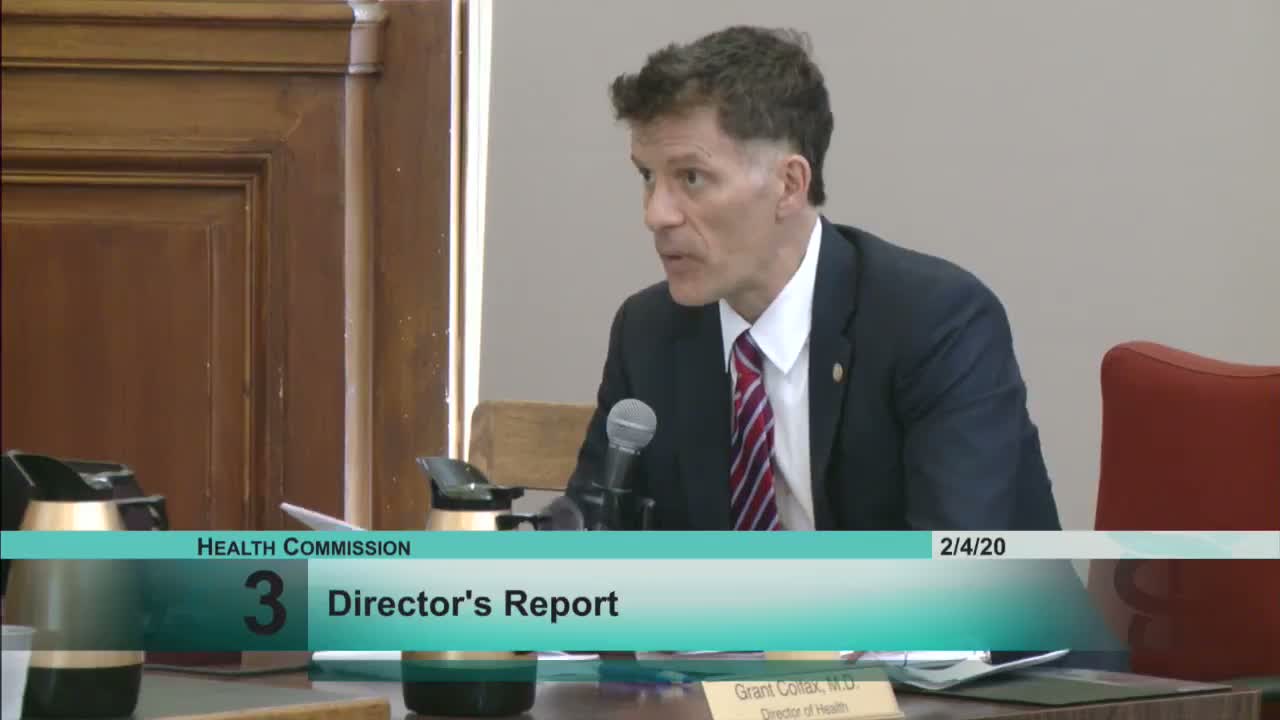
Grant Colfax, director of the San Francisco Department of Public Health, told the Health Commission that the department had no newly diagnosed coronavirus cases in San Francisco and that most response efforts remain focused on prevention and containment.
The update delivered by Dr. Thomas Aragon, DPH—s communicable-disease lead, laid out the department—s strategy: identify and transport suspected cases, isolate and test symptomatic people, quarantine close contacts (mandatory quarantine for some travelers from Hubei Province), and use active monitoring for other returnees from affected areas. Aragon noted national case counts and the department—s intent to be transparent if a local case is confirmed. "We have no newly diagnosed cases in San Francisco of coronavirus at this time," Colfax said. "We believe the risk is low," Aragon added.
Why it matters: The commission requested specificity about what city agencies and frontline workers should do. Aragon said DPH adapted the CDC—s guidance for San Francisco, will circulate it through Human Resources and other city channels, and is producing multilingual public materials. He emphasized prioritizing limited medical supplies for health-care workers (N95 respirators and other protective equipment) and training staff on infection control and N95 fit testing so the workforce can continue to care for patients.
Details and context: Aragon summarized international and U.S. numbers as of the briefing (international counts rising, 11 U.S. cases at that point, six in California) and the rationale behind the city—s current approach: prevention first; containment if a travel-related case appears; and community mitigation if sustained person-to-person transmission emerges locally. He described airport rerouting and quarantine logistics (some travelers transported to designated facilities for a 14-day mandatory quarantine) and said the department was preparing field teams that could perform community testing if needed.
DPH communications director Rachel Kagan described three priorities for public information: active rumor control, targeted outreach to the Chinese community (including language media and community partners), and timely, accurate postings so residents know where to find verified updates. She told commissioners the city is directing residents to the WHO and CDC for global guidance and to SFDPH—s website and sf72.org for local information.
Commissioner questions and follow-up: Commissioners asked about medical-supply chain risks from global demand and whether the department would issue guidance for frontline city employees and other agencies. Aragon said health systems were ordering supplies but global demand lengthens deliveries; he said DPH has adapted the latest CDC guidance and will provide agency-specific instructions. The commission requested that DPH share the HR-distributed guidance and wrinkle out operational details with city partners.
What happens next: DPH will continue multilingual public outreach, release adapted CDC guidance for city frontline staff, and notify the public immediately if a confirmed local case is identified.