Get Full Government Meeting Transcripts, Videos, & Alerts Forever!
Get email alerts on the Behavioral Health Reform topic
No spam. Unsubscribe anytime.
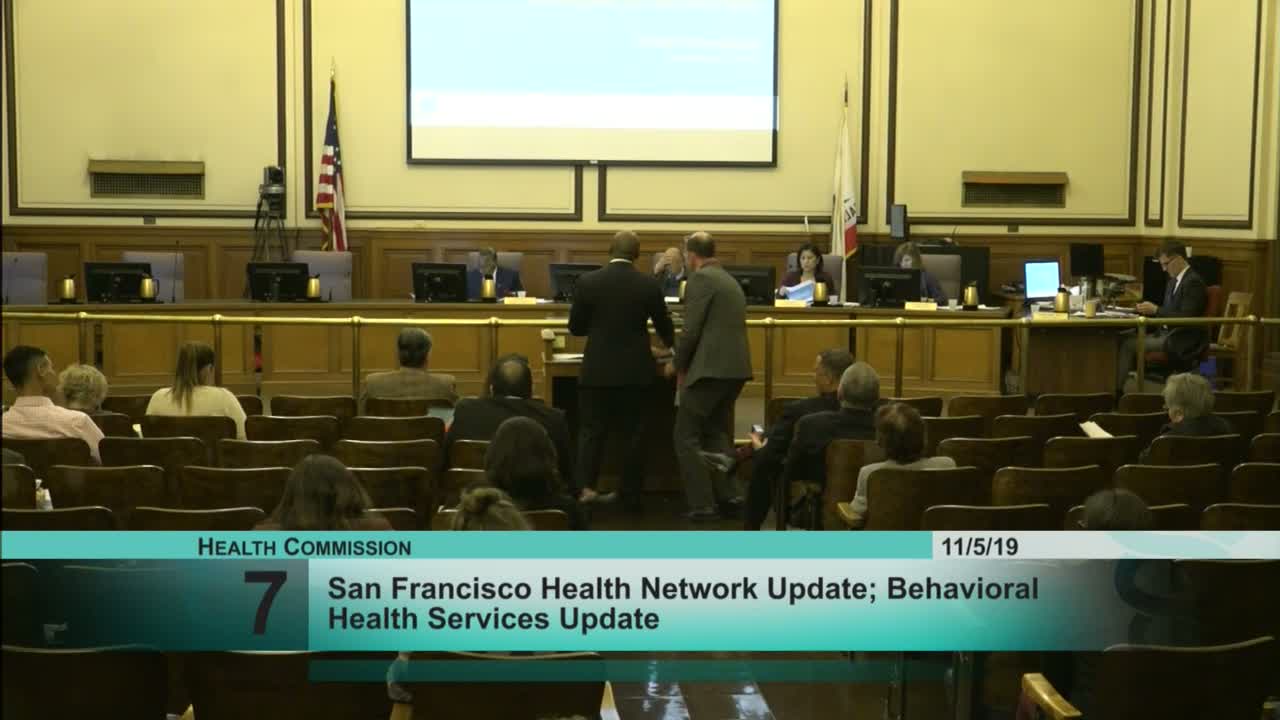
San Francisco outlines behavioral-health overhaul, targets 4,000 unhoused residents for wraparound care
Summary
San Francisco Health Department leaders laid out a population‑health plan to expand behavioral‑health capacity, identify a target group of about 4,000 unhoused residents with co‑occurring disorders, and shift toward outcome metrics as EPIC data is validated and workforce gaps are addressed.
San Francisco public‑health leaders presented a multi‑year plan to expand behavioral‑health services for the city’s most vulnerable residents and to shift measurement from process reporting toward outcome‑focused metrics.
Dr. Nagusa Bland, a board‑certified psychiatrist leading the mental‑health reform effort, told the Health Commission the department’s analysis identifies roughly 18,000 residents experiencing homelessness and a priority subpopulation of about 4,000 people with co‑occurring mental‑health and substance‑use disorders. "We identified a target population for our reform efforts," Bland said, adding that the group is medically vulnerable and heavily represented in urgent and emergent behavioral‑health services.
Bland said 90 percent of that target population do not have an intensive case manager and described stark disparities: approximately 35 percent are Black or African American despite that group comprising a much smaller share of the city’s total population. The reform team has set performance measures to reduce service utilization, increase connection to housing and intensive case management, and monitor client‑level improvement using the ANSA (Adult Needs and Strengths Assessment).
Acting Behavioral Health Director Dr. Irene Sung described the department's current capacity and constraints: a roughly $384 million behavioral‑health budget, about 800 budgeted civil‑service FTEs and scores of community‑based contractors. Sung said the department is working to move manual and disparate data systems into EPIC and Avatar and that regulatory reporting requirements still demand a large share of quality‑management and IT resources.
Sung told commissioners the department has begun several operational efforts that will feed the reform: expanding intensive‑case‑management slots in targeted programs, developing electronic tracking to replace manual spreadsheets, and piloting peer navigation to improve warm handoffs to outpatient care. She acknowledged a 20 percent vacancy rate in some intensive‑case‑management programs and said hiring and retention remain core obstacles.
Both presenters discussed state‑level change. Sung summarized CalAIM (California Advancing and Innovating Medi‑Cal) reforms under development at the California Department of Health Care Services, including enhanced care management and in‑lieu services that could shift how local services are paid and organized. Bland said city and departmental leaders are participating in statewide workgroups and are preparing for incremental implementation steps through 2024–2026.
Commissioners pressed for concrete timelines and workforce targets. Bland said the department is aiming to improve its case‑manager ratio (citing an informal current average of roughly 1:17 and an operational goal closer to 1:10 for high‑need populations) and to provide more transparent outcome metrics tied to housing status, jail contacts and engagement in care. Department leaders said they expect clearer EPIC‑based data by January and formalized metric baselines by the July 1 start of the next fiscal year.
The presentations concluded with community requests for expanded cultural and linguistic competency, rapid hiring and improved transitions between levels of care. Commissioners and staff agreed next steps include workforce recruitment plans, validation of EPIC data, and continued development of the shared whole‑person‑care approach.