Get Full Government Meeting Transcripts, Videos, & Alerts Forever!
Get email alerts on the Homelessness topic
No spam. Unsubscribe anytime.
Health Department launches interagency "shared priority" and Whole Person Integrated Care for highest‑need homeless adults
Summary
The department presented its Whole Person Care waiver work and an interagency "shared priority" to prioritize and coordinate services for the highest‑need adults experiencing homelessness, identifying a data‑driven cohort and new street‑to‑home plans with a high‑intensity care team and UCSF evaluation dashboards.
Maria Martinez and Dr. Hallie Hammer presented the Health Department's interagency "shared priority" launch and the new Whole Person Integrated Care clinical model to the Health Commission on Oct. 1.
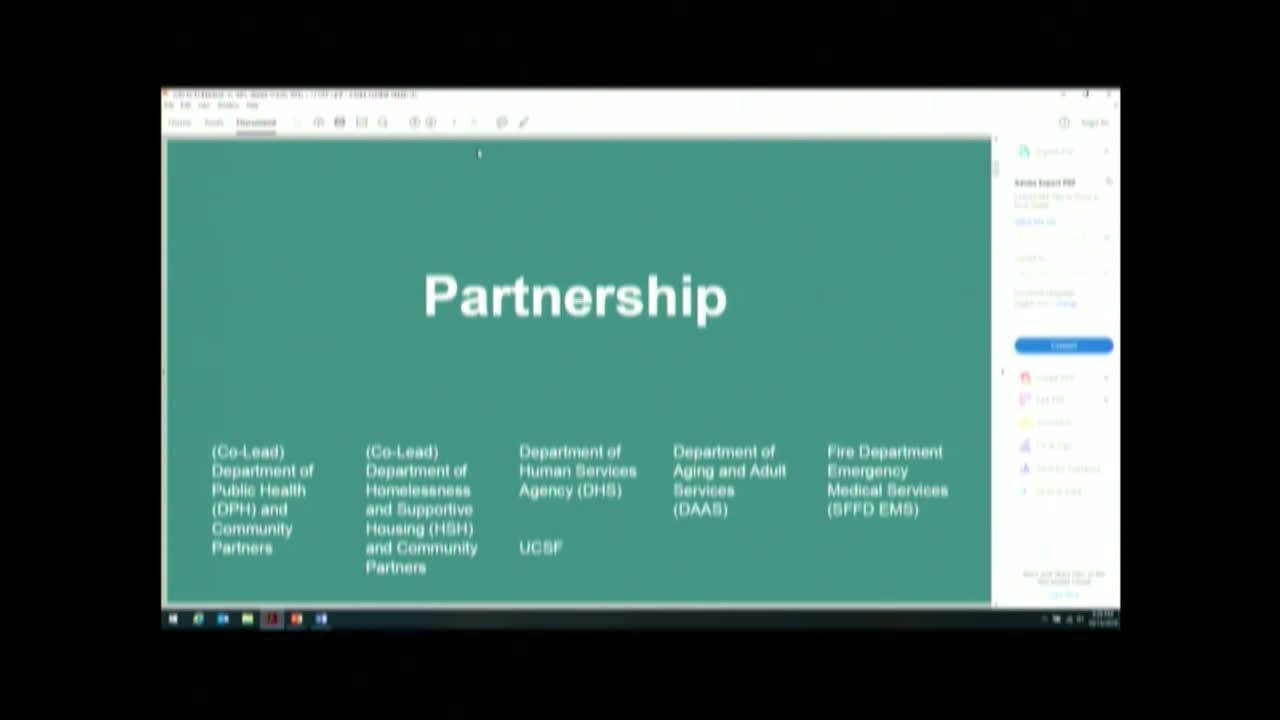
Martinez described the Medi‑Cal Whole Person Care waiver (presenters said it began in 2017 and runs through Dec. 2020) and said the state awarded about $1.5 billion for county innovation programs; she said San Francisco used integrated data (CCMS) to identify a population of roughly 4,000 people with histories of psychosis and co‑occurring substance use disorders and that a smaller prioritized cohort (referred to in the presentation as about 237 people) will receive intensive, coordinated outreach and street‑to‑home planning.
Dr. Hallie Hammer described the operational model for Whole Person Integrated Care: a new ambulatory care section that combines medical respite, sobering center, Tom Waddell Urgent Care, street medicine, shelter health and supportive‑housing nursing services. The plan calls for a single care coordinator and a "high intensity care team" (an interagency first‑response team including EMS, a street‑medicine psychiatrist and case management) to be available roughly 06:00'02:00 daily for prioritized clients. Martinez said alerts will be activated across clinical systems (EPIC, Avatar, CCMS) so providers see when a shared‑priority client presents and can contact the response team.
Presenters emphasized evaluation: UCSF and other partners will help build a dashboard to track how many of the prioritized cohort are housed or placed into safe settings, measures of avoidable ER use, and client‑level behavioral health measures (ANSA). Martinez said hundreds were engaged in workshops to define principles (transparency, equity, adaptive pathways) and that the department will evaluate the pilot and "course correct" starting in February.
Commissioners asked about the coordinated entry tool, whether medical comorbidities factor into prioritization, how to assess people who cannot complete a 20‑minute intake, targets for housing retention, and how data and staffing constraints (including funding expiry in Dec. 2020) will affect implementation. Presenters said the coordinated entry assessment is being endorsed as part of the prioritization, that medical conditions were included in the tool, and that some clients will need alternate assessment pathways and substantial case management to be housed successfully.
Next steps: the department will continue interagency case conferencing, finalize street‑to‑home plans for the prioritized cohort, launch the high‑intensity care team, and deliver a dashboard report to the commission in February for initial evaluation.