Get Full Government Meeting Transcripts, Videos, & Alerts Forever!
Get email alerts on the Hospital Services topic
No spam. Unsubscribe anytime.
San Francisco health commission finds Saint Mary's cardiovascular closure detrimental to community health
Summary
The San Francisco Department of Public Health Commission voted Aug. 6 that Saint Mary's Medical Center's planned closure of its cardiovascular surgery program would be "detrimental" to community health, citing loss of local capacity and potential impacts on Chinatown patients; hospital leaders defended program quality but cited low volume.
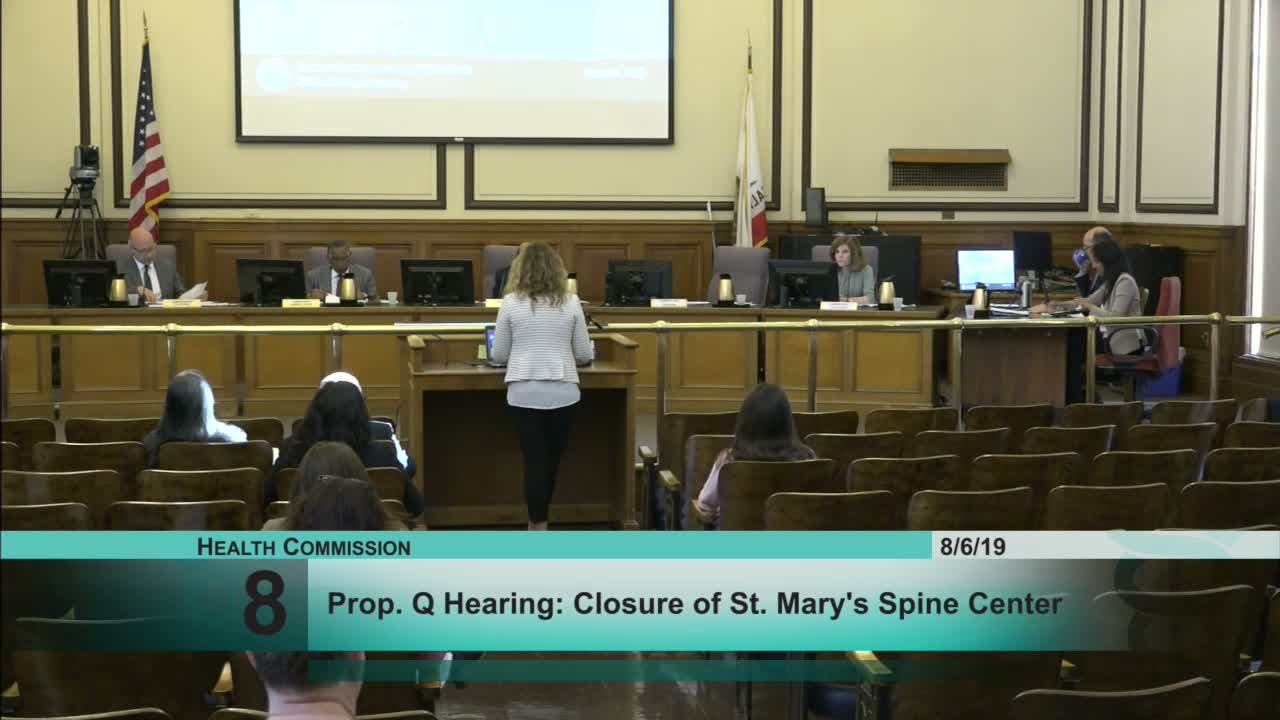
The San Francisco Department of Public Health Commission voted on Aug. 6 that Saint Mary's Medical Center's planned closure of its cardiovascular surgery program would have a detrimental impact on health services in the community.
Lindsay, a senior health planner for the department, told the commission the hospital notified the department in April of the planned closure and supplied follow-up data showing that from 2011 to 2018 roughly 58 percent of Saint Mary's cardiac surgeries were nonelective (urgent or emergent). She said the hospital's 2018 figures suggest approximately eight cardiovascular surgery cases that year would have needed medical transfer to nearby centers and that an average of 30 patients annually could no longer receive surgical services at Saint Mary's after the unit closes.
Dr. David Klein, president and CEO of Saint Mary's and Saint Francis, told the commission the program's quality data (OSHPD through 2016) showed good quality and that more recent quality work is reviewed through the hospital's cardiac quality committee. He said individual patient data cannot be shared "because of privacy concerns."
Commissioners focused questions on the relationship between surgical volume and team competency. One surgeon testifying for the hospital said low-volume programs have worse outcomes and that a well‑organized transfer system can move complicated cases to higher‑volume centers; he cited an example in which a patient was transferred to UCSF in about an hour following a complication.
When Commissioner Chow moved that the commission find the closure would be detrimental, he cited the concrete loss of one surgical service for San Francisco and said that some Chinatown patients would lose culturally familiar teams and relationships. "I would move that the motion read that it will have a detrimental impact on health services in the community," he said before the voice vote. The motion was seconded and adopted by voice vote with no recorded opposition.
The commission's formal finding does not itself order Saint Mary's to reverse the closure; it records the department's judgment under Proposition Q procedures and is intended to inform any further administrative or public review.
The commission indicated it will retain oversight and may request follow-up information. Saint Mary's representatives said they will continue to update the commission as the closure and any transfer arrangements proceed.