Get Full Government Meeting Transcripts, Videos, & Alerts Forever!
Get email alerts on the Bond Projects topic
No spam. Unsubscribe anytime.
Bond update: Zuckerberg Building 5 risks mitigated but seismic work drives schedule and cost adjustments
Summary
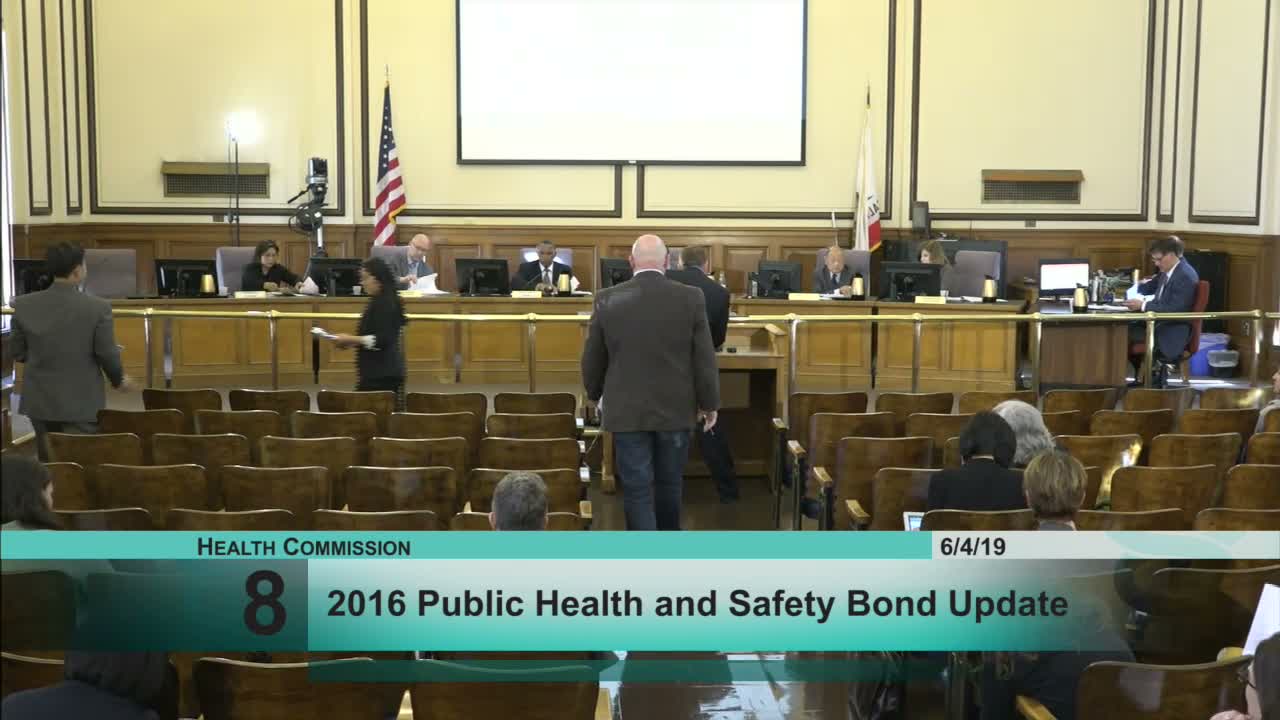
Officials updated the Health Commission on the 2016 Public Health and Safety Bond portion for DPH, describing budget balancing measures, seismic retrofit risks at Zuckerberg Building 5, and schedules for clinic projects; UCSF’s Research & Academic Building plan and outreach timeline were also presented.
DPH and project partners updated the Health Commission on June 4 about progress and risks for projects funded by the 2016 Public Health and Safety Bond and related campus initiatives at Zuckerberg San Francisco General.
Mark Primo, oversight advisor, explained the department’s approach to balancing a $2.72 portion of the 2016 bond, noting it combines nine funding elements (program contingency, grants, interest earnings, donations and other sources) to offset unanticipated increases. He said some clinic projects showed a 15–16 percent rise in forecasted expenditures, primarily because previously un‑encumbered bids (for example Maxine Hall) recently came in within budget and thus increased the encumbrance figures.
Terry Salz of Zuckerberg Capital Programs focused on seismic work risks at Building 5 and described mitigation steps taken after an early phase‑1 mock‑up. Salz said the project team built a joint DPW/DPH structural‑engineering and project management team, which helped avoid an estimated $4,000,000 pharmacy rebuild by adopting an alternate design approach that reduced that risk to roughly a $70,000 design path. Salz outlined deliverables already underway, including fiber‑wrap column work and OSHPD submissions.
Joe Chin, Public Works program manager, reviewed milestones and schedules for 19 core Building‑5 projects (15 active), noting several projects in construction or pre‑construction (6a storage at ~80% complete; rehabilitation relocation ~35% complete) and the need to align clinic construction with the EPIC electronic‑health‑record go‑live (August 3). Chin also described temporary clinic arrangements (trailers/parklet) to preserve services during construction.
Ellen Owens, UCSF project manager, presented the UCSF Research & Academic Building site plan and schedule. She said the design‑build team (Bolt; Skidmore, Owings & Merrill) is in design, construction is planned to start early 2020, site roadway and related work targeted to finish by end of 2020, and building occupancy is anticipated in summer 2022. Owens noted community outreach milestones, including Arts Commission review and forthcoming historic‑preservation review.
Commissioners asked about reforecast frequency, whether the clinical or seismic buckets pose larger exposure, and how lessons learned from phase‑1 work would apply to other elevations of the building. Staff said reforecasts occur as projects progress, they expect higher expenditure encumbrances as projects move into construction, and the phase‑1 approach provides intelligence that should reduce downstream surprises.
No formal vote was required for the update; staff will return with additional schedule and budget detail in subsequent quarterly reports.