Get Full Government Meeting Transcripts, Videos, & Alerts Forever!
Get email alerts on the Charity Care topic
No spam. Unsubscribe anytime.
DPH: Charity-care patients declined but costs and Medi‑Cal shortfalls persist, report finds
Summary
The San Francisco Department of Public Health presented a draft 2017 Charity Care Report showing a multi‑year decline in unduplicated charity‑care patients while charity‑care expenditures and Medi‑Cal shortfalls have stabilized or risen in recent years; commissioners asked for deeper demographic and utilization analysis.
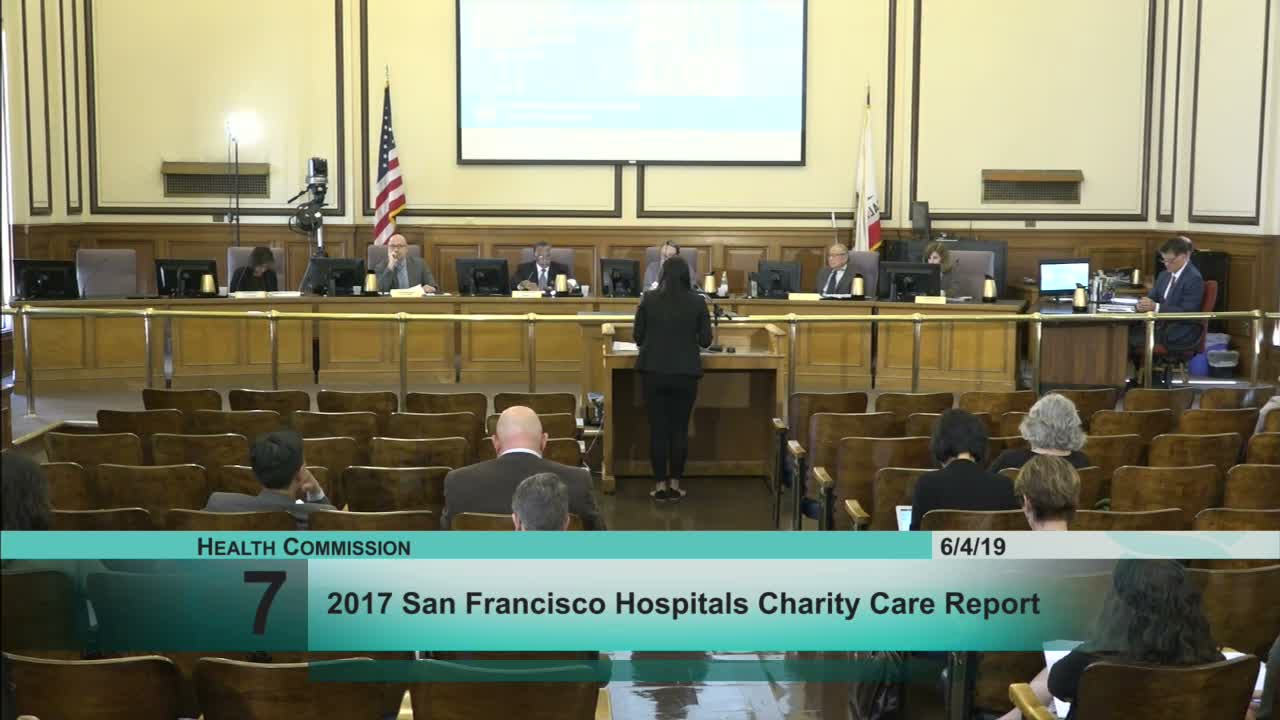
The San Francisco Department of Public Health on June 4 presented its draft 2017 Charity Care Report, which shows unduplicated charity‑care patient counts have fallen over the past five years while some cost measures have stabilized or inched upward.
Gretchen Pauley, senior health program planner, told the Health Commission that eight hospitals report charity‑care data to DPH — five by ordinance and three voluntarily — and that the city is seeing three key trends: a decline in the number of unduplicated charity‑care patients; continued importance of Healthy San Francisco as an access point for people ineligible for Affordable Care Act coverage; and the persistence of traditional charity care to serve hard‑to‑reach populations. “Overall, there has been a shift from charity care to Medi‑Cal shortfall,” Pauley said, referring to the gap between Medi‑Cal payments and hospitals’ costs.
The report identifies both service‑type shifts and local concentration of need. Pauley said emergency and outpatient volumes decreased between fiscal years 2015 and 2017 while inpatient utilization rose slightly for traditional charity‑care patients. San Francisco General (ZSFG) remains the largest provider of charity care in the city and recorded the highest ratio of charity‑care costs to net patient revenue at 9.62 percent for fiscal 2017, the report shows.
Commissioners pressed staff about who continues to rely on charity care and whether the department could provide demographic and utilization cross‑tabs. Commissioner Green asked for more detail on the 69–70 percent of traditional charity‑care patients who are San Francisco residents and about intersecting factors such as food insecurity and immigration concerns. Pauley said the current annual reporting process does not collect race and ethnicity at the granularity requested, but she offered to look into additional analyses and sample datasets from hospitals.
Several commissioners asked whether rising inpatient costs reflect sicker patients or more out‑of‑county or newly homeless patients seeking care. Pauley said hospitals report ZIP codes and district breakdowns and that many hospitals serve their local communities, but she acknowledged limitations in linking ZIP‑level residence to service type in the current dataset.
Commissioners recommended that DPH pursue targeted follow‑up work: (1) sample and, where feasible, cross‑match hospital data with DPH’s high‑utilizer lists to identify repeat users; (2) explore a small‑sample demographic probe to capture race/ethnicity and other social‑determinant markers; and (3) examine whether the increased inpatient share reflects delayed care among vulnerable groups.
The commission did not take action on the draft report; staff said they will continue to refine the analysis and present further detail at future meetings.