Get Full Government Meeting Transcripts, Videos, & Alerts Forever!
Get email alerts on the Patient Billing topic
No spam. Unsubscribe anytime.
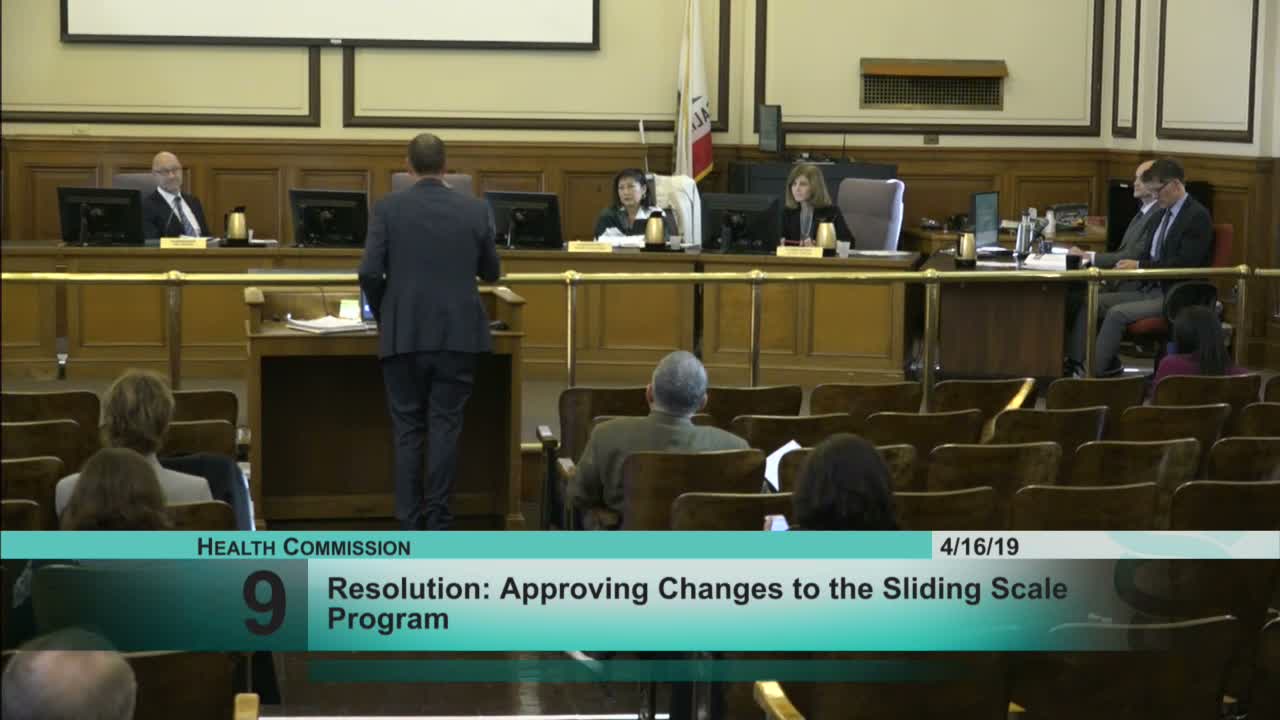
Health Commission adopts new sliding‑scale and billing rules to limit out‑of‑pocket costs at ZSFG
Summary
The San Francisco Health Commission voted to adopt a resolution revising sliding‑scale charity care, eliminating an asset test for low‑income patients and capping out‑of‑pocket costs — and directing ZSFG to limit charges for insured out‑of‑network patients to the in‑network cost‑sharing amount. The policy took effect Feb. 1, 2019 for new service dates.
The San Francisco Health Commission on a motion and second adopted a resolution revising patient billing and financial assistance policies at Zuckerberg San Francisco General Hospital to reduce balance billing risks and limit patients’ out‑of‑pocket exposure. The changes include in‑network‑parity billing for insured, out‑of‑network patients, income‑tiered caps on out‑of‑pocket payments, expansion of charity care eligibility and elimination of an asset test for the lowest income bracket.
The changes, presented by DPH Chief Financial Officer Greg Wagner, are intended to protect patients who receive care at ZSFG but whose insurance treats the hospital as out of network. "We will bill them no more than they would pay at an in network hospital under their existing plan," Wagner said, explaining the department would still pursue reimbursement from insurers while limiting what is charged to patients.
Wagner said the new rules would layer on existing protections (sliding scale, charity care and discount programs) and that the department would set out‑of‑pocket caps by income so no person pays more than a targeted share of income for a bill. He offered examples from the proposal: reduced inpatient and outpatient caps for lower income tiers, and a maximum capped daily patient liability for higher income tiers (the proposal used a graduated scale with an upper cap in the example of $4,800 for the highest category). Wagner also told commissioners the department estimated a reduction in patient revenue of about $1.9 million to $2.2 million under the changes and that DPH factored that estimate into its budget submissions.
The commission discussed operational details and how the changes would affect collections and the city’s ability to seek third‑party or legal reimbursements. Wagner said DPH will continue to pursue reimbursement from insurers and third parties when money is due to the hospital and that the city attorney and tax collector will assist on those collections. He also said the department contracted Deloitte to benchmark charge masters at peer hospitals as part of a separate study.
Commissioners questioned how the reforms might change insurer behavior and whether removing the pressure point of an unpaid patient bill could reduce leverage in negotiations with payers. Wagner acknowledged that dynamic, saying the policy represents a judgment to prioritize patient financial protection while continuing to press insurers for fair reimbursement.
The commission amended the resolution to clarify that the in‑network parity billing provision applies when ZSFG is an out‑of‑network facility and then voted to adopt the resolution. The department said the patient policy changes are effective retroactive to Feb. 1, 2019 for service dates on or after that date and will be applied to unresolved accounts that were open when the freeze on balance billing was announced.
Implementation steps include re‑adjudicating open accounts, improved patient communication (delaying preliminary statements while insurance is being resolved), publicizing a patient hotline and simplifying access to financial assistance. DPH staff said they will continue coordination with the city attorney and tax collector in cases where third‑party reimbursements become available.
The commission’s action follows earlier discussions with the mayor’s office and Board of Supervisors and tracks pending state legislation referenced in the presentation.