Get Full Government Meeting Transcripts, Videos, & Alerts Forever!
Get email alerts on the Budget topic
No spam. Unsubscribe anytime.
San Francisco Department of Public Health submits FY'2021 budget with behavioral-health investments and EPIC staffing changes
Summary
At a Health Commission hearing, DPH leaders presented a budget submission that funds new substance-abuse recovery beds, a $5 million environmental health IT replacement (budget-neutral), an Office of Equity, and a reclassification plan tied to Epic registration workflow affecting roughly 130 positions; commissioners approved sending the package to the mayor's office.
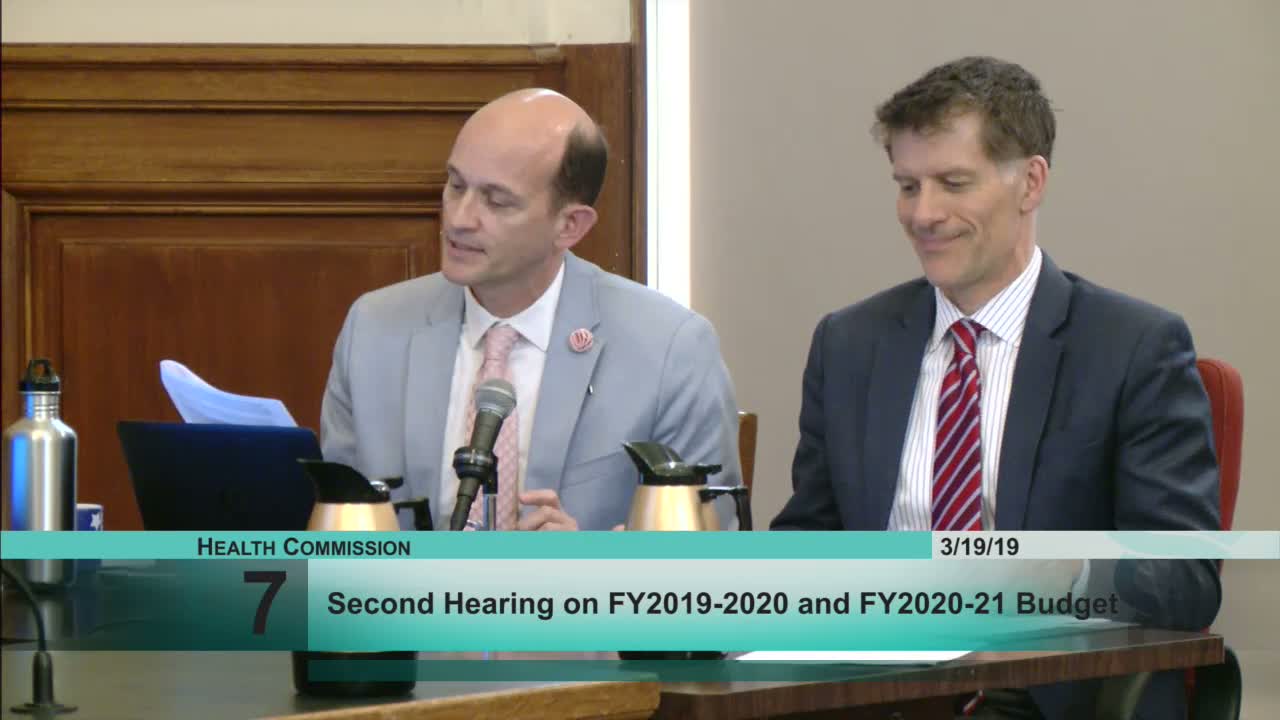
San Francisco Health Commission at its public meeting voted to submit the Department of Public Health's combined FY 2021 budget proposals to the Mayor's office, following a second hearing where department leaders outlined a series of initiatives and contingency proposals.
Grant Colfax, the department's director, framed the request as part of a broader set of investments in behavioral health and operational readiness. Chief Financial Officer Greg Wagner and budget director Jenny Louie described the items that will be forwarded to the mayor and controller for the June budget cycle.
Key funding and program items include 72 new substance-abuse residential step-down recovery beds (appropriated midyear), 14 additional beds at St. Mary's Healing Center, and a request to accept about $3,100,000 in state funds to expand outreach to people experiencing homelessness and support the city's Healthy Streets Operations Center. Wagner said these midyear dollars will serve as bridge funding while legal issues around Proposition C are resolved.
Louie described a budget-neutral initiative to replace an outdated environmental-health database with a modern permit-tracking system. "We expect $5,000,000 cost over the life of the implementation of it," she said, and noted funds would come from the refuse lien program permitted under the city's Administrative Code.
The department also proposed creating an Office of Equity that will report to the director and be led by Dr. Ayanna Bennett; Colfax said the office will "codify specific tools and policies related to equity" and coordinate equity work across divisions.
A prominent operational change is a combined scheduling-and-registration workflow tied to the Epic electronic health record rollout. Louie and HR director Ron White said the conversion affects roughly 130 positions and involves consolidating many classifications into a single eligibility-worker classification (29-03). Louie said she estimated an average cost of about $14,000 per position including fringe benefits as part of the conversion, and that the department will complete an HR process with labor to finalize job classifications and training.
Wagner emphasized the budget's dependence on effective Epic implementation. He said even small improvements in revenue-cycle productivity could materially affect DPH finances: "One percent increase in productivity in terms of revenue is dollars 5 to $6,000,000," he said, citing capitation and fee-for-service impacts if enrollment and clearance improve.
The department also proposed modest contingency savings (salary-savings placeholders totaling roughly $6,005,000). Wagner and Louie described those numbers as placeholders to be refined with the Mayor's office and cautioned that implementation details would be returned to the commission if the city needed to operationalize any contingency reductions.
After commissioners asked for additional detail on timing, staffing impacts and revenue assumptions, the commission moved and approved submitting the combined initiatives to the Mayor's office and the Controller.
Next steps: DPH will provide follow-up reports on Epic-related reclassifications and implementation milestones, and staff will work with the Mayor's office as the city's proposed budget is developed.