Get Full Government Meeting Transcripts, Videos, & Alerts Forever!
Get email alerts on the Hospital Billing topic
No spam. Unsubscribe anytime.
San Francisco public hospital pauses balance billing, launches 90‑day review and proposes out‑of‑pocket caps
Summary
Zuckerberg San Francisco General announced a temporary halt to sending balance‑billing statements and a 90‑day policy review to recommend out‑of‑pocket caps, expanded income‑based financial assistance and improved patient communication. Hospital officials said the changes aim to protect patients while preserving hospital revenue needed for trauma care.
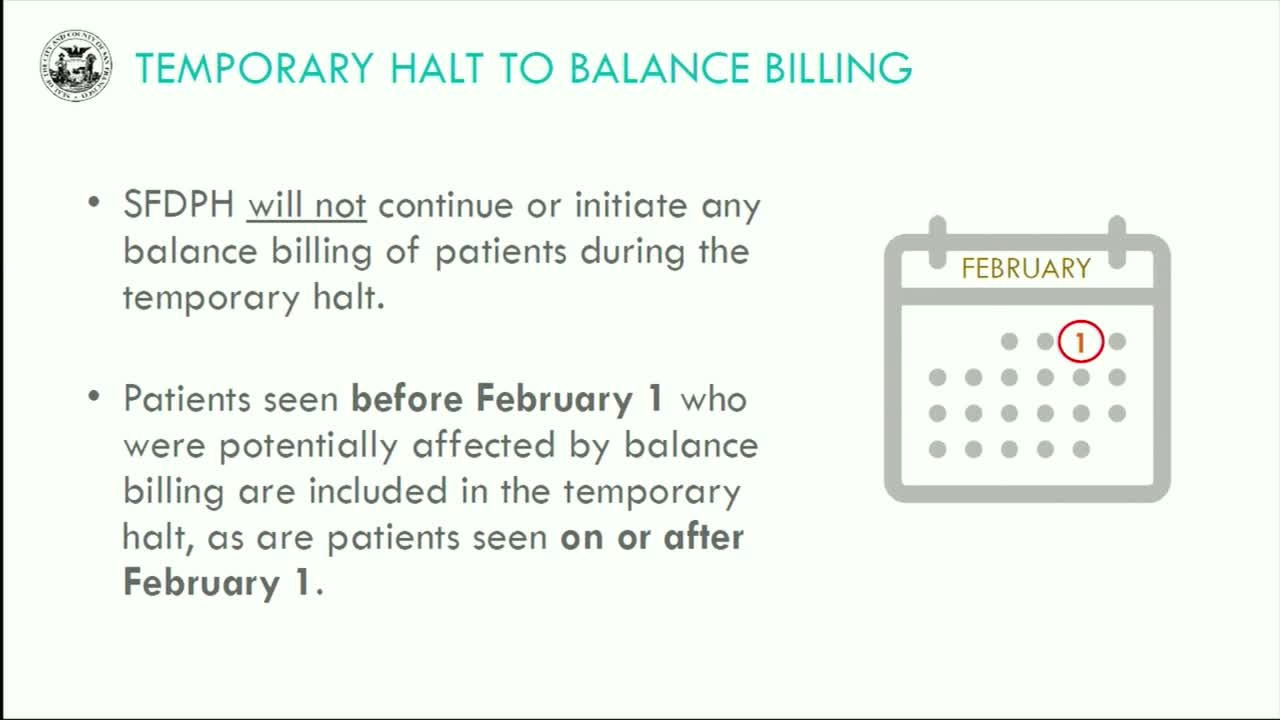
Zuckerberg San Francisco General announced on the Health Commission floor that it has temporarily halted the practice of sending balance‑billing statements to patients while it completes a 90‑day review of billing and financial assistance policies.
Greg Wagner, chief financial officer for the Department of Public Health, told commissioners the pause — announced Feb. 1 in coordination with the mayor's office and the Board of Supervisors — is intended to stop issuing statements while staff review patient accounts and develop policy changes. "We are temporary halting the practice of balance billing, and we're taking a 90 day window to review our policies and practices and come to the health commission with recommendations," Wagner said.
Wagner outlined three principal policy directions under study: expand and streamline existing financial assistance programs (including Healthy San Francisco, charity care and sliding‑scale discounts); develop an income‑based financial assistance scale and out‑of‑pocket caps for patients above current thresholds; and improve patient communication so that eligibility and account status are assessed and explained proactively. He said the hospital will also examine its charge-setting practices and continue outreach to insurance plans and state partners.
Wagner provided data to illustrate the scope of the problem for individuals: in FY2017‑18 the hospital had about 104,000 patient accounts; roughly 4,000 were associated with PPO plans, and of those about 1,700 accounts may be subject to balance billing. He estimated "up to about 17,100 patients" may be affected by balance billing when broader account history is considered, while acknowledging that number is an upper estimate requiring account‑by‑account review.
Commissioners pressed on how trauma care and emergency transfers would be treated. Wagner said an out‑of‑pocket cap would protect patients who cannot choose their hospital during life‑saving care and that the department is exploring potential legislative changes and contractual agreements with insurers to address the unique role of a public level‑1 trauma center. "We want to protect patient financial well‑being while still making sure that we are collecting what we believe that we are due from commercial insurance," he said.
Wagner said hospital staff will finalize recommendations with the city attorney and treasurer and return to the commission and the Board of Supervisors. He also said the department is collecting comparative data from other California public health systems through the California Association of Public Hospitals and Health Systems.
Next steps: the department will present preliminary recommendations to the Board of Supervisors this week and expects to return to the Health Commission with a detailed plan at the end of the 90‑day review. The commission did not take a formal vote on a policy change at the meeting; Wagner described the department's actions as administrative implementation and staff follow‑up.