Get Full Government Meeting Transcripts, Videos, & Alerts Forever!
Get email alerts on the Public Comments Students topic
No spam. Unsubscribe anytime.
UCSF pharmacy students urge better implementation of sharps/mail-back, opioid safety and card standardization
Summary
Several UCSF pharmacy students gave public comments asking DPH to prioritize implementation and outreach for a sharps mail-back bill ("SB 2 12"), promote opioid-safety measures for pediatric populations, standardize health-care cards for pharmacy processing, and include pharmacists in overdose-prevention legislation.
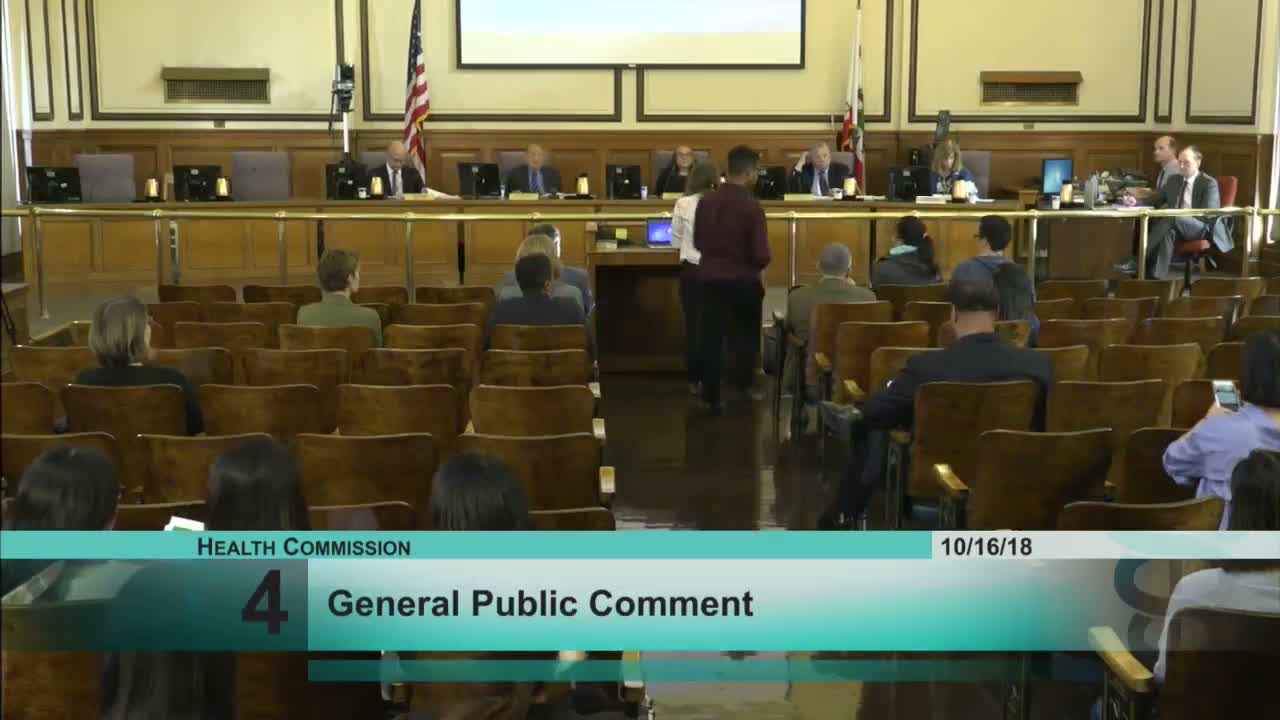
A group of third-year pharmacy students from UCSF addressed the Health Commission during the public-comment period on Oct. 2 with several related policy requests.
Rachel Gordon urged stronger public education about the recently passed sharps and medical-waste law (referred to in her remarks as "SB 2 12") and recommended that the Department of Public Health advertise mail-back options, publish a clear phone and website contact for bag requests, and ensure that elderly and homebound residents have access to return options for insulin and liquid medications. "This is critical for the elderly population who may not be able to go to a pharmacy for the take-back program," Gordon said.
Henry Huang highlighted pediatric opioid safety, citing a Journal of Pediatrics report that pediatric opioid-related hospital admissions nearly doubled in the period cited in his remarks. He and his peers advocated limiting opioid prescribing when not medically necessary, strengthening parent/child education on diversion risks and expanding drug take-back use to reduce household exposure.
Melissa Kawakawa asked the commission to pursue clearer standardization of health insurance and prescription cards so pharmacies can reliably process claims, noting the Health and Safety Code 136303 requires a uniform card but does not mandate BIN/PCN/group codes that many pharmacies need to process prescriptions. She suggested an amendment to the code to require additional processing information on cards.
Ashnal Krishna and Nikki Orguam urged support for workforce incentives and overdose-prevention legislation: Krishna endorsed "SB1241" to provide tax credits to attract specialists to free clinics; Orguam urged inclusion of pharmacists and other providers in AB 186 (controlled-substance overdose-prevention programs) to strengthen clinical data and program design.
Staff told the students their comments would be passed to policy teams and advocacy/lobbying partners in Sacramento and Washington, and commissioners thanked the students for their engagement.