Get Full Government Meeting Transcripts, Videos, & Alerts Forever!
Get email alerts on the Cpmc Propq topic
No spam. Unsubscribe anytime.
Health Commission defers decisions on CPMC Prop Q items after community warnings about lost beds and oversight
Summary
After public testimony that transfers of services from CPMC to the Sutter Pacific Medical Foundation could reduce public oversight and cut local capacity, the Health Commission deferred Prop Q resolutions — including changes tied to an Alzheimer's day program, the closure of a 24‑bed residential unit and outpatient transfers affecting 7,500 patients — to allow staff to return with more data.
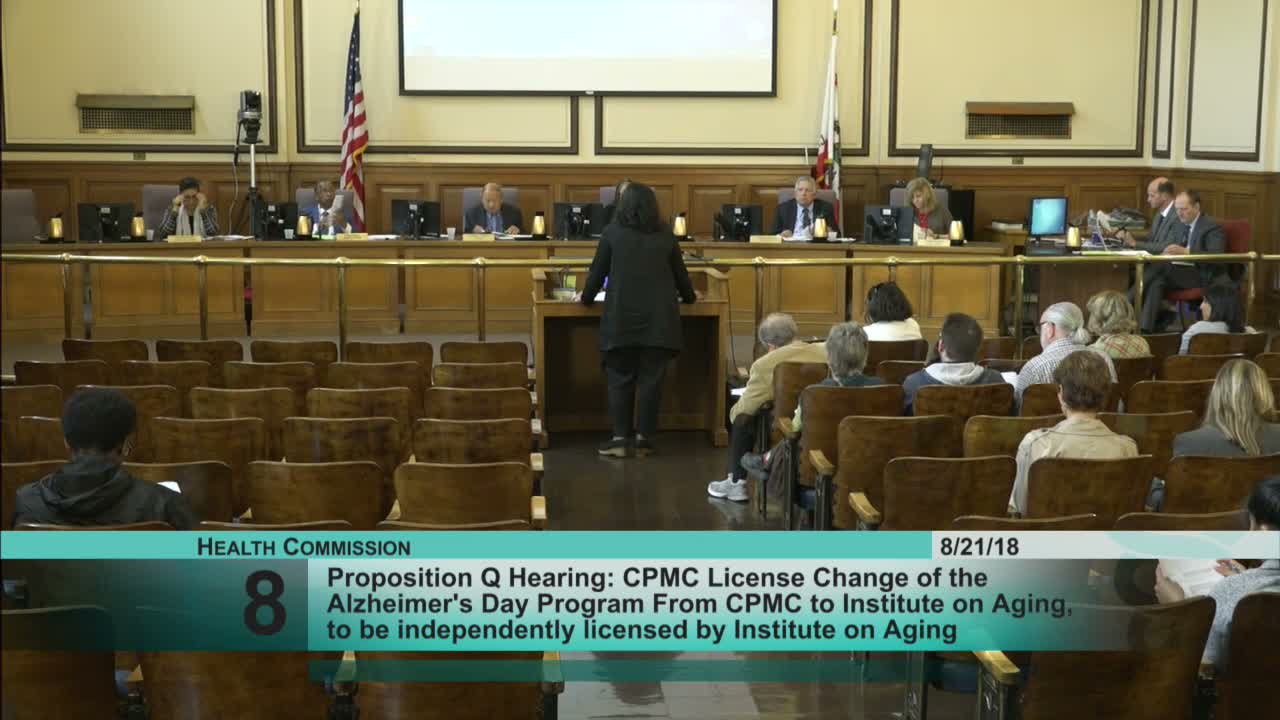
The San Francisco Health Commission held a lengthy Prop Q hearing on multiple items related to California Pacific Medical Center (CPMC) proposed changes and management transfers.
Staff described three linked items: a licensure change to transfer an Alzheimer’s Adult Day Program from CPMC to the Institute on Aging (IOA); the closure of a 24‑bed Alzheimer’s residential care facility (Swindells) that staff said would produce a net loss of roughly 10 residential care beds citywide; and the management transfer of five outpatient departments (including breast health/mammography, noninvasive cardiology, diabetes centers and an outpatient psychiatry clinic) from CPMC to Sutter Pacific Medical Foundation (SPMF).
Sneha Patel of the Office of Policy and Planning reminded commissioners the item was introduced July 17; she said IOA is still seeking donors and a site to continue adult day services and that CPMC's California campus is slated to cease acute care in March 2019.
Public commenters, including Mark Aronson, Ken Barnes, Matthew Fennell of the California Nurses Association and Kim Cavallone of the National Union of Healthcare Workers, urged the commission to find the proposed actions "detrimental". Speakers argued the changes would withdraw needed services from neighborhoods, reduce access for non‑English speakers or Medi‑Cal patients and limit public oversight when services move from an acute‑care hospital to a private foundation.
CPMC and SPMF representatives responded that SPMF has accepted initial transfers and that, to date, operations at the transferred programs have been "business as usual." Karen Rizvi Jaffrey, an SPMF operations executive, said the Breast Health Center and Cardiac Echo Lab moved on Aug. 5 and the St. Luke's diabetes program on Aug. 19 with no immediate contracting issues. Staff also provided a payer‑mix estimate for the roughly 7,500 affected patients: about 17% Medi‑Cal, 48% commercial, and 35% Medicare/self‑pay/other.
Commissioners debated two related questions: whether to find the transfers detrimental immediately (in part because moving services to a foundation would remove them from Proposition Q public oversight) and whether to defer voting to allow time for data on contracting, Medi‑Cal continuity and patient flows. Commissioner Chung moved to adopt resolutions declaring the transfers detrimental with amendments about lost Prop Q oversight; others pressed for more evidence. Ultimately the commission voted to defer the Prop Q resolution(s) concerning the CPMC transfers for four months to gather specific data, including where the 7,500 patients will be served after transfer and whether contracts will preserve Medi‑Cal access.
Next steps: The commission will reconvene the Prop Q hearing in approximately four months and requested staff provide targeted information on contracting outcomes, Medi‑Cal acceptance and patient continuity.