Get Full Government Meeting Transcripts, Videos, & Alerts Forever!
Get email alerts on the Hcao Revisions topic
No spam. Unsubscribe anytime.
Health Commission approves updated minimum standards under Healthcare Accountability Ordinance
Summary
The San Francisco Health Commission on a voice vote approved staff-recommended updates to the Healthcare Accountability Ordinance minimum standards for 20192020, including aligning out-of-pocket limits to the state benchmark, lowering prescription deductibles, and deeming gold/platinum cost-sharing automatically compliant; public commenters warned $45 primary-care copays still pose barriers for low-wage workers.
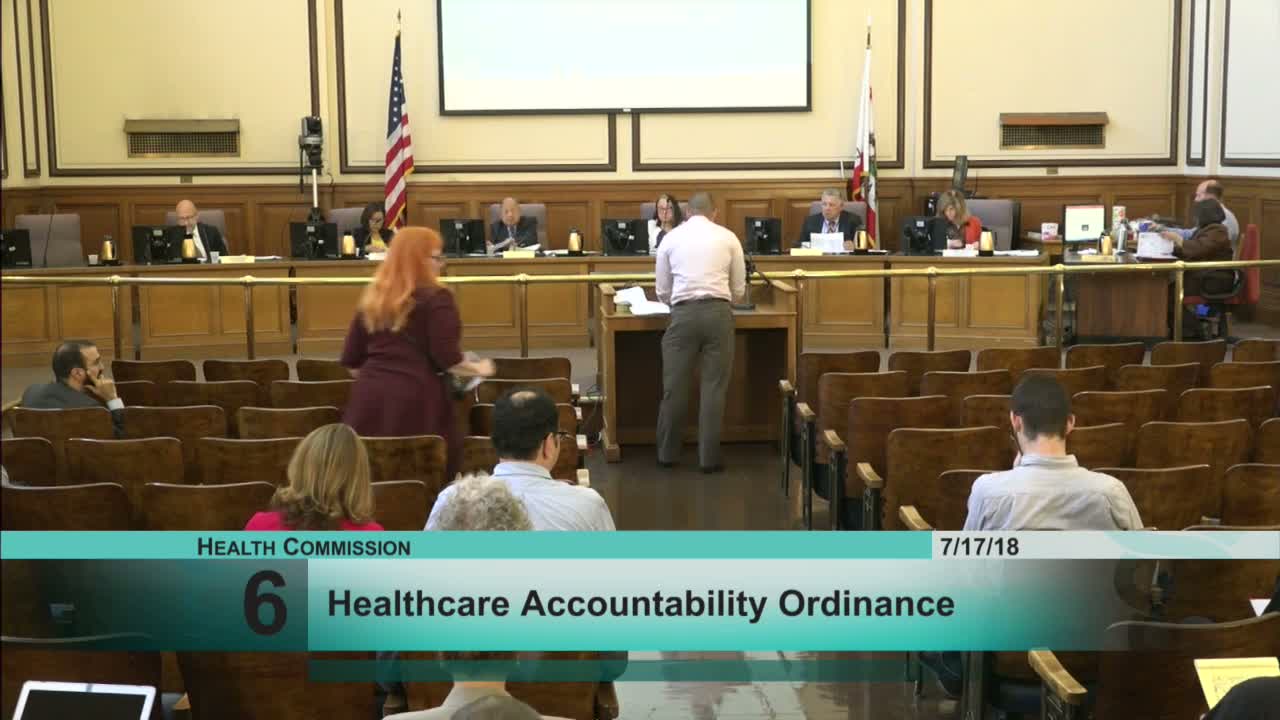
The San Francisco Health Commission voted to adopt a package of recommended revisions to the citys Healthcare Accountability Ordinance (HCAO) minimum standards for 20192020 after receiving a presentation from Patrick Chang of the Office of Policy and Planning and hearing public testimony from labor and nonprofit representatives.
The revisions approved by the commission maintain the requirement that employers pay the full premium for employee coverage, align the individual out-of-pocket maximum with the California patient-centered benchmark (keeping the allowable HCAO limit below the federal ACA cap), lower the allowable prescription deductible to $200, and reduce allowable coinsurance from 30% to 20%. The work group also recommended that gold and platinum plans be considered automatically compliant on cost-sharing criteria to simplify employer compliance and encourage offering higher-tier plans.
Supporters on the work group and Department of Public Health staff said the package increases the number of plans available to employers and balances affordability with coverage. Chang said the recommended set is intended to preserve the laws purpose of increasing access while giving employers workable options.
Public testimony at the meeting emphasized concerns about remaining cost barriers. Representatives of the National Union of Healthcare Workers and other advocates urged the commission to address a $45 primary-care copay they said deters low-wage workers from using care. A San Francisco geriatrician and nonprofit leaders said higher copays and rising housing and operating costs make it harder for contracted nonprofits to offer generous plans without additional city funding.
Commissioners discussed dependent coverage (which is outside the minimum standardsscope), the laws enforcement through the Office of Labor Standards and the Department of Public Health, and the mechanics of how employers that do not offer plans can pay fees to support uninsured workers. The commission noted that some employers choose to pay the fee because of workforce fluidity (seasonal and part-time workers) and that the HCAO has reduced the number of workers left uninsured since its adoption.
The commission adopted the staff resolution (Resolution No. 18.2) approving the standards as recommended. Director Garcia and staff said they will provide implementing guidance and additional materials for employers and that the commission will receive further reports in coming months.