Get Full Government Meeting Transcripts, Videos, & Alerts Forever!
Get email alerts on the Hunters Point Retesting topic
No spam. Unsubscribe anytime.
Health commission backs Hunters Point rescans and outlines expanded opioid treatment funding
Summary
The San Francisco Department of Public Health said it will support the Navy and California Department of Public Health in rescanning and retesting portions of Hunters Point Shipyard after community concerns about past testing, and announced $6 million in funding to expand buprenorphine access alongside harm-reduction measures for fentanyl exposure.
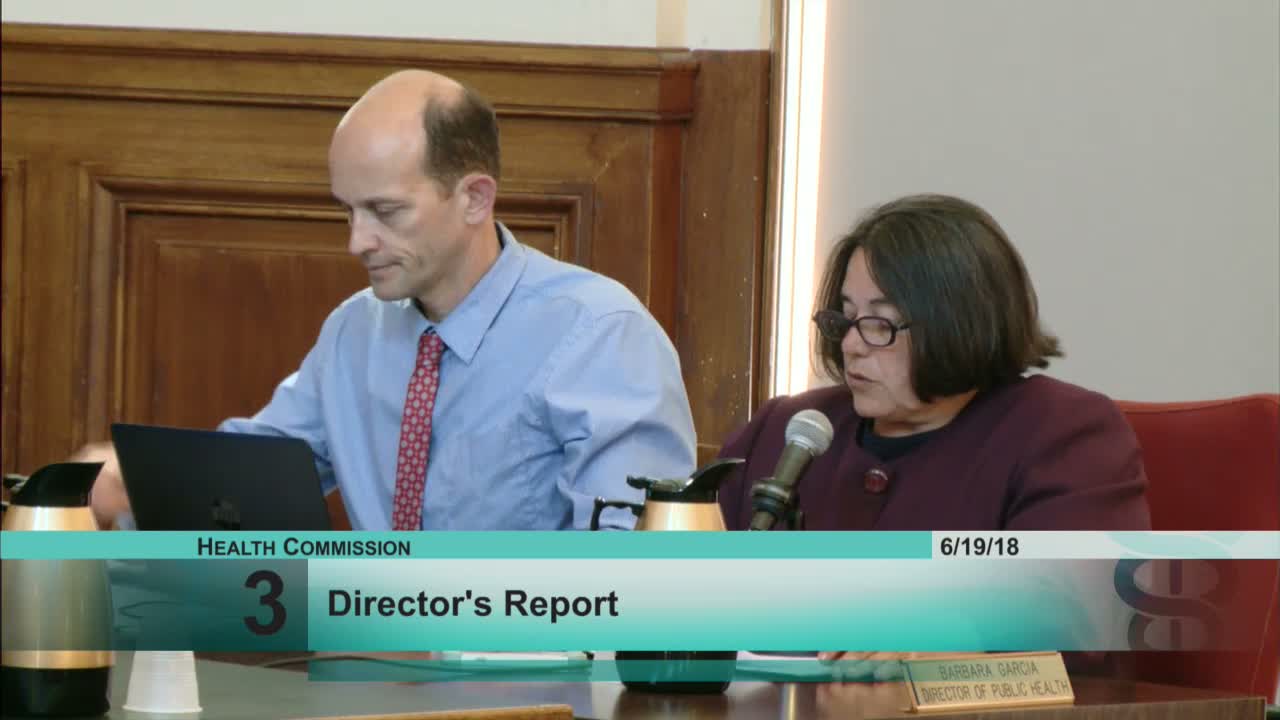
Director Garcia told the Health Commission that the Department of Public Health will support rescanning Parcel A and radiological retesting of a portion of Parcel G at the Hunters Point Shipyard to address community health and safety concerns raised after fraudulent testing by a Navy subcontractor, Tetra Tech. The department encouraged public participation in the Navy's comment period on the Parcel G work plan and said the California Department of Public Health will conduct the Parcel A rescan while the Navy conducts the Parcel G radiological retesting.
The director said the department has reviewed Hunters Point work for more than two decades and will coordinate monthly with the Environmental Protection Agency and the Navy. She named engineer Amy Burnell, Environmental Health Director Stephanie Cushing, and Health Officer Thomas Aragon as staff who will support the effort.
On opioid-related harms, Director Garcia described a near-fatal overdose in San Francisco after a person consumed a counterfeit oxycodone pill stamped "M30" and was treated at Zuckerberg San Francisco General on June 11. She said no pill remained for testing but warned that counterfeit pills and fentanyl contamination have been widely reported and detected by syringe access programs using fentanyl test strips.
To reduce overdose risk, the department is expanding harm-reduction work, including outreach through syringe access programs, a street medicine team, naloxone distribution (via prescription or pharmacy provision), and clinician referrals to treatment. The director said the department would fund $6,000,000 (described as $3,000,000 per year) to expand access to buprenorphine and make treatment more widely available through methadone programs and the triage center at 1380 Howard Street.
The department urged physicians and hospitals to be aware of fentanyl contamination and to refer patients with opioid use disorder to available treatment; it also urged residents to carry naloxone if they or others use illicit drugs.
Ending: The department said it will publish opportunities for public comment and report back to the commission as the Navy and state retesting plans proceed.