Get Full Government Meeting Transcripts, Videos, & Alerts Forever!
Get email alerts on the Emergency Preparedness topic
No spam. Unsubscribe anytime.
Department outlines emergency-preparedness upgrades after recent incidents
Summary
Public Health officials described efforts to improve call-down procedures, radio resilience, multilingual community communications and a 20% medical-surge exercise requirement; staff said lessons from recent wildfires and power outages drove WEA and mask distribution changes.
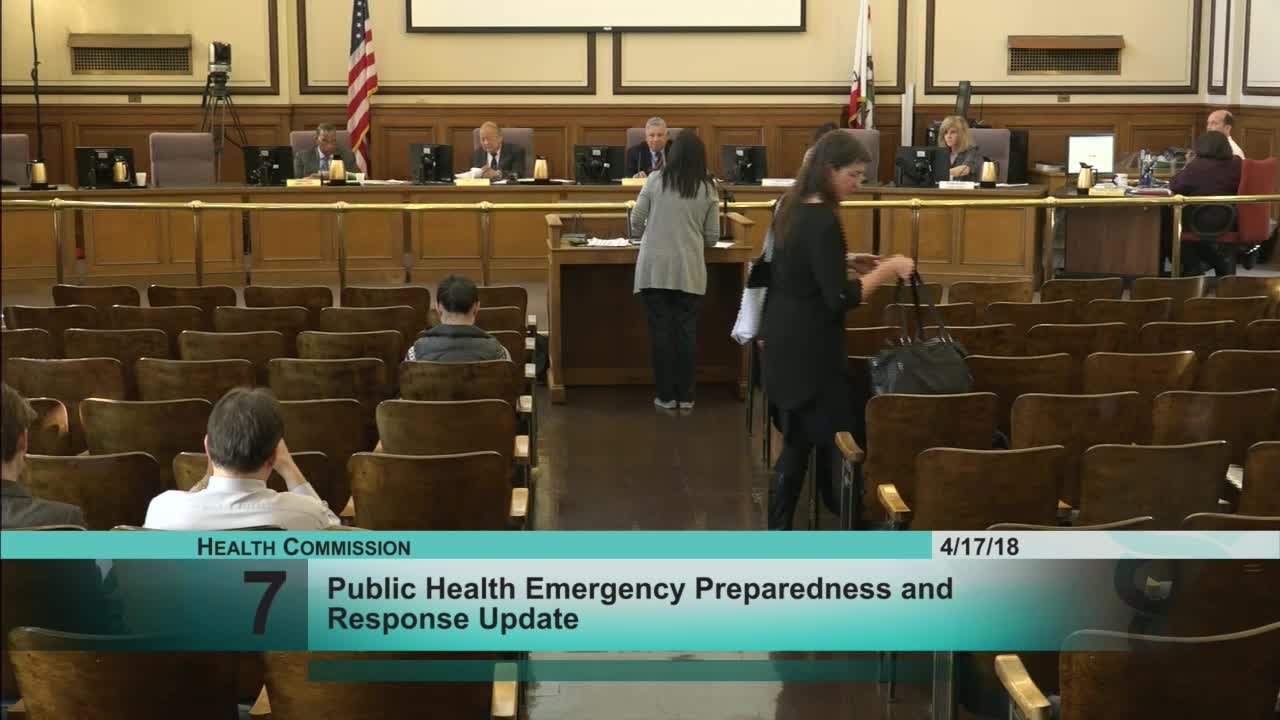
Navina Baba, of the Department of Public Health's Public Health Emergency Preparedness and Response Branch, briefed the Health Commission on preparedness activities and recent responses including power outages, the North Bay fires and a hepatitis A effort.
Baba said the branch, consolidated in 2010, uses an incident command structure and follows national capabilities for public-health and health-care preparedness. She described operational metrics for call-downs (staff acknowledgement and reporting goals), radio system monthly checks and an equipment transition from 800 MHz to 700 MHz. The branch has trained more than 700 staff in disaster roles and conducts regular exercises.
On community communications, Baba said the department maintains a roster of community partners that reach vulnerable groups and has revised heat-wave communications after recent experience. She described distributing N95 masks and providing guidance and training on their use during wildfire smoke episodes.
Baba also outlined changes in healthcare preparedness: federal guidance now emphasizes system-wide readiness rather than hospital-only planning. San Francisco will test its ability to handle a 20 percent surge in acute-care beds as part of a national exercise, she said, and has begun outreach to more than 126 agencies for a healthcare coalition.
Commissioners asked about lessons from the North Bay fires, Wireless Emergency Alerts (WEA) use and volunteer credentialing. Baba said the city is using WEA more aggressively and continues to use the state's disaster healthcare volunteer (DHV) system to credential volunteer clinicians when needed.
The commission thanked staff and requested follow-up reporting on the national medical-surge exercise and other preparedness metrics.