Get Full Government Meeting Transcripts, Videos, & Alerts Forever!
Get email alerts on the Proposition Q topic
No spam. Unsubscribe anytime.
Health commission hears emotional testimony as CPMC announces closure of St. Luke’s skilled nursing and subacute unit
Summary
At an August Prop Q hearing, the San Francisco Health Commission heard Department of Public Health analysis that CPMC’s planned closure of St. Luke’s would remove 79 skilled nursing beds — including the city’s only hospital-based subacute unit — and received dozens of family testimonies urging the commission to seek in‑county alternatives and delay the closure pending PAC findings.
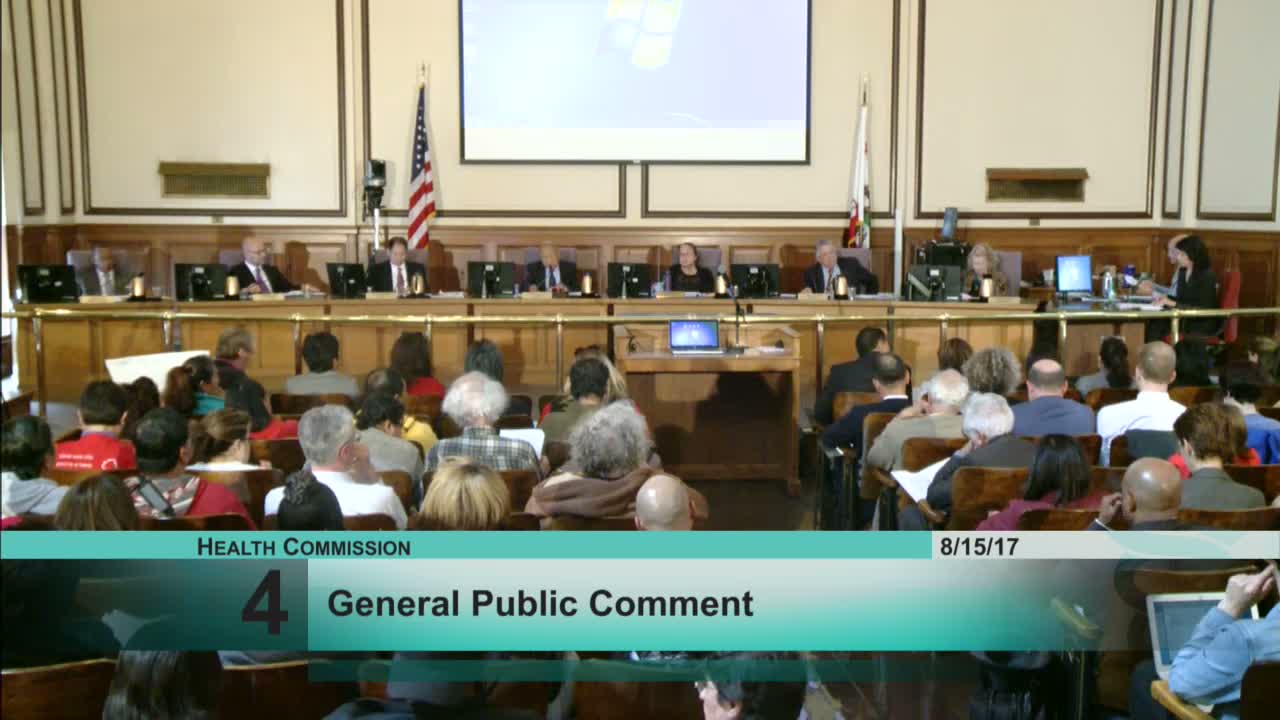
The San Francisco Health Commission heard more than three hours of testimony on a Proposition Q notice from California Pacific Medical Center (CPMC) announcing plans to close the skilled nursing facility (SNF) and subacute unit at St. Luke’s Hospital.
Sneha Patel, a senior health planner with the Department of Public Health, told commissioners the closure notification — received June 6, 2017 — would reduce the city’s licensed skilled nursing supply by 79 beds (39 general SNF beds and 40 subacute beds) and would eliminate the only hospital‑based subacute unit in San Francisco. “The closure of St. Luke’s skilled nursing and subacute unit will have a detrimental impact on the healthcare services in the community,” Patel said, summarizing the department’s recommendation that the commission consider those impacts in its Prop Q determination.
CPMC CEO Dr. Warren Browner said the hospital is following federal, state and local regulatory processes and that the October 31 date cited in the notice is a conservative target required by regulators. He described individualized assessment and relocation efforts for patients and said Davies campus will continue operating 38 SNF beds. “We will continue to provide each patient with the same high level of care that they receive now until they are accepted into a new facility,” Browner said, adding that translators and care teams have been used in the notification process.
Family members, nurses and advocates urged the commission to find the closure detrimental and to press for in‑county alternatives. Raquel Rivera, family council coordinator for St. Luke’s subacute unit, testified that the unit is “her sister’s home” and said moving patients to San Jose, Sacramento or Los Angeles would be “cruel and inhumane.” Physicians and the ombudsman program warned that subacute patients — many ventilator dependent or with tracheotomies — need hospital‑based care and that transfers out of county raise safety, access and continuity‑of‑care concerns.
The Hospital Council’s Post Acute Care Collaborative (PAC) and the council’s regional vice president, David Serrano Sewell, described PAC’s work to identify implementable, financially sustainable options for high‑risk populations and pledged a full report and recommendations later this year. PAC leaders emphasized land‑use and permitting changes, public‑private partnerships and other policy tools to increase freestanding SNF capacity.
Commissioners pressed presenters on the data and timeline: they asked how bed‑need projections were calculated (DPH cited demographic growth to 2030 as the basis for some scenarios), whether beds could be leased or temporarily held, and how families were notified. CPMC and PAC representatives said subacute beds are scarce regionally and that placement can require individualized planning; CPMC representatives acknowledged communication problems and apologized for distress caused to families.
The commission did not take a final Prop Q vote at this meeting. Commissioners asked staff to incorporate the public testimony and PAC findings into draft resolution language and indicated a resolution will be on the agenda at the next commission meeting (Sept. 5) for consideration. The chair and commissioners also requested CPMC and PAC meet with families and produce more detailed placement plans before commissioners vote.
The hearing record includes a large volume of public comment, written submissions and technical memoranda from DPH and CPMC; the commission directed staff to continue coordinating with community members, the hospital and the PAC as it prepares a Prop Q recommendation to the city.