Get Full Government Meeting Transcripts, Videos, & Alerts Forever!
Get email alerts on the Ehr topic
No spam. Unsubscribe anytime.
Department details EHR procurement, phased go-live and contingency funds
Summary
DPH staff presented a consolidated EHR RFP and implementation plan, described a six-month shift from a UCSF path, outlined three phased go-lives (Wave 1: Envision billing sites and two hospitals; Wave 3: behavioral health in 2020), cited vendor letters of intent and estimated costs with a contingency fund of about $70 million.
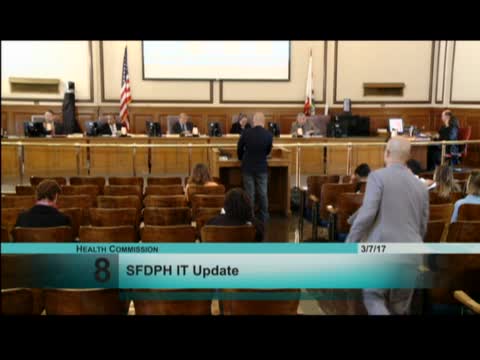
Bill Kim, the department's chief information officer, and Albert Yu, chief health information officer, presented an update on the Department of Public Health's electronic health record (EHR) effort, the procurement timetable and the project's critical path.
Kim said the EHR RFP and contracting effort has been consolidated into one track and noted the timeline has shifted partly because the department is moving from a UCSF sole-source approach to an RFP-based procurement. He said the department expects contracting to be complete by the end of 2017 and will build EHR phases in parallel; phase 1 will go live about six months before phase 2.
Albert Yu described three implementation waves: Wave 1 will include Envision billing sites, primary care clinics and Laguna Honda and is an intensive go-live covering hospitals and ambulatory care; Wave 2 will include non-Envision sites and population-health clinics; Wave 3 will incorporate behavioral health because vendor solutions currently offer limited behavioral-health clinical documentation and state-level billing compatibility. Yu said behavioral health is planned for July 2020 under the current schedule.
On costs, staff said the department's estimates remain provisional until contracts are finalized but noted a contingency bucket of about $70,000,000 to manage unanticipated risks. Regarding meaningful-use incentive and penalty timing, staff said the six-month delay against the UCSF timeline should have minimal impact on incentive dollars but projected roughly $1,000,000 in potential fines unless federal reporting rules change.
During Q&A commissioners pressed on contract-specific milestones, vendor roles (a question about PCG clarified that PCG performs security and privacy work), the number of vendor responses (staff said roughly five expected vendors replied and letters of intent were received), and how the department will present critical-path milestones at future meetings. Commissioners requested a tighter, single critical-path timeline and more focused financial reporting at the next update.
Two of five facility-maintenance contracts were approved on the consent calendar (about $2,000,000); three contracts were deferred for further review.