Get Full Government Meeting Transcripts, Videos, & Alerts Forever!
Get email alerts on the Legislative Platform topic
No spam. Unsubscribe anytime.
DPH lays out 2017 state and federal legislative platform as budget uncertainty looms
Summary
DPH staff presented the department—s 2017 state and federal legislative platform and reviewed the governor—s January budget, noting the budget holds health spending steady, assumes no ACA changes and that potential federal action (repeal/reconciliation) could affect Medi-Cal funding and the city—s federal support.
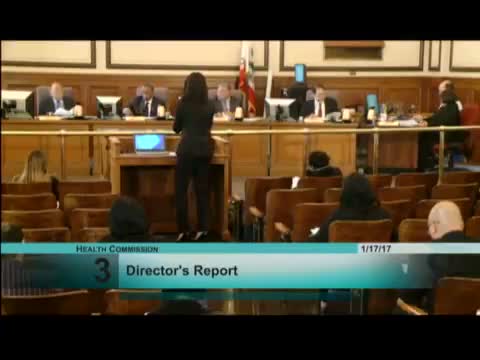
The San Francisco Department of Public Health presented a draft 2017 state and federal legislative platform and a summary of recent state and federal policy activity, and asked the Health Commission for feedback before the department returns a resolution for a February vote.
Cindy Commerford, manager in the Office of Policy and Planning, said the platform aggregates priorities from across the health network and aligns DPH positions with city goals. She outlined the department—s role in advancing positions (position letters, testimony, technical support and lobbyist coordination when needed) and summarized tracking of hundreds of bills in the last two years.
Colleen Chawla, speaking earlier in the director—s report, described the governor—s January budget as a $179.5 billion statewide proposal that projects a $1.6 billion shortfall while generally holding health and human services funding level and preserving coverage expansions such as Medi-Cal benefits for undocumented children.
Commissioners and staff discussed the potential effects of pending federal actions on Medi-Cal. "Because it's an entitlement, the... federal government doesn't set rates," Chawla said, describing federal matching mechanics and the higher federal share for the ACA expansion population (90 percent federal, 10 percent state). Staff warned that proposals under consideration at the federal level (including block grants or changes to matching rates) could reduce overall federal funding to states and that the department will monitor those risks.
Nikki Sandberg described the platform—s development process and highlighted cross-cutting priorities DPH plans to track in 2017, including behavioral health integration, opioid abuse prevention and treatment, affordable housing, cannabis regulation, automated speed enforcement, and implementation of Proposition 63 No Place Like Home funding for supportive housing.
Commissioners suggested additions and clarifications, including telehealth/telecare reimbursement and rules, NIH funding concerns for research and analytics, and the explicit inclusion of improved reimbursement advocacy for Medi-Cal providers. Staff said those items could be incorporated and that the commission will have an opportunity to review the final resolution before it is forwarded to the mayor—s office.