Get Full Government Meeting Transcripts, Videos, & Alerts Forever!
Get email alerts on the Vision Zero topic
No spam. Unsubscribe anytime.
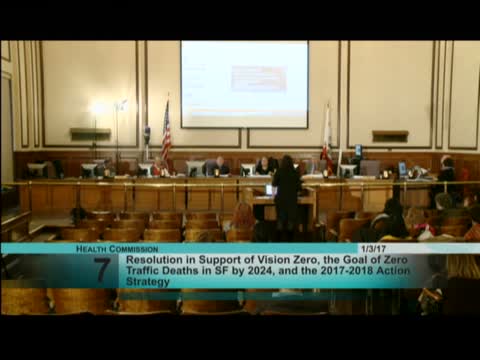
Health Commission hears Vision Zero update; resolution deferred pending strategic plan
Summary
San Francisco’s Health Commission received a data-driven update on Vision Zero, including fatality trends, a high-injury network focus, and plans for expanded automated speed enforcement and community engagement; the resolution tied to the plan was deferred until the full strategic plan is presented on 2017-02-07.
San Francisco’s Health Commission heard a detailed Vision Zero update from Megan Weir, co-chair of the city’s Vision Zero task force, who outlined recent fatality trends, the program’s data tools and a two‑year action strategy focused on speed, engineering and equity.
Weir said San Francisco’s fatality data (through November 2016) show roughly 30 traffic deaths a year in recent years and that pedestrians account for over half of fatalities. She described the city’s “high‑injury network,” 12 percent of streets that account for about 70 percent of severe and fatal collisions, and presented a hospital medical‑cost analysis tied to transportation injuries that leadership estimated at about $35 million annually.
The presentation emphasized speed as a critical predictor of death and injury. Weir described a year‑long targeted enforcement campaign launched in October, in which SFPD conducts weekly, three‑hour operations on high‑injury corridors, paired with outreach and engineering projects. She said automated speed enforcement is a priority and that the city has secured a legislative sponsor; a formal announcement was expected at the end of the month.
Commissioners asked for concrete priorities. In response, Weir said automated speed enforcement and comprehensive street redesigns to slow traffic (for example lane reductions and targeted engineering in SoMa) are the measures she would press for first because they are likely to have the biggest near‑term impact on fatalities. She also agreed to provide the commission with the full list and map of the 12 targeted streets and supporting data.
Several commissioners raised equity and accessibility concerns, asking how Vision Zero will protect seniors and people with disabilities. Commissioner Sanchez said bus stop removals and red‑zone configurations on corridors such as Mission Street can impose hardship on older and mobility‑impaired residents. Staff said they have conducted community outreach (more than 100 senior‑center responses to date), will bring senior concerns back to MTA planning, and are adding a “safe streets for seniors” focus to the action strategy.
Because the strategic plan is still being finalized, the commission deferred the formal resolution tied to the Vision Zero update until the full plan is presented; staff indicated the resolution is now planned for Feb. 7, 2017. The commission requested additional documentation — the list of 12 targeted streets, enforcement schedules, and the final strategy materials — at the next presentation.