Get Full Government Meeting Transcripts, Videos, & Alerts Forever!
Get email alerts on the Collective Impact topic
No spam. Unsubscribe anytime.
San Francisco health officer urges collective-impact approach to population health
Summary
Health Officer Tomas Aragon outlined a strategy—LEAD Initiative—that pairs collective impact with lean continuous improvement, trauma-informed systems and cultural humility to address complex population-health challenges and highlighted Getting to 0 and Vision Zero as examples.
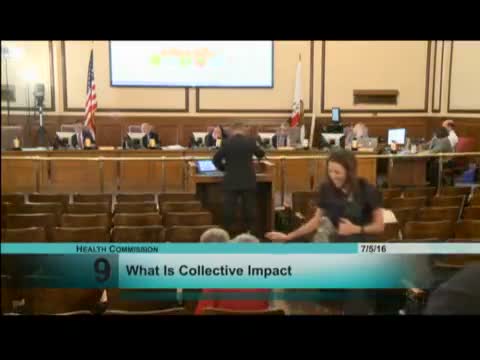
Dr. Tomas Aragon, San Francisco's health officer, presented a conceptual overview of "collective impact" and how the framework fits into the department'wide LEAD Initiative. He said collective impact reframes cross-sector work to tackle complex or "wicked" social problems by combining a common agenda, shared measurement, mutually reinforcing activities, continuous communication and backbone support.
Why it matters: Aragon said San Francisco has adapted collective impact to local priorities and emphasized backbone support (data analytics, project management, coordination funding) as essential. He presented Getting to 0 (HIV) and Vision Zero (traffic fatalities) as exemplars where population-level indicators and program-level performance measures are aligned. He reported a 44 percent reduction in new HIV infections between 2012 and 2015 (from 453 to 255 new infections cited in the slides).
Operational approach and limitations: Aragon mapped collective impact onto public-health tools (health impact assessments, community-based participatory research and continuous improvement) and listed principles of practice including equity, shared data and community co-creation. He acknowledged critics who point to gaps and limitations and said the approach is a long-term "marathon" that requires patient, funded backbone support.
Follow-up: Commissioners asked about funding sources and how the department will scale backbone capacity; Director Garcia said investments are being planned in the public health division with a five-year funding horizon and that several initiatives have backbone-funded segments.