Get Full Government Meeting Transcripts, Videos, & Alerts Forever!
Get email alerts on the Budget topic
No spam. Unsubscribe anytime.
Health Department CFO details FY 2016–17 budget priorities; warns of waiver‑driven revenue risk
Summary
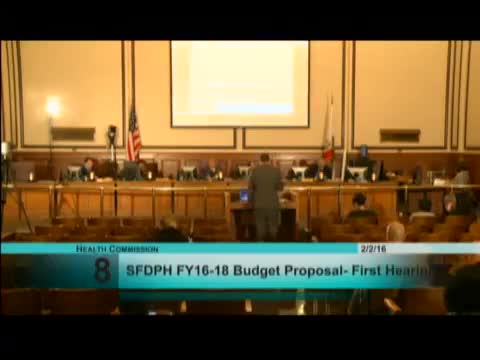
Greg Wagner, the department CFO, presented the first budget hearing for FY 2016–17, outlining growth in expenditures, expected revenue offsets, and strategies to meet Mayor's general‑fund reduction targets. Staff projected a net $14M reduction in year one from Medi‑Cal changes and proposed using prior‑year reserves and salary adjustment savings to close gaps.
Greg Wagner, Chief Financial Officer for the San Francisco Department of Public Health, opened the commission’s first budget hearing for the FY 2016–17 planning cycle and described the department’s base budget, revenue structure and strategies to meet city deficit targets.
Wagner said the department’s base budget is growing modestly and remains dominated by personnel costs, with San Francisco General Hospital and the Public Health Division as the largest spending centers. He reviewed revenue‑generation and general‑fund subsidy patterns and noted that departments were instructed to reduce general‑fund support by 1.5% in the first year and another 1.5% in the second year under the Mayor’s budget instructions.
On waiver‑driven risk, Wagner summarized staff estimates that changes in the Medi‑Cal waiver create an anticipated net reduction to the department’s revenue of roughly $14,000,000 in fiscal year 2016–17 (growing to larger amounts in later years) after accounting for non‑federal share adjustments and other offsets. He explained the technical underpinnings (DSH reductions, non‑federal share financing, and assumptions about the department’s ability to meet PRIME metrics) and said staff are modeling conservative drawdown assumptions (for example, projecting 90% attainment on PRIME and 75% on Global Payment in initial estimates).
To meet targets, Wagner proposed tapping prior‑year revenue reserves for one‑time smoothing, realizing $7.5M in salary/fringe timing adjustments, and pursuing other revenue assumptions including Laguna Honda and mental‑health revenue lines. He emphasized that reserves are intended as a one‑time cushion, not a permanent revenue source, and pledged to present follow‑up materials and additional hearings as the budget process proceeds.
Commissioners asked detailed budget and risk questions; staff said they will return with more line‑item detail at the next hearing and keep the commission informed as the mayor’s and board’s processes continue.