Get Full Government Meeting Transcripts, Videos, & Alerts Forever!
Get email alerts on the Network Strategy topic
No spam. Unsubscribe anytime.
San Francisco Health Network outlines True North strategy; pharmacy integration highlights cost and safety gains
Summary
Network director Roland Pickens presented a strategic "True North" vision and a managed-care roadmap aimed at increasing the Health Network panel toward 90,000 for financial sustainability. Pharmacy chief Dave Woods described integrated operations, roughly $7 million in patient-assistance savings last year, and drug-price and 340B challenges.
Roland Pickens, director of the San Francisco Health Network, presented a strategic update on Jan. 19 that framed a multi-year plan to make the network more integrated and financially sustainable. Using Lean methodology, staff have developed mission and "True North" metrics to align divisions, a managed-care roadmap to expand beyond Medi-Cal managed care and a marketing plan to attract additional patients and payers.
Pickens said the network currently manages roughly 62,000 patients in its managed-care footprint and that consultants recommended growing to about 90,000 panel patients to improve financial sustainability. That increase would rely in part on converting some commercially insured residents and using small tests of change (including Covered California contracting) before pursuing broader commercial contracts.
The presentation highlighted several infrastructure priorities tied to that strategy: an enterprise EHR (discussed separately at the meeting), a cost-accounting system for rate setting, centralized network operations and a marketing/branding effort to enroll and retain members.
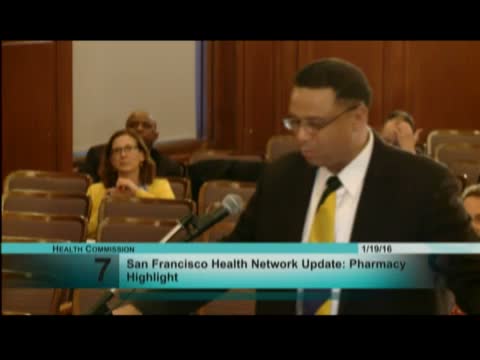
Dave Woods, chief pharmacy officer, gave a demonstration of pharmacy integration across DPH. Pharmacy manages an annual pharmaceutical budget of more than $50 million and reported savings of roughly $7 million last year through manufacturer patient-assistance programs. Woods described standardized formularies, new residency programs and IT improvements, and said SFGH outpatient pharmacy reduced patient wait times from more than two hours to less than 30 minutes through Lean workshops.
Woods also flagged challenges: national prescription drug price inflation and an HRSA-proposed change to 340B eligibility that could reduce program savings and increase costs. He said pharmacy is projecting a conservative inflation scenario and is preparing to respond to federal guidance.
Commissioners asked about marketing language, equity and enrollment strategy; Pickens and staff said the network intends to prioritize historically underserved populations while testing expansion into commercially insured groups, starting with Covered California contracts. Commissioners requested follow-up briefings on internal and external marketing, risk profiling for new panels and the operational requirements for commercial contracts.
Pickens and Woods said the EHR initiative will be a core enabler for many of these efforts: better data sharing and integrated systems are expected to improve care coordination, medication safety and revenue cycle performance.