Get Full Government Meeting Transcripts, Videos, & Alerts Forever!
Get email alerts on the HIV And STD Initiatives topic
No spam. Unsubscribe anytime.
Health Commission hears Getting to 0 and STD updates; CDC and private grants expand PrEP and retention work
Summary
Officials reported progress toward Getting to 0, described a new $1.9 million-per-year CDC grant for PrEP scale-up and a $500,000 grant for retention navigators, and outlined rising STD rates and plans for faster syphilis case contact and community behavioral work.
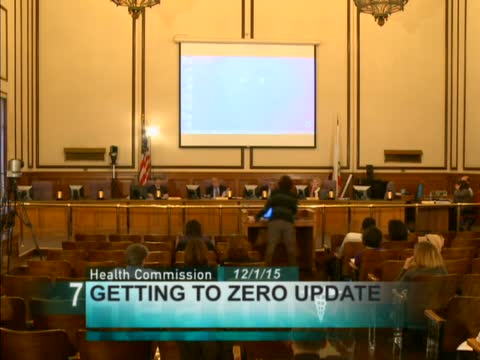
At a meeting on World AIDS Day, the San Francisco Department of Public Health updated the Health Commission on its Getting to 0 initiative and on an STD prevention strategy that officials said will pair biomedical prevention with renewed behavioral and screening efforts.
Susan Buckbinder, director of Bridge HIV and a member of the Getting to 0 steering committee, presented data showing new HIV diagnoses at their lowest recorded level in 2014 and said the city is featured as a North American Fast-Track city. Buckbinder said San Francisco has a small share of people living with HIV who are unaware of their infection (about 7 percent in the city-level cascade) and that the department is focusing on rapid linkage and retention in care.
"We did get a $1,900,000 a year grant for three years from CDC... to scale up PrEP and outreach, particularly with emphasis on people of color and transgender individuals," Buckbinder said, adding that PrEP navigators are in place at three DPH clinics and that new tracking systems will report early results soon. (Susan Buckbinder, Bridge HIV)
Buckbinder also highlighted that non-HIV causes of death among people living with HIV ' notably drug overdoses and suicides ' are rising and that the department is analyzing those trends.
Susan Phillip, director of disease prevention and control and STD controller, said STD rates for gonorrhea, chlamydia and syphilis are increasing among men who have sex with men even as HIV diagnoses decline. She described internal performance improvements: contacting newly reported infectious syphilis cases within three days is now routine, and the department is shifting focus to contacting cases within one day. Phillip said the current 1-day contact rate is about 78 percent and the department's target is 85 percent.
"We're focusing now on how many can be contacted within one day... We're up to 78 percent, and we're going to try to do better than that by the end of the next calendar year and try to get that up to 85 percent," Phillip said. (Susan Phillip, STD Controller)
Phillip said the department plans to contract a behavioral-health consultant to design campaigns and community engagement to support condom promotion and other STD prevention efforts. She described the Bahi project (city clinic network efforts) to raise chlamydia screening for women ages 15'25: the department expects baseline clinic data in the coming weeks and a pilot phase lasting roughly four to six months to document best practices.
Dr. Ayanna Bennett, interim medical director for CHIPE and SPI programs and founder of the Third Street Youth Center and Clinic, described pilot strategies including home-based screening and clinic-based drop-off options and said youth clinics will act as incubators for practices to spread across larger clinics.
Commissioners asked about persistent disparities affecting young African American women and about access to after-hours testing; staff said congenital syphilis has not occurred in San Francisco since February 2014 and that narrowing disparities remains a priority. The commission asked for follow-up at the committee level and requested another update in about six months.
The presentations referenced two grant awards by name: a CDC grant for PrEP scale-up and a private grant of $500,000 per year for retention navigators (Mac AIDS fund), both of which staff said will support navigators, outreach and tracking work. No formal vote accompanied these reports; commissioners asked staff to return with further detail and progress reports.