Get Full Government Meeting Transcripts, Videos, & Alerts Forever!
Get email alerts on the Ambulatory Care Preparedness topic
No spam. Unsubscribe anytime.
Ambulatory care describes clinic drills, staff training and systems to keep patients connected during disasters
Summary
Leslie Dubin said ambulatory care has trained clinic staff in three modules, run site drills and is inventorying behavioral‑health and CBO sites to ensure continuity of care for dialysis, methadone and high‑utilizer patients during disasters.
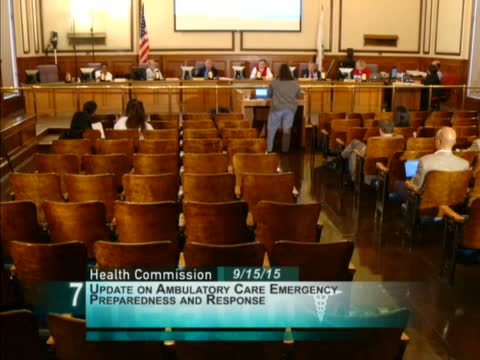
Leslie Dubin, chief program integration officer for Ambulatory Care, presented the network pproach to disaster readiness for 14 primary‑care clinics and affiliated services. She said ambulatory care has delivered a three‑module training package (phases of disaster/ICS roles; clinical stabilization; crisis standards and ethical allocation) and has moved from didactic teaching to hands‑on tabletop and full‑site moulage drills.
Dubin reported that all 14 primary‑care clinics have received the three‑module trainings and that about 600 ambulatory staff have completed all three modules. To maintain continuity of care during a localized or citywide event, clinics will triage and proactively outreach to their highest‑acuity patients (for example, dialysis patients who receive care at SFGH Ward 17, and patients receiving office‑based opioid treatment), and will use the operations center at 1380 Howard to coordinate intake, resource deployment and escalation to the DPHDOC.
Ebola response and lessons learned: Dubin said the ambulatory response to Ebola in 2014 demonstrated the value of standardized screening, coordinated trainings with occupational health, site drills and protocol standardization across clinics.
Systems and redundancy: Dubin described a new facility status reporting tool to track physical capability and operational readiness at each clinic, and noted ambulatory care maintains a server outside the city (in Sacramento) to preserve operational data if local communications fail: "We actually have a server that is actually not here in the city. It's in Sacramento, so it's kind of separated from services here in the city in case there was a citywide event that would knock out, for instance, telephone and pager systems." The network is inventorying behavioral‑health and community‑based organization (CBO) sites and developing metrics to measure preparedness and surge capacity.
What the commission asked: commissioners praised the integrated approach and pressed for measurable goals and ongoing evaluation; Dubin said outside evaluators will be used for real‑time feedback at drills and that targeted behavioral‑health/CBO training will begin the next calendar year.
Next steps: ambulatory care plans to complete hands‑on drills, implement competency metrics and continue an inventory of dispersed behavioral‑health and CBO access points. The department will report back on training coverage and drill evaluations.