Get Full Government Meeting Transcripts, Videos, & Alerts Forever!
Get email alerts on the Emergency Preparedness topic
No spam. Unsubscribe anytime.
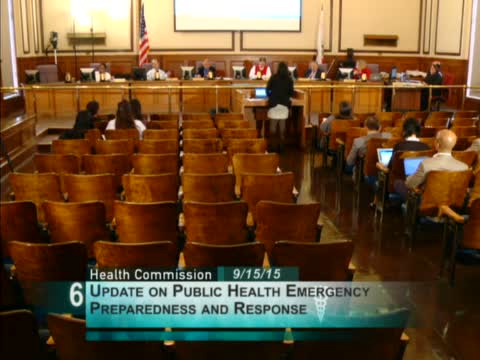
San Francisco public health officials outline citywide emergency preparedness, training and neighborhood resilience
Summary
Navina Baba, director of the Public Health Emergency Preparedness & Response Branch, told commissioners the department is centralizing training tracking, expanding exercises and partnering with hospitals and neighborhoods to prepare for threats from El Niño rains to infectious outbreaks and mass evacuations.
Navina Baba, director of the Department of Public Health—mergency Preparedness & Response Branch, told the commission that San Francisco is ramping up citywide preparedness across three lines: department operations coordination, health‑system partnerships and community resilience. "We will be hiring a trainer into our branch," Baba said, describing a newly approved position to strengthen workforce training and follow‑up.
Baba opened with examples of recent and looming hazards—rom drought shifting into El Nino rains to wildfires and infectious threatsto illustrate how disasters create health consequences requiring a coordinated public‑health response. She said the department relies on two federal funding and capability frameworksthe CDC—unded Public Health Emergency Preparedness program and the HHS Hospital Preparedness Programand that those streams guide training and exercises.
Why it matters: commissioners pressed for details about capacity and how the city would absorb a large funding shortfall at the state level. Director Garcia and staff warned of a possible $1,000,000,000 shortfall tied to a managed‑care tax dispute and Commissioners asked staff to track potential local impacts. Baba said preparedness work is also tied to reimbursement rules: "training is tied to FEMA reimbursement," and documenting exercises and credentials helps secure future recovery funds.
What the department will do: Baba described several near‑term and programmatic steps. The department is moving toward a centralized training tracker (population health has a database started in 2014 and DPH is moving to an eMERGE training system), will pursue a funded trainer post, and plans ongoing exercises including full‑scale and tabletop drills. She said the department ran a regional full‑scale exercise in November focused on mass prophylaxis and has used exercises (including Ebola activations) to build response capacity.
Hospitals and the broader health system: Baba emphasized the Healthcare Coalition on Preparedness that convenes hospitals and other partners monthly and runs joint exercises (UCSF, Kaiser, VA and San Francisco General were cited). She said preparedness is not just hospital‑centric: long‑term care, dialysis centers, pharmacies and community clinics are integral partners so hospitals are not overwhelmed in a surge.
Community preparedness and resilience: the department is working with the mayor nd the city's "100 Resilient Cities" effort to support neighborhood planning for heat, flooding and other climate‑linked hazards. Baba noted neighborhood outreach, mapping tools and a climate indicator map that breaks risk measures down by neighborhood. She highlighted psychological first‑aid trainings delivered to residential care staff and neighborhood emergency teams (more than 200 trained).
Commissioner questions focused on maintaining readiness and interagency communications. Baba pointed to the Incident Command System as a common language across agencies and described Bay Area coordination with state and federal partners (FEMA, CDC, HHS and law enforcement in certain incidents). She said Super Bowl event planning will be used to test detection and communications protocols.
Next steps: staff will provide follow‑up metrics on training uptake and on navigation‑center service dashboards; commissioners asked for tracking of the managed‑care tax risks and further briefings on neighborhood resilience work.
The commission did not take a new policy vote on preparedness at this meeting; Baba's presentation closes with an agreement to return with more data and performance metrics.