Get Full Government Meeting Transcripts, Videos, & Alerts Forever!
Get email alerts on the Charity Care topic
No spam. Unsubscribe anytime.
San Francisco DPH report: charity care patient counts fall after ACA; commissioners ask staff to redesign reporting
Summary
DPH presented a combined FY2013–14 Charity Care Report showing a drop in overall charity care patients and expenditures after ACA enrollment; commissioners and hospital representatives agreed to continue reporting this year while DPH returns in about three months with a plan to streamline reporting and emphasize community benefit and equity.
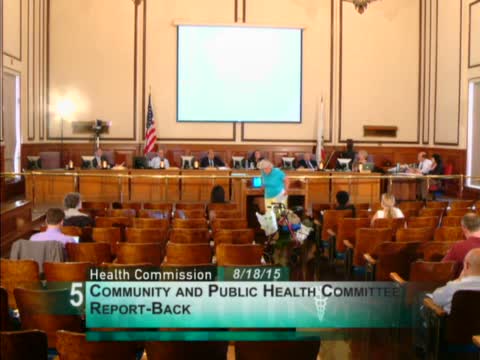
Colleen Chawla and Mavis Acedu Frimpong presented the Department of Public Health(DPH) report on the FY2013— charity care data, saying the ordinance that established reporting in 2001 remains an important transparency tool.
The report showed a marked shift from traditional charity care to Healthy San Francisco enrollment: Healthy San Francisco patient counts fell from about 61,000 to about 51,000, a decline of roughly 10,000, and total charity care patients declined from about 110,000 to about 97,000 between the two years analyzed. Across the eight hospitals that submit data, charity care expenditures declined by about $21 million while the Medi-Cal shortfall rose by roughly $63 million during the same period, the presenters said.
"The ACA likely did have a significant effect on the charity care landscape in San Francisco," Mavis Acedu Frimpong said, noting that many uninsured residents migrated into Medi-Cal and Covered California in 2014. She added that reporting-period differences among hospitals and other hospital-specific factors produced variation that complicates simple comparisons.
Hospital community-benefit directors agreed that the ordinance produced valuable historical data but asked the commission to consider aligning local reporting with state and federal filings to reduce duplicate burdens and produce more actionable data. "Wewould like DPH to work with hospitals to come up with recommendations to amend the ordinance to make it more useful," Emily Webb, Director of Community Health Programs at CPMC, said during public comment.
Commissioners pressed staff to define which data elements are essential for policy-making, to normalize disparate reporting periods, and to focus on equity and outcomes in areas that consistently contribute the largest shares of charity-care patients. Several commissioners recommended keeping the current reporting cycle for one more year so the data record remains continuous while the department develops a revised framework.
Acting Director Chawla agreed to return with a plan in about three months laying out what data the department would recommend collecting, how it would be used for policy, and how the department would engage hospitals and community partners to implement changes. The commission did not vote to change the ordinance during the meeting; staff described the next steps as a planning and stakeholder engagement process.
Whatto watch: DPHwill return to the commission with a concrete timeline and a proposed set of core data elements for the charity care report, and stakeholders asked for a staff-facilitated convening to explore alignment with OSHPD and federal Schedule H reporting.