Get Full Government Meeting Transcripts, Videos, & Alerts Forever!
Get email alerts on the Vision Zero topic
No spam. Unsubscribe anytime.
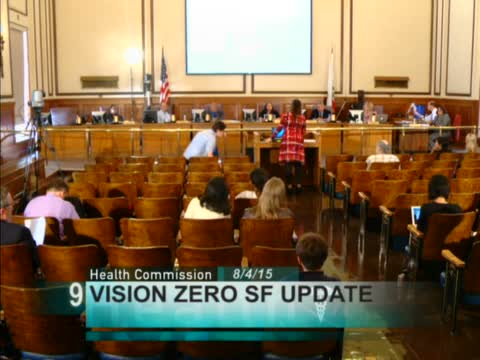
San Francisco health officials report Vision 0 progress, target high-injury corridors and school zones
Summary
The San Francisco Health Commission received an update on Vision 0: city staff reported about 30 traffic fatalities and up to 200 severe injuries annually, identified a high-injury network covering 12% of streets, and said Safe Routes to School will expand to 10 more elementary schools.
Megan Weir, co-chair of the Vision 0 Task Force and director of the Program on Health Equity and Sustainability, told the Health Commission on July 28 that San Francisco records roughly 30 traffic fatalities and up to 200 severe injuries a year, and that pedestrians and cyclists account for about 70 percent of fatalities.
"No more deaths are acceptable," Weir said, describing Vision 0's goal of eliminating traffic deaths. She and colleague Anna Vlitzig described a "high injury network"—about 12 percent of street miles where more than 70 percent of severe and fatal collisions are concentrated—and explained that targeting that network will allow the city to prioritize engineering, enforcement and education measures efficiently.
The presenters said the San Francisco Municipal Transportation Agency committed to a "24 projects in 24 months" goal; as of June 16 projects were already in the ground. The department highlighted expanding Safe Routes to School (adding 10 elementary schools, covering roughly half of district elementary schools) and a new mayor-funded Safe Streets for Seniors program aimed at the disproportionate number of senior pedestrian fatalities.
Commissioners asked for data beyond fatalities. Commissioner Singer requested severe-injury statistics be included alongside fatalities; Vlitzig and Weir said the department's epidemiologist will present hospital-linked severe-injury analysis in September and described ongoing work linking San Francisco General Hospital data with police reports to capture previously unreported injuries.
Weir framed Vision 0 as an equity effort, noting that many high-injury corridors fall in communities of concern that are disproportionately low-income or transit-dependent. The task force said it is coordinating engineering changes, public education campaigns, enforcement and research with community partners, and that an interactive online map and monthly-updated database are now available for monitoring progress.
The commission thanked staff for the report and asked staff to return with benchmarked metrics on severe injuries and progress on project delivery.