Get Full Government Meeting Transcripts, Videos, & Alerts Forever!
Get email alerts on the Massage Regulation topic
No spam. Unsubscribe anytime.
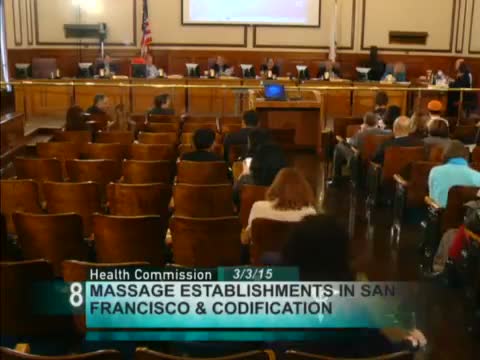
Health Commission backs tighter permitting, outreach for massage businesses to curb illicit operations
Summary
The San Francisco Health Commission voted to endorse amendments to local health and planning codes that would require permits and annual licenses for establishments previously exempt under CAMTC rules, increase enforcement tools and add outreach to support potentially exploited workers. The resolution includes staff direction to craft amendments to reduce burdens on legitimate small businesses.
The San Francisco Health Commission on Wednesday adopted a resolution to amend local health-code and planning-code provisions governing massage establishments, directing Department of Public Health staff to work with Supervisor Katie Tang—s office and stakeholders on refinements before the ordinance goes to the Board of Supervisors.
The measure would delete the local exemption that allowed businesses staffed entirely by California Massage Therapy Council-certified practitioners to avoid Department of Public Health (DPH) permits and local land-use review; previously exempt establishments would be required to apply for a DPH permit, obtain an annual license and pay cost-recovery fees, officials said.
DPH planner Cindy Comerford said the changes are intended to "conform local law to state law, improve enforcement and transparency, and increase cultural competency to support healthy communities." She told commissioners DPH—s review found a two-tiered regulatory system that has allowed some establishments to operate with minimal oversight and cited a task-force inspection where unlicensed practitioners were found and the Police Department—s Special Victims Unit took protective action.
Supporters at the meeting, including Deanna Kizon from Supervisor Katie Tang—s office and Minish Kandell from the Department on the Status of Women, urged robust outreach. "We are very excited about the possibility of having bilingual health outreach workers to accompany the inspections," Kandell said, noting the potential to provide services and information to people who may be trafficked.
Industry speakers including representatives of the California Massage Therapy Council (Beverly May) and the American Massage Therapy Association—s California chapter (Tony Siakotis) urged caution. May said CAMTC—s authority covers individual practitioners, not establishments, and warned against returning to "onerous" local rules that could harm legitimate therapists. Several small-business owners and educators described the time and cost of planning referrals and permit applications and asked for grandfathering or reduced fees for long-standing, compliant operators.
Staff said the fiscal impact of running the expanded permitting program would be roughly $117,000 and that the department expects the fee structure to be net-neutral; staff cited an application fee of $6.81 and an annual license fee in the range of $1,200 for a licensed establishment as currently projected. Commissioners directed staff to pursue amendments to reduce unnecessary burdens (for example, simplifying the conditional-use process for sole proprietors and reconsidering public posting of ID cards) and to return with a final package and an evaluation plan.
The Commission adopted the resolution by voice vote after a motion to incorporate additional "resolves" to address cost mitigation, grandfathering, and an implementation review; staff committed to continuing outreach with CAMTC, industry stakeholders and the Mayor—s anti-human-trafficking task force. The Office of the Department of Public Health will meet with Supervisor Tang—s office and the City Attorney—s office to finalize language before land-use committee consideration.
The resolution directs DPH to monitor implementation and report back after an interval to assess whether the regulatory changes reduce illicit activity while minimizing burdens on legitimate businesses.