Get Full Government Meeting Transcripts, Videos, & Alerts Forever!
Get email alerts on the Healthy San Francisco topic
No spam. Unsubscribe anytime.
San Francisco panel advances proposed Healthy San Francisco eligibility changes, asks staff for financial impact analysis
Summary
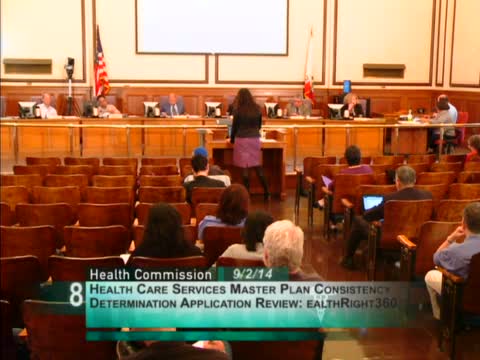
The Health Commission reviewed and advanced staff'proposed changes to Healthy San Francisco: removing the upper age limit to include some seniors, lowering the income cap from 500% to 400% of the federal poverty level, and extending the Covered California transition through Dec. 31, 2015. Commissioners requested a financial analysis before final adoption on Oct. 7.
San Francisco's Health Commission on the latest meeting heard a detailed staff proposal to modify Healthy San Francisco eligibility and the city'option, advancing the measures toward a final vote scheduled for Oct. 7.
Director of Public Health (Director) Garcia and Office of Policy and Planning staff urged three primary changes. First, staff recommended removing the program''s upper age limit (currently 18'64) so seniors who are undocumented or who lack the work-history to qualify for Medicare could become eligible; staff estimated roughly 1,200 San Franciscans might be newly eligible. Second, staff proposed aligning the income threshold with Covered California subsidies, lowering the eligibility ceiling from 500% of the federal poverty level (FPL) to 400% FPL. Third, staff proposed extending the transition period that lets Covered California'eligible employees remain in Healthy San Francisco through Dec. 31, 2015 (the commission had previously extended the period through Dec. 31, 2014).
Colleen Chavla of the Office of Policy and Planning described operational changes to the city'option that would favor medical reimbursement accounts (MRAs). Rather than automatically assigning uninsured employees with employer contributions to Healthy San Francisco, the employer contribution could instead be deposited into an MRA the employee controls and can use later to buy exchange coverage. Staff said MRAs would be administrated by the San Francisco Health Plan and would remain with the employee over time.
Public comment illustrated the urgency for some residents. Jerry Meehan, a long'time taxi driver and Healthy San Francisco participant, said he fears losing primary-care continuity if program access changes at year'end. Dina Long of the San Francisco Community Clinic Consortium said clinics support the proposed changes and urged clear public communication as enrollment shifts to Medi'Cal and exchange coverage.
Commissioners pressed staff for more precise numbers and fiscal analysis. Commissioners asked how many employees receive employer contributions (staff estimated less than 1,000, roughly 500), how automatic MRA-to'Healthy San Francisco conversions would work, and how the transition would be managed at reenrollment dates. Staff said fewer than 175 current participants have incomes in the 405'100% FPL band (of about 25,000 total enrolled) who would be affected by the income limit change. Staff also said they have drafted a consultant scope to study affordability mechanics and costs; one proposal to perform the analysis came in at $90,000.
Commissioners unanimously asked staff to include a financial impact estimate with the draft resolution brought back for the Oct. 7 vote. The item remains a proposal and will be finalized at the commission'level after the requested financials and clarifications on senior eligibility rules are provided.
What happens next: Staff will incorporate commissioner feedback, provide clearer language describing senior eligibility (including the requirement that applicants be ineligible for publicly subsidized programs such as Medicare) and deliver a financial analysis prior to the commission'scheduled vote on Oct. 7.