Get Full Government Meeting Transcripts, Videos, & Alerts Forever!
Get email alerts on the Suicide Prevention topic
No spam. Unsubscribe anytime.
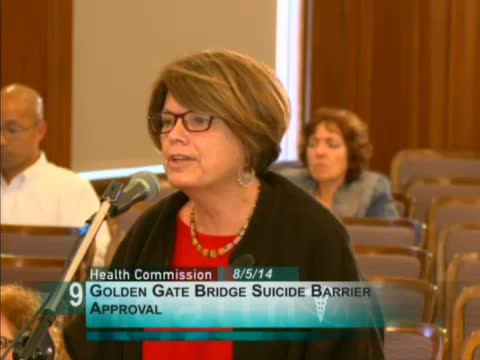
Health Commission hears briefing on Golden Gate Bridge suicide‑prevention barrier and funding
Summary
Behavioral‑health leaders briefed the commission on the Golden Gate Bridge suicide‑prevention barrier approved in June, presented evidence that barriers reduce jumping deaths without transfer, and outlined a projected $83 million budget with several funding sources including ~$7 million from Proposition 63 MHSA.
The Health Commission received a briefing on the Golden Gate Bridge suicide‑prevention barrier and the public‑health rationale for the project.
Jill Robinson, Behavioral Health Director for the San Francisco Health Network, presented national and local suicide figures and described research on barriers. "There are approximately 38,000 suicides in The United States annually," she said, and noted roughly 100–110 suicides occur annually in San Francisco, with about 10 percent related to bridge deaths. Robinson said studies show that survivors who jump do not necessarily re‑attempt by other means; she cited a longitudinal study of survivors showing high survival rates 10 years after a nonfatal jump.
Project cost estimates presented to the commission put the total around $83 million. Robinson said funding sources are mixed and include approximately $7 million from California's Proposition 63 (the Mental Health Services Act), state MHSA funds that were not restricted to San Francisco. Commissioners commended the years of advocacy that led to approval and asked about next prevention priorities; Robinson and Eve Meyer, an advocate present at the briefing, recommended focusing on removing lethal means and physician education to improve detection and intervention in clinical settings.
The briefing was informational; the barrier had been approved by other governing bodies earlier in the year and was presented to the Health Commission for background and coordination.
Sources: Behavioral Health briefing to the Health Commission; budget and study citations provided by presenters.