Get Full Government Meeting Transcripts, Videos, & Alerts Forever!
Get email alerts on the Benefits Policy topic
No spam. Unsubscribe anytime.
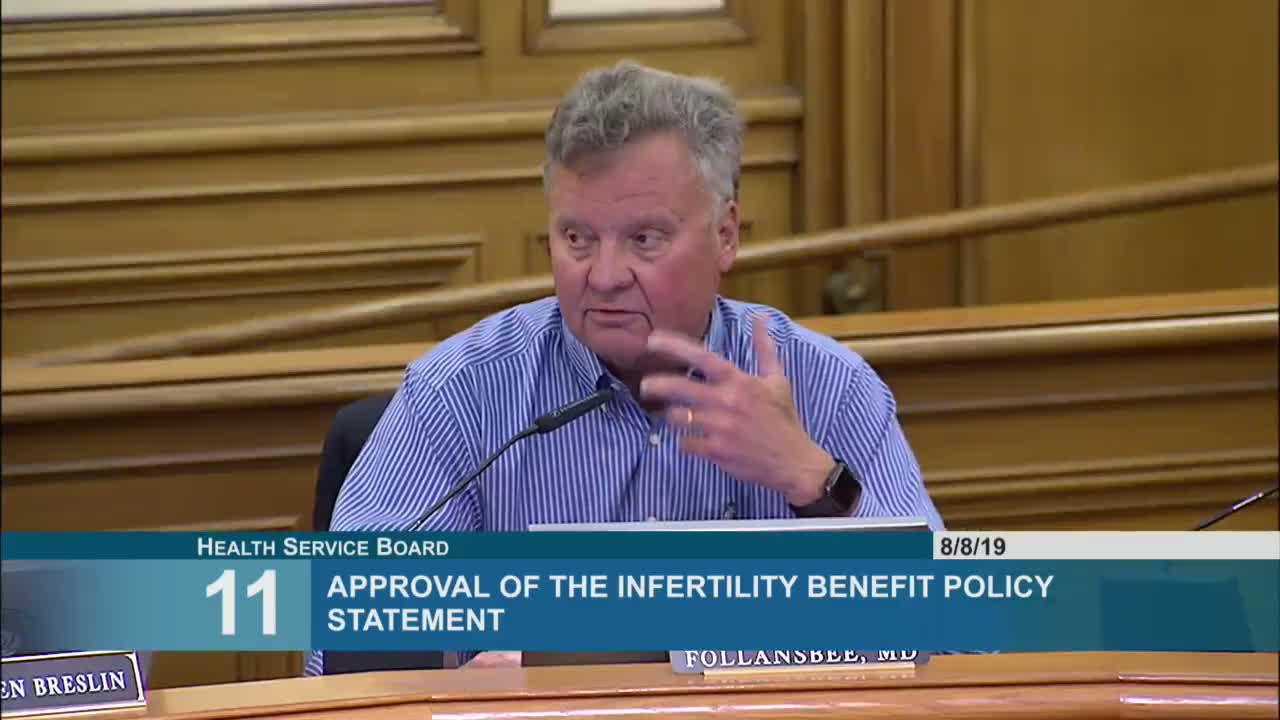
Board defers vote after debate over wording and access in proposed fertility benefit policy
Summary
The board reviewed an Aon‑recommended policy to provide 50% coinsurance for insemination services and expand access regardless of partnership status, but members and public commenters pressed to remove infertility‑diagnosis requirements and to clarify whether IVF and related procedures are included; the board deferred the matter for further drafting.
The San Francisco Health Service System Board considered a proposed policy update that would expand coverage of insemination services and make related benefits available without regard to partnership status, sexual orientation or gender identity — but commissioners and members of the public raised substantive drafting and implementation questions and the board deferred action.
Aon consultant Anne Thompson summarized the evaluation of current plan coverage and recommended a policy that “it shall be the policy of the San Francisco Health Service System and the Health Service Board to apply 50% coinsurance benefit for insemination services for all members regardless of partnership status, sexual orientation, or gender identity as part of the full scope of benefits offered.”
Public commenters urged more precise language and operational safeguards: Erica Maybaum, a city employee and legislative aide, urged removing any requirement that a member first meet a clinical diagnosis of "infertility," arguing that this requirement has been a barrier for same‑sex couples and single people seeking reproductive assistance. “Requiring a diagnosis of infertility is exactly the problem,” she said, and suggested the board adopt a “fertility” framing or explicitly include IVF and related services in the policy language.
Board discussion focused on semantics, coding and practice versus policy. Some members said the existing draft does not require an infertility diagnosis and that practice gaps — not policy wording — explain some prior denials; carriers acknowledged past operational problems. Blue Shield said it has identified authorization timing and procurement problems in one member’s case and is creating a single point of contact and specialized clinicians for fertility authorizations. Kaiser’s representatives confirmed their benefit administration already treats same‑sex and single members without differential coverage.
Why it matters: The change would expand benefits administratively to populations who previously encountered access obstacles; commissioners were concerned that vague terminology or reliance on billing codes could leave room for denials in practice.
Outcome: Given the volume of substantive questions and requested clarifications (terminology, whether insemination language includes IVF and related services, pharmacy/drug cost issues and implementation timelines), the board withdrew the pending motion to adopt the policy and voted to continue the matter to a future meeting so staff can return with clarified policy language and operational fixes. No policy was adopted at the meeting.
What’s next: Board staff and health plans have been asked to (1) clearly define the set of covered services (insemination, IVF, related procedures), (2) remove or explicitly address any infertility‑diagnosis requirement that would restrict access for same‑sex or single members, and (3) provide commitments on prior authorization handling, drug procurement and a concurrent reporting plan for new implementations.