Get Full Government Meeting Transcripts, Videos, & Alerts Forever!
Get email alerts on the Dependent Verification Audit topic
No spam. Unsubscribe anytime.
SFHSS audit finds about 808 dependents ineligible, estimates ~$2.9 million in 2018 premium savings
Summary
HSS reported results of a full dependent verification audit covering 26,319 members: 25,511 dependents verified, 808 dependents were not verified and removed from coverage; the audit produced a conservative estimate of roughly $2.9 million in 2018 premium savings and revealed communications challenges with third‑party mailings.
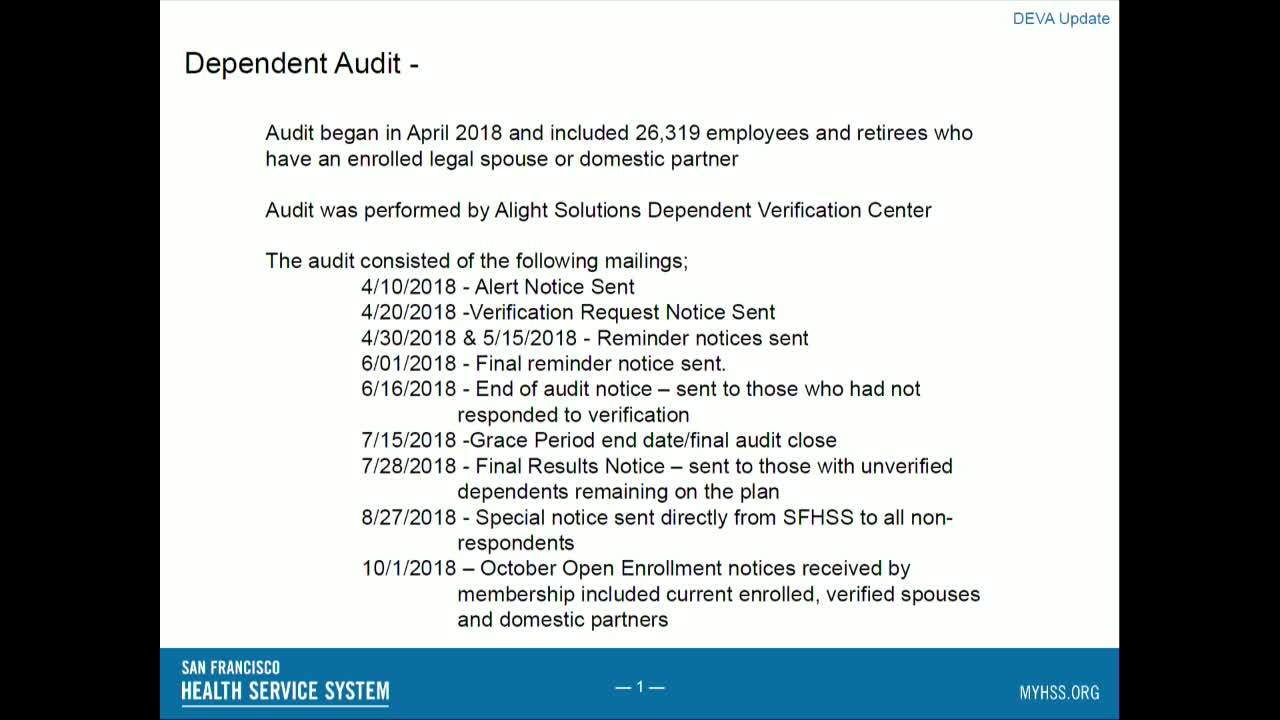
Mitchell Griggs, chief operating officer of the San Francisco Health Service System, told the board that a dependent eligibility verification audit begun in April 2018 covered 26,319 employees and retirees who had an enrolled spouse or domestic partner. "Our audit began in April 2018, and included, just over 26,000 employees and retirees who have an enrolled legal spouse or domestic partner," Griggs said.
Griggs said 25,511 dependents were verified and kept on coverage; about 808 dependents were not verified and were dropped from eligibility under the system's member rules. "When the verification was complete, the dependents that were not verified and moving forward they did not have eligibility was about 808," he said.
HSS contracted Alight Solutions to administer the work; Griggs said Alight processed approximately 65,000 documents and handled roughly 12,517 inbound contacts, while HSS member services managed about 3,000 calls and roughly 641 in-person document submissions during the audit period. He characterized the $2.9 million figure as conservative and limited to premium reductions based on 2018 rates: "The total annual savings, this is a very conservative amount... It's 2, almost $3,000,000. That's based on 2018 rates." The estimate does not include downstream claims or utilization effects.
Board members and public commenters raised concerns about communications. Dennis Kruger, representing active and retired firefighters and spouses, said members had received a confusing UnitedHealthcare letter and urged a clarifying notice; Shannon Haas of UnitedHealthcare acknowledged some letters sent to about 94 members included language that did not apply to group coverage and agreed to relay feedback.
The board discussed process improvements and vendor oversight. Griggs said HSS and its partners are reviewing lessons learned on communications, call-handling and whether future audits should be done internally, by contract or in collaboration with other agencies such as CalPERS or the city controller. He described a typical cadence other public entities use—audits on a rolling basis covering sections of membership so no individual is audited more frequently than about every three years.
On appeals and follow-up, Griggs said a small number of members appealed and many were ultimately able to provide documentation; those dropped for divorce or legal separation retain the ability to elect COBRA for up to 36 months at full premium plus a 2 percent administrative fee, provided the employer is timely notified.
The board did not take separate action on the audit today; members commended staff for completing a large and complex effort and asked staff to return with proposed improvements to communications and the mechanics of future audits.
The HSS office and Alight remain the sources for detailed member-level communications and appeal outcomes.