Get Full Government Meeting Transcripts, Videos, & Alerts Forever!
Get email alerts on the Opioids topic
No spam. Unsubscribe anytime.
San Francisco health plans detail programs to curb opioid prescriptions and support treatment
Summary
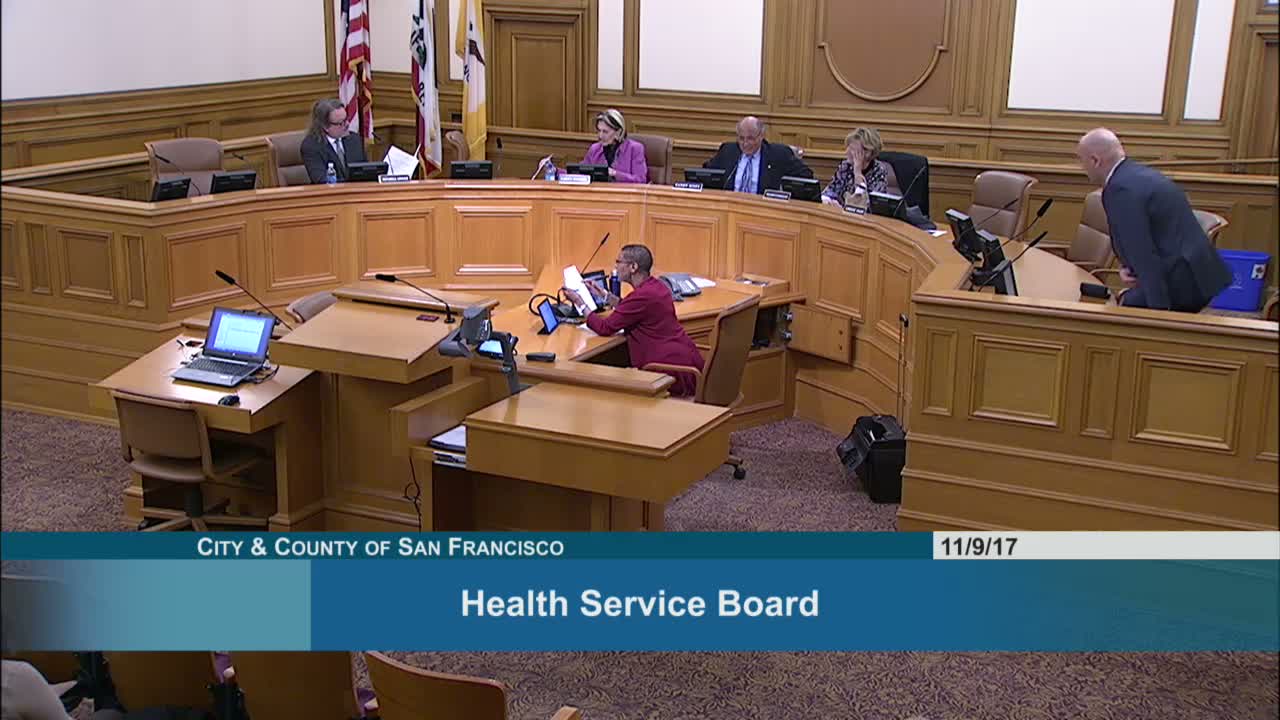
Aon and four plan representatives told the Health Service System Board that plan-level steps — prior authorization, quantity limits, case management, prescriber outreach, naloxone access and medication-assisted treatment — have reduced opioid prescribing in the plans’ books of business and for SFHSS members.
Paige Seipps Metzler, an Aon consultant, told the Health Service System Board that national and state responses to the opioid crisis are accelerating and that private insurers are already using programmatic levers to reduce risk. "In 2016, the 21st Century Cures Act allocated $1 billion for the opioid crisis," Seipps Metzler said as she set the national context for the board.
Selena Wong, director of clinical pharmacy programs at Blue Shield of California, told the board Blue Shield launched a Narcotic Safety Initiative in 2014 aimed at reducing prescriptions and high‑dose opioid use. "Our goal is to reduce noncancer opioid prescribing by 50% from our 2014 baseline," Wong said, adding that Blue Shield observed a 32% reduction in overall consumption as of the first quarter and a 13% drop in total consumption for the HSS population compared with 2015. She described tactics including prescriber education, reports that show clinicians a member’s full medication profile, case management for problematic use, and expanded access to medication‑assisted treatments such as buprenorphine (Suboxone) and naloxone for overdose reversal.
Representatives from the city plan’s pharmacy benefit manager (OptumRx) and UnitedHealthcare described multi‑tiered programs that seek to prevent inappropriate long‑acting opioid starts, cap daily morphine‑equivalent doses, and identify high utilizers for intervention. Michael Terhaar of OptumRx said the city plan had 1,692 opioid prescriptions year‑to‑date in the January–September 2017 window and that prior authorization, edits, and targeted outreach had helped bend the trend. "We monitor claims, identify outlier prescribers, and engage physicians and pharmacists to address risky patterns," Terhaar said.
Michelle Lasix, clinical pharmacy director for UnitedHealthcare’s Medicare Part D program, said retirees use opioids at higher rates: about 3,600 retirees (roughly 24% of that population) had at least one opioid prescription year‑to‑date. Lasix described quantity limits, prior authorization, morphine‑equivalent calculations and case management used to review clinical appropriateness before imposing benefit restrictions.
Sameer Aussory of Kaiser Permanente described a systemwide initiative that combined physician education, electronic‑medical‑record prompts, physician‑level prescribing reports, and pharmacist interventions. "We produced a list for each physician that shows their patients, doses and risk flags so clinicians know who to follow up with," Aussory said. He reported large reductions at Kaiser’s scale: roughly a 42% reduction in total opioids and a 30% reduction in patients on high doses since the program began.
Board members asked about patterns by occupation and whether work‑related injuries explain higher use in some groups; Marina Kolarich, SFHSS Enterprise Systems and Analytics manager, said the team did not yet slice utilization by job code but can do so in a follow‑up report. Chair President Scott closed the session by thanking presenters and noting a planned follow‑up meeting next year to continue review of data and renewal‑cycle implications.
The presentations emphasized that plans are combining education, utilization controls, case management, fraud‑waste‑abuse efforts and improved access to medication‑assisted treatment rather than relying on a single policy. The board received the information for further discussion during upcoming renewal work and open‑enrollment reporting.